Read the post as text
Mark Kelly voted against banning congressional stock trading at the end of September, right before the midterms. [Attached image: a list headed "NAYs ---47" naming the 47 senators who voted no, with "Kelly (D-AZ)" highlighted.]
The Sept. 30 vote was real. The bill would have limited lawmakers' stock buying and added a voter ID rule. Kelly co-leads a stricter ban.
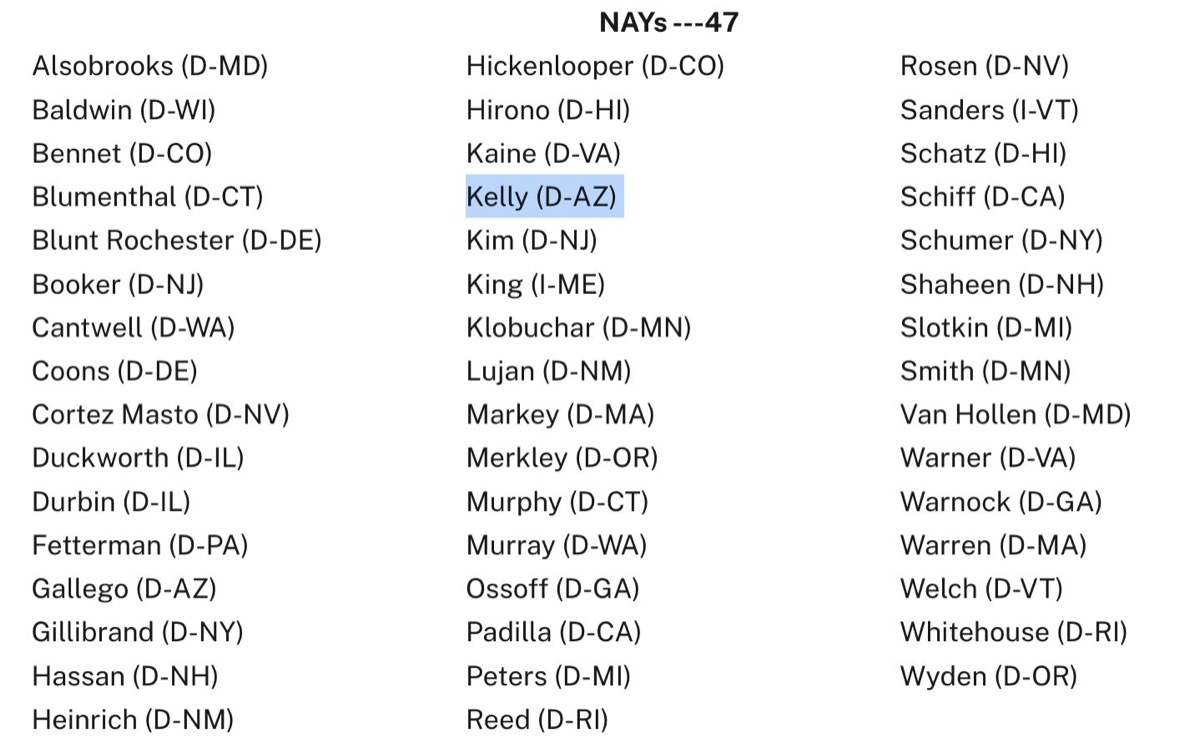
Mark Kelly voted against banning congressional stock trading at the end of September, right before the midterms. [Attached image: a list headed "NAYs ---47" naming the 47 senators who voted no, with "Kelly (D-AZ)" highlighted.]
Kelly did vote no on Sept. 30 on advancing a House bill that would have barred lawmakers from buying stocks1. The post omits its photo ID rule2, Kelly's stricter ban bill and his blind trusts, per his 2024 disclosure3,4. The fight is over taking a partial limit tied to a policy you oppose, or holding out.
What the post says or clearly implies, checked one by one. How verdicts work
Kelly did vote no on Sept. 30, under five weeks before the midterms. But the bill would have barred buying stocks, letting members keep theirs and sell after 7 to 14 days' notice, and it required photo ID to vote.
The post's image lists the 47 senators who voted no5. The vote, on starting debate on H.R. 7008, the Stop Insider Trading Act, failed 53–47, short of the 60 needed. Every Republican voted yes. All 45 Democrats and both independents voted no1. The House had passed it 232–198, with 13 Democrats for it6.
"Banning" overstates it. The bill would have barred members, spouses and dependent children from buying securities of public companies, or derivatives on them, and required 7 to 14 days' public notice before a sale. Members could keep what they own2. A second section requires photo ID to vote in federal elections. In person, voters without one could cast a provisional ballot and show ID within three days. By mail, the alternatives are the last four digits of a Social Security number plus an affidavit, or notarization2. That section wasn't in the version the House committee reported in February7.
The vote came less than five weeks before the midterms8. Kelly wasn't on that ballot. His term runs to January 20299.
Kelly has backed a bill, filed with Sen. Jon Ossoff in 2022, 2023 and 2025, that would make lawmakers sell their stocks or put them in blind trusts. His 2024 disclosure shows his own portfolio in blind trusts.
Ossoff introduced the Ban Congressional Stock Trading Act with Kelly in January 2022, requiring members to divest covered investments or use a qualified blind trust10,11. They refiled it in 202312 and 202513. That version, S. 1879, covers any security, public or private, plus commodities3. H.R. 7008 covers public companies' securities and derivatives on them2.
His 2024 disclosure lists qualified blind trusts dated June 25, 2021, the largest worth $5 million to $25 million. Its only trades are his wife's quarterly buys of a target-date fund in her 401(k), an excepted investment fund4. H.R. 7008 excludes such funds. It would appear to exempt his trusts too, if no family member directs the trustee and the trustee isn't a relative2.
Kelly's bill shares one gap Democrats cited against H.R. 7008. Neither covers the president3,14. Kelly put Trump at "over 28,000 stock trades in the last two years"15. Bloomberg counted nearly 28,700 from Jan. 20, 2025, to June 30, 202614,16. That's 53 to 55 a day over 17 months, by our math.
Facts can't settle this part, so we don't rule on it.
Should a lawmaker vote for a real but partial limit on stock trading when it comes tied to a policy they oppose?
Trump asked Congress to pass the Stop Insider Trading Act in his State of the Union17. The Senate fight started in July. Sen. Ashley Moody asked to pass H.R. 7008 by unanimous consent. Sen. Alex Padilla asked to pass S. 1498 instead, a committee bill whose listed sponsors include Republicans Josh Hawley and Bernie Moreno and Democrats Jon Ossoff, Gary Peters and Jeff Merkley18. Moreno objected, saying the committee's version "was not the bill that we sponsored," and Padilla objected to the original19. S. 1498 would make members, the president and the vice president divest covered investments18. As of Sept. 30 it hadn't had a floor vote20.
A ban on buying stocks that can become law now beats a perfect ban that never does, and voter ID is popular anyway.
The bill would bar members and their families from buying stocks and charge violators a fee of at least $2,000 or 10% of the trade plus any gain. Sales need public notice first2. It passed the House with 13 Democrats6. Sen. Bernie Moreno said that but for Padilla's objection in July, "tomorrow the President of the United States would have signed this bill into law." He called the committee bill "an alternative measure that they know will never pass"19. Majority Leader John Thune said Democrats "can't take yes for an answer"20.
Voter ID is popular. The Senate Republican leader's office cites polls with about 80% support, and quotes Schumer saying in March, "Democrats support voter ID"21. It also quotes Kelly on Sept. 19: banning members' trades is "the clearest way to prevent insider trading." He voted no 11 days later21,1.
A ban that lets members keep and sell their stocks isn't a ban, and tying it to a voting law was meant to fail.
Members could keep their stocks and sell them at a profit, and they could still trade in privately held companies14,20. Schumer called it "Swiss-cheese legislating, creating loophole after loophole after loophole"8. It leaves out the president, whose accounts, by Bloomberg's count, have outtraded all of Congress14. A stronger committee bill that covers the president was ready, and Moreno objected when Padilla asked to pass it18,19.
The photo ID section wasn't in the bill the House committee reported7. Sen. Tim Kaine called it "a backdoor effort to basically pass the SAVE Act." Sen. Alex Padilla said requiring an ID copy with mail ballots violates the right to a secret ballot14. Kelly has pushed a stricter ban since 2022, and his own portfolio went into blind trusts in 202111,4.
Every source was opened and read. Advocacy groups are labeled as such.
Think we got something wrong? Email editor@viewfromthegallery.com with a source. Corrections are made openly and logged on the page.
New breakdowns in your inbox: what was true, what wasn't, and what the argument is really about. No ads, no spin.