Congress · Elections

No ballot-harvesting ban reached the Senate. A voter ID vote did.

No bill the House passed this Congress bans ballot harvesting or mail voting. Voter ID and proof of citizenship passed, then stalled in the Senate.

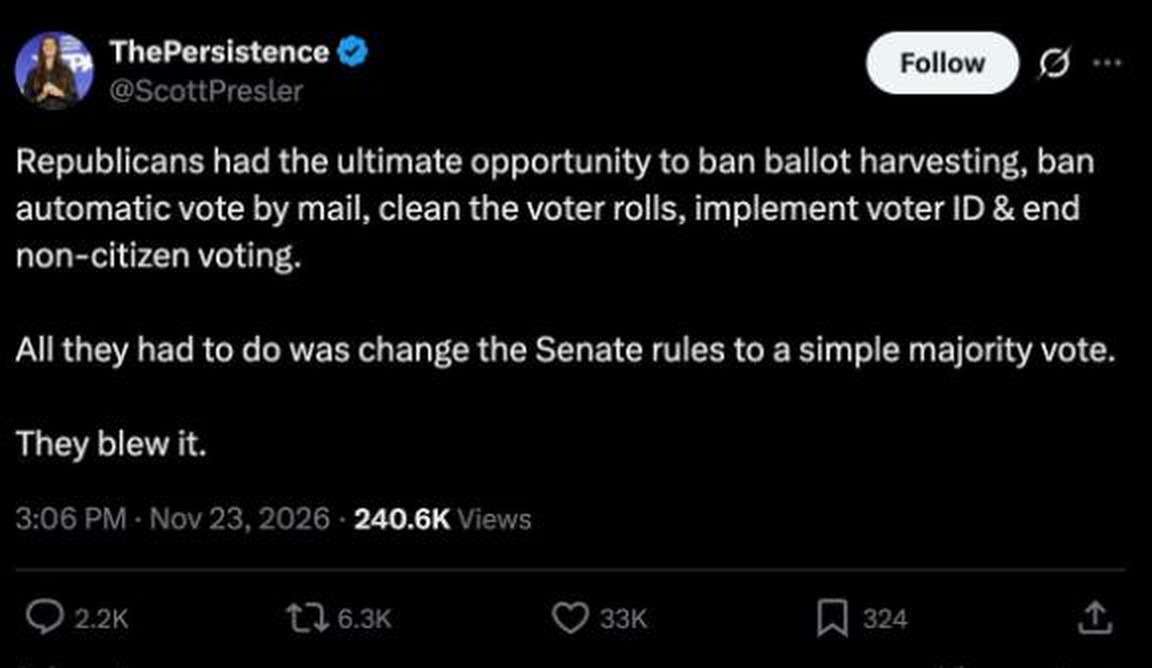
· @ScottPresler · on XThe post we're checking
Republicans had the ultimate opportunity to ban ballot harvesting, ban automatic vote by mail, clean the voter rolls, implement voter ID & end non-citizen voting.

All they had to do was change the Senate rules to a simple majority vote.

They blew it.
Screenshot of the post on X. Shown for commentary.
Read the post as text
Republicans had the ultimate opportunity to ban ballot harvesting, ban automatic vote by mail, clean the voter rolls, implement voter ID & end non-citizen voting. All they had to do was change the Senate rules to a simple majority vote. They blew it.
Posted Nov 23, 2026245,132 views, 6,206 reposts and about 34,000 likes on X at 12:47 UTC on Nov. 24, 2026. Presler has about 2.49M followers.See the original

The bottom line

Voter ID, proof of citizenship and noncitizen removal were in the SAVE America Act, which the Senate took up by majority vote in March. Cloture on its photo-ID amendment failed 53-47, and the bill itself never got a vote. Nothing banning ballot harvesting or mail voting passed the House this Congress.

The claims

What the post says or clearly implies, checked one by one. How verdicts work

1

Implied: a harvesting and mail-voting ban was before the Senate, needing only a rules change.

Wrong

Four bills would ban or restrict one or both, and all four sit in committee. We read the text of every measure the House passed this Congress and found no ballot-collection or mail-voting provision. No Senate vote title mentions either.

The bill on the floor was the SAVE America Act, which the House attached to S. 1383 in February1. Its text never uses "harvest" and does not ban voting by mail. For mail ballots it requires a photo ID copy, or the last four Social Security digits plus an affidavit that the voter cannot obtain one2.

Four bills would do some of it, and all four sit in committee3. H.R. 160 makes it unlawful "to possess or return a mail-in ballot completed by another person"4. H.R. 7356 would cut federal election money to states that allow that5. H.R. 7874 would bar "distributing unsolicited ballots"6. H.R. 7300, with 70 cosponsors, abolishes universal mail voting and caps ballot possession at four7,8.

The House passed 831 measures this Congress. We read the text of the 827 with one posted. None has a ballot-collection or mail-voting provision9. The Senate could have amended S. 1383 instead. Trump asked for a mail-ballot ban, and Thune said the House "would probably have to pass a new bill"10.

2

Republicans had the opportunity to clean the voter rolls, implement voter ID and end non-citizen voting.

Missing context

All three were in the SAVE America Act, and the Senate took it up by majority vote. Only its photo-ID amendment got a cloture vote, failing 53-47. The bill itself never got one, and the roll-cleaning covers noncitizens only.

The bill requires documentary proof of citizenship to register and photo ID to vote, and tells states to run their lists through the federal SAVE system to find and remove noncitizens2. It says nothing about voters who have moved or died, the broader cleaning the post implies.

The Senate took it up. On March 17 the motion to proceed carried 51-48, a simple majority, with Murkowski the only Republican voting no and Tillis not voting11. On March 26, cloture on the Husted photo-ID amendment failed 53-47, all 53 Republicans for and all 47 Democrats and independents against12. The SAVE America text itself never got a cloture or passage vote, and the file's last action is "considered" that day1.

The House kept sending it over, inside H.R. 22 in April 2025, the national-security appropriations bill in July and the defense authorization bill a week later. None carries a harvesting or mail-ballot ban, and the Senate acted on none of them9. A photo-ID bill of its own, S. 5271, fell 52-46 on cloture in August13.
3

All Republicans had to do was change the Senate rules to a simple majority vote.

Missing context

A simple majority can lower the cloture threshold by setting a precedent, as the Senate did for nominations in 2013 and 2017. It has never been done for legislation. Neither route was put to a vote on legislation this session.

Rule XXII sets cloture on legislation at three-fifths of the Senate, or 60 votes14. Cloture on amending a standing rule takes two-thirds15. The post's route goes around both. On Nov. 21, 2013, the Senate overturned a ruling of the chair on appeal and reinterpreted Rule XXII to need a simple majority for most nominations, without changing its text. Republicans did the same for Supreme Court nominations in 201716. For legislation it has never been done, and CRS treats whether a majority could get there as an open question15.

This majority has used the route for nominations. Twice in September 2025 it overturned the chair to speed en bloc confirmations, 45-53 and 47-5217. On legislation, nothing. By their titles, none of the 279 recorded votes this session through Nov. 20 asks to change the cloture threshold or a rule's text13.

Leadership never brought one. On the talking-filibuster route, Thune said in February that forcing Democrats to hold the floor "ties the floor up for an indefinite amount of time"18.

4

Implied: Senate Republicans had enough votes to change the rules.

Unsupported

It was never put to a vote, so there is no tally. The four Republicans on record against would leave 49 at most, which loses 49-51 even with the vice president.

The route needs 50 of the 53 Republicans plus the vice president's tiebreak, with all 47 Democrats and independents opposed12. At least four Republicans are on record against. Murkowski joked about a T-shirt saying "No, I'm not interested in blowing up the filibuster." Curtis wrote that "under no circumstance" would he support ending or altering it. Tillis said "nuking the filibuster doesn't work." Cramer, who opposes ending it, said "the other 25 or 30 people who oppose blowing up the filibuster don't say it out loud like I do"16,10.

Four against leaves 49, and 49 plus the vice president loses 49-51. Thune has said as much all year: "That is just a function of math"10. Roll Call reported Cornyn came out for ending the filibuster in March, while noting his break with Trump "may end up shutting that door again." Thune's July 29 answer: "That must be a different form of math"16.

None of that is a roll call, and positions shift16. The post assumes 50 would back a motion four have ruled out.

The real disagreement

Facts can't settle this part, so we don't rule on it.

Should a Senate majority lower the 60-vote bar to pass election bills, or keep it and bargain for 60?

Congress can act here if it wants to. The Elections Clause lets each state set the times, places and manner of federal elections, "but the Congress may at any time by Law make or alter such Regulations"19. Today those rules are state law and they differ widely. NCSL counts eight states plus D.C. that mail a ballot to every active registered voter, and limits on who may return someone else's ballot run from "no one other than the absentee voter" in Alabama to "a person authorized by the voter" in California20. The fight over this post is inside the party. Trump and Sen. Mike Lee want the majority to lower the 60-vote bar21. Thune, Curtis and others say the votes are not there or the price is too high16. We looked at the same 60-vote bar when the complaint was about stalled House bills22.

Use the Senate majority to pass it

Republicans won the White House and both chambers in 2024, voters back voter ID, and the 60-vote bar is a Senate habit that majorities have changed before.

Republicans won the presidency and both chambers in 202410. The 60-vote bar is a Senate rule, not a constitutional one14, and majorities have lowered it before, for nominations in 2013 and 201716. Trump wants the filibuster ended, and Lee argues the Senate should at least make Democrats filibuster in public. "We won't pass the SAVE America Act unless we start by making filibustering senators speak," Lee wrote21. "[W]e can be certain that failure will be the outcome if we don't try"10.

Voter ID draws wide support. Pew found 83% of Americans favor requiring government-issued photo ID to vote, including 95% of Republicans and 71% of Democrats23. On banning mass ballot collection the party's own voters are with it, 55% of Republicans in favor against 45% of Americans overall23. A majority that cannot act on a priority its voters back has a procedure problem.

Keep the 60-vote bar

A rule that helps the majority today binds it tomorrow, the votes to end it were never there, and election law is state work best changed by agreement.

Thune has said all year that the votes are not there: "That is just a function of math"10. Curtis wrote that any party that ends the filibuster "wouldn't be guaranteed survival," and that its agenda would be "guaranteed death come the next majority"16. The talking-filibuster route has its own cost. Thune said it "ties the floor up for an indefinite amount of time," with unlimited amendments18.

Others object to the content. Tillis, a cosponsor of the earlier SAVE Act, balked at "taking the language from the White House without understanding the state-by-state implications" and proposed paying states that adopt voter ID instead24. States write the rules now20, and the add-ons are less settled than ID: 52% of Americans oppose banning mass ballot collection, and 58% favor letting any voter vote by mail, though 68% of Republicans and Republican leaners oppose that23.

Where they agree

  • Requiring government-issued photo ID to vote is popular across both parties: 95% of Republicans and 71% of Democrats favor it23.
  • Congress has constitutional authority over the manner of federal elections, whatever it chooses to do with it19.
  • The 53 Republicans could not reach 60 votes alone: all 45 Democrats and both independents voted against the photo-ID amendment12.

What would change minds

  • A recorded Senate vote on a point of order lowering the cloture threshold for legislation, which would finally show how many Republicans back it.
  • A House vote on H.R. 7300, or on any bill restricting ballot collection, which would show whether the policy has a majority anywhere in Congress8.

Sources

Every source was opened and read. Advocacy groups are labeled as such.

Show all 24 sources
  1. 1
    S. 1383 bill status (House amendment: SAVE America Act)
    GovInfo bulk data (Congress.gov records)Primary document
  2. 2
    S. 1383, House engrossed amendment: the SAVE America Act as passed by the House
    U.S. Government Publishing Office (GovInfo)2026-02-11Primary documentFull bill text. The word "harvest" does not appear in it, and it contains no ban on voting by mail.
  3. 3
    Bill Status bulk data, 119th Congress (H.R. and S.)
    GovInfo, U.S. Government Publishing Office (Congress.gov records)2026-11-24DataOur own search of titles, summaries, subjects and action text (not full bill text) in 11,135 House and 5,804 Senate bill records for ballot harvesting and mail voting terms. Twelve House and five Senate records match, including bills that expand mail voting. None passed either chamber. Most records carry no CRS summary, so a differently worded provision can be missed; the full-text scan of House-passed measures is the stronger check.
  4. 4
    H.R. 160, Restoring Faith in Elections Act: bill status and CRS summary
    GovInfo bulk data (Congress.gov records)2025-01-03Primary documentRep. Brian Fitzpatrick (R-PA). No cosponsors. Referred to committee Jan. 3, 2025, no further action. CRS summary: the bill "makes it unlawful to possess or return a mail-in ballot completed by another person (commonly referred to as ballot harvesting), with exceptions."
  5. 5
    H.R. 7356, No Federal Funds for Ballot Harvesting Act: bill status and CRS summary
    GovInfo bulk data (Congress.gov records)2026-02-04Primary documentRep. Chuck Edwards (R-NC), 8 cosponsors. Referred to House Administration Feb. 4, 2026, no further action. CRS summary: requires each state, to receive federal election-administration funds, "to prohibit the knowing collection and transmission of a ballot in a federal election that was mailed to another person."
  6. 6
    H.R. 7874, Mail Ballot Integrity Act: bill status
    GovInfo bulk data (Congress.gov records)2026-03-09Primary documentRep. Clay Higgins (R-LA), 10 cosponsors. Official title: "To prohibit a State from distributing unsolicited ballots for voting by mail in any election for Federal office, and for other purposes." Referred to House Administration March 9, 2026, no further action.
  7. 7
    H.R. 7300, Make Elections Great Again Act, as introduced
    U.S. Government Publishing Office (GovInfo)2026-01-30Primary documentSec. 212 limits possession of other people's mail ballots. Sec. 214 abolishes universal vote by mail.
  8. 8
    H.R. 7300 bill status: sponsor, cosponsors and all actions
    GovInfo bulk data (Congress.gov records)Primary documentIntroduced Jan. 30, 2026 by Rep. Bryan Steil (R-WI), 70 cosponsors. Referred to the Committee on House Administration and three subcommittees, then no further action: no markup and no floor vote.
  9. 9
    Bill text bulk data, 119th Congress: every measure passed by the House
    GovInfo, U.S. Government Publishing Office2026-11-24DataOur own full-text search of every measure the House passed in the 119th Congress: 759 H.R. bills, 49 Senate bills and 23 H.J.Res. joint resolutions, 831 in all, of which 827 have a text version posted. For each we read the version the House acted on, engrossed in House where there is one and the Senate-engrossed text for Senate bills passed unamended. Thirteen contain a form of "harvest", all of them about organs, timber, crops, fish, rainwater or web harvesting. None contains a ballot-collection, unsolicited-ballot or mail-voting provision. The SAVE America text appears in four: S. 1383, H.R. 22, H.R. 8595 and H.R. 8800.
  10. 10
    Thune says Senate to consider voting bill but pushes back on demands for 'talking filibuster'
    Associated Press, carried by the Anchorage Daily News2026-03-10JournalismAP copy by Mary Clare Jalonick. The AP's own page refuses automated requests, so we read the ADN syndication.
  11. 11
    Roll Call Vote 57: motion to proceed to the House message on S. 1383
    U.S. Senate2026-03-17Primary documentAgreed to 51-48. Murkowski the only Republican nay; Tillis not voting.
  12. 12
    Roll Call Vote 73: cloture on Husted Amendment No. 4732, requiring photo identification
    U.S. Senate2026-03-26Primary documentRejected 53-47, with all 53 Republicans in favor and all 45 Democrats and both independents (King, Sanders) opposed.
  13. 13
    Roll call vote lists, 119th Congress, 2nd session
    U.S. Senate2026-11-20Primary document279 recorded votes through Nov. 20, 2026. By their titles, none is on the filibuster threshold, ballot harvesting or mail voting. Vote 231 (Aug. 8) was cloture on the motion to proceed to S. 5271, a photo-ID bill: rejected 52-46.
  14. 14
    About Filibusters and Cloture
    U.S. SenatePrimary document
  15. 15
    Majority Cloture for Nominations: Implications and the "Nuclear" Proceedings (R43331)
    Congressional Research Service, via EveryCRSReport2013-12-06ResearchCongress's own nonpartisan research arm. EveryCRSReport republishes CRS reports in full.
  16. 16
    The not-so-secret filibuster society
    Roll Call2026-08-03Journalism
  17. 17
    Roll call vote lists, 119th Congress, 1st session
    U.S. Senate2025-12-18Primary documentVotes 515 (Sept. 11, 2025, 45-53) and 524 (Sept. 17, 2025, 47-52): the decision of the chair was not sustained, setting precedents for en bloc consideration of nominations. Both concern nominations, not legislation.
  18. 18
  19. 19
  20. 20
    Evolution of Absentee/Mail Voting Laws, 2016-2026
    National Conference of State Legislatures2026-08-26DataNonpartisan organization serving state legislators of both parties. Table 3 counts all-mail states; Table 6 lists each state's ballot collection law.
  21. 21
  22. 22
    We count 670 House bills awaiting the Senate. In 2018 it was 730
    View from the Gallery2026-11-20JournalismOur own earlier breakdown.
  23. 23
    Majority of Americans Continue to Back Expanded Early Voting, Voting by Mail, Voter ID
    Pew Research Center2025-08-22ResearchSurvey of 3,554 U.S. adults, Aug. 4-10, 2025.
  24. 24

Think we got something wrong? Email editor@viewfromthegallery.com with a source. Corrections are made openly and logged on the page.