Congress · Elections

The GOP Congress didn't do "nothing." It did pass unusually few laws.

Matt Walsh says the Republican Congress did "precisely zero." It passed its signature tax and spending law, but few laws overall.

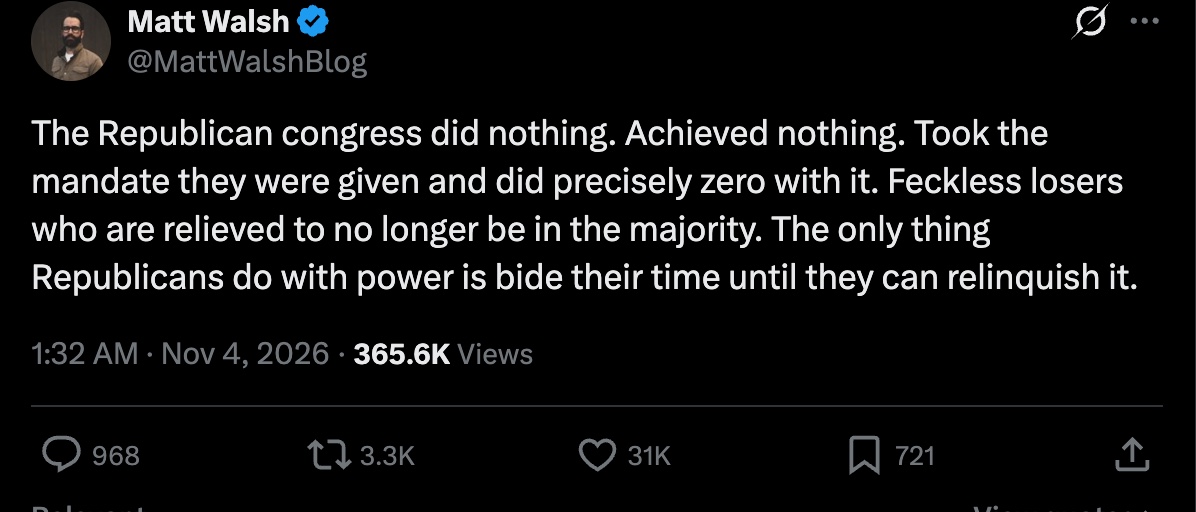
· @MattWalshBlog · on XThe post we're checking
The Republican congress did nothing. Achieved nothing. Took the mandate they were given and did precisely zero with it. Feckless losers who are relieved to no longer be in the majority. The only thing Republicans do with power is bide their time until they can relinquish it.
Read the post as text
The Republican congress did nothing. Achieved nothing. Took the mandate they were given and did precisely zero with it. Feckless losers who are relieved to no longer be in the majority. The only thing Republicans do with power is bide their time until they can relinquish it.
Posted Nov 4, 2026365.6K views and 31K likes on X by about 6:45 a.m. ET Nov. 4, and climbing.See the original

The bottom line

Walsh is wrong that the Republican Congress did nothing. It passed the One Big Beautiful Bill Act, which made the 2017 individual tax rates permanent and added Medicaid work requirements. His real point holds up better. It enacted the second-fewest laws in 40 years at this stage, and much of the agenda ran through executive action instead.

The claims

What the post says or clearly implies, checked one by one. How verdicts work

1

The Republican Congress achieved nothing with the mandate voters gave it.

Wrong

Its 2025 tax and spending law made the 2017 individual tax rates permanent and put $45 billion into immigration detention. A second law added $70 billion for border agencies, and Congress repealed a record 23 federal rules.

The reconciliation law known as the One Big Beautiful Bill Act (P.L. 119-21) became law on July 4, 20251. Beyond the tax cuts, it added Medicaid work requirements for expansion adults and $45 billion for immigration detention. It also raised the debt limit $5 trillion2. CBO estimates it adds $3.4 trillion to deficits through 20343. A second budget law, signed June 10, 2026, gave DHS, Customs and Border Protection and ICE $70 billion through fiscal 20294.

Other laws include a stablecoin framework, $9 billion in spending cuts, the Epstein files law and a housing package5. Its 23 Congressional Review Act repeals are the most of any Congress6.

Walsh's complaint has a basis. Outside the 2025 law, the president's agenda "has substantially been implemented through executive action," the Washington Examiner reported in March7. Senate leaders resisted forcing a talking filibuster on the SAVE America Act in March, and it hasn't become law8,9. In February, Republican Sen. Ron Johnson said "not much is going to get done" before the midterms10.
2

This Congress passed far fewer laws than usual.

Checks out

Pew counted 121 laws by Oct. 14, the second-fewest for any Congress at that point in 40 years. Only the 2023–24 Congress passed fewer. Later signings and the lame-duck session will raise the total.

Pew counted the public laws each Congress since 1987 enacted before Election Day. This one had 121 as of Oct. 14, and 109 were substantive by Pew's "deliberately generous criteria." The 118th had 106. The Congresses of 1987 to 2009 averaged 4405. USAFacts, comparing the first 20 months of every term since 1973, also ranks it second-fewest11.

More laws were signed after Pew's cutoff. The Federal Register's list reaches 136 by Oct. 22, with nothing newer by Election Day9. That's still second-fewest, by our count from Pew's table12. The total will grow. 168 of the 118th's 274 laws became law after the 2024 election5.

A count treats a ceremonial law, such as a building renaming, and the 330-page tax law as one each1. Congress now passes fewer but larger bills, GovTrack notes, so falling counts don't by themselves mean less work13. The slide began decades ago5.

Laws passed before Election Day: second-fewest in 40 years

02004006008001988199119941997200020032006200920122015201820212024This Congress: 121

Our sum of Pew's substantive and ceremonial counts for each Congress. Each point is dated to the Congress's election year: 1988 is the 100th Congress (1987-89), 2026 is the 119th, through Oct. 14, 2026.

Public laws each Congress enacted before its election, from Pew's analysis of Congress.gov data5,12. Each point is one two-year Congress, at its election year. 2026 runs through Oct. 14, and the count reached 136 by Election Day9. "All laws" is our sum of Pew's two counts.
Show the numbers
Laws passed before Election Day: second-fewest in 40 years: the numbers
YearAll lawsSubstantive laws
1988635388
1990523299
1992584387
1994463324
1996332286
1998349306
2000449344
2002276199
2004414304
2006367247
2008448286
2010284194
2012196143
2014185141
2016244172
2018277206
2020193150
2022214160
202410684
2026121109

The real disagreement

Facts can't settle this part, so we don't rule on it.

What does a congressional majority owe the voters who gave it power?

Republicans held the House, Senate and White House for two years. On Nov. 3, Democrats won both chambers14. Critics on the right, like Walsh, say the majority did too little with its power. Critics on the left say the problem was what it did. On forcing a talking filibuster to pass the SAVE America Act, Senate Majority Leader John Thune said, "show me how, in the end, it prevails"8. He says Republicans will resist Democrats' attempts "to unwind everything we've done"14.

Write the agenda into law

Voters gave Republicans full control to make lasting change, and executive orders the next president can erase aren't lasting.

Outside the One Big Beautiful Bill Act, the president's agenda "has substantially been implemented through executive action," though the Republican Study Committee said voters "handed Republicans a trifecta and a mandate"7. Executive action is fragile. In February the Supreme Court ruled that the emergency law Trump used doesn't authorize tariffs15. DOGE reported $110 billion in contract, grant and lease savings, some of which GAO found incorrect or unsupported16. Congress wrote about $9 billion of cuts into law17.

The filibuster blocked much of the rest. The SAVE America Act, requiring proof of citizenship to register, had majority support in the Senate and never became law8,9. "The one thing we know with certainty is that it won't pass if we don't try," lead sponsor Sen. Mike Lee said in March8. In August a separate voter-ID bill got 52 votes and failed, short of 6018.

Judge it by what it did

The trouble was what it passed and the checks it didn't use.

The majority's main law adds $3.4 trillion to deficits through 2034, CBO estimates, and its Medicaid changes alone would leave 7.5 million more people uninsured in 20343,19. Enhanced ACA subsidies also expired. KFF estimated premium payments for subsidized enrollees would more than double20. The House passed an extension in January, with 17 Republicans for it and 196 against, and the Senate never took it up21,22,23.

Each chamber voted to end some of his tariff emergencies, but no measure cleared both24,25. The Supreme Court struck the tariffs down in February15. GAO found NIH broke the Impoundment Control Act by withholding grant money Congress had approved26. In AP's voter poll, about 7 in 10 voters said Congress wasn't doing enough to check the president, including about 4 in 10 Republicans27.

Where they agree

  • Both sides treat the One Big Beautiful Bill Act as this Congress's defining law, whether they count it as the achievement or the problem.
  • Both would rather see major policy settled by Congress than left to executive actions that courts or the next president can undo.

What would change minds

  • A count, a year from now, of how many of Trump's executive actions survived the courts and a Democratic Congress, set against what was written into law.
  • Medicaid and marketplace enrollment once the work requirements take effect, compared with CBO's projected coverage losses.

Sources

Every source was opened and read. Advocacy groups are labeled as such.

Show all 27 sources
  1. 1
    Public Laws: 119th Congress, First Session
    Office of the Federal Register, National ArchivesPrimary document
  2. 2
    H.R. 1 (Public Law 119-21) bill status and CRS summary
    Congressional Research Service, via GovInfo bulk data (Congress.gov records)Primary document
  3. 3
  4. 4
    S. 2, Secure America Act (Public Law 119-98) bill status and CRS summary
    Congressional Research Service, via GovInfo bulk data (Congress.gov records)Primary document
  5. 5
    So far, the 119th Congress is among the least productive of the past 40 years
    Pew Research Center2026-10-15ResearchNonpartisan research organization. By Drew DeSilver.
  6. 6
    The Congressional Review Act (CRA): A Brief Overview (IF10023)
    Congressional Research Service, via EveryCRSReport.com2026-10-01ResearchCounts 23 rules overturned in the 119th Congress, against 16 in the 115th.
  7. 7
    Conservatives complain GOP Congress isn't doing enough ahead of midterm elections
    Washington Examiner2026-03-13JournalismRight-leaning outlet. By W. James Antle III.
  8. 8
    Senate leaders resist Trump pressure on talking filibuster, SAVE America Act
    The Washington Times2026-03-09JournalismConservative-leaning newspaper.
  9. 9
    Public Laws: Numbers for the Current Session of Congress (119th Congress, Second Session)
    Office of the Federal Register, National Archives2026-10-26Primary documentLists Public Law 119-136, approved Oct. 22, 2026, as the latest. Checked Nov. 4, 2026: still the latest.
  10. 10
    Trump-led GOP lacks clear midterm legislative agenda after State of the Union
    Washington Examiner2026-02-27JournalismRight-leaning outlet.
  11. 11
    How many laws has Congress passed in its current term?
    USAFacts2026-11-03DataNonpartisan government-data site. Updated monthly. Says 117 laws as of September 2026.
  12. 12
  13. 13
    Statistics and Historical Comparison
    GovTrack.us (Internet Archive copy, Oct. 25, 2026)2026-10-25Data
  14. 14
  15. 15
    Learning Resources, Inc. v. Trump, No. 24-1287
    Supreme Court of the United States2026-02-20Primary document
  16. 16
    DOGE Wall of Receipts: More Transparency Needed on How Savings Are Derived from Contract, Grant, and Lease Terminations (GAO-26-108615)
    U.S. Government Accountability Office2026-08-06Primary documentGAO found "some savings estimates are incorrect or lack supporting evidence."
  17. 17
    Congress Approves $9 Billion Rescissions Package
    American Action Forum2025-07-18Advocacy / think tankCenter-right policy institute.
  18. 18
  19. 19
    Public Law 119-21, Title VII, Finance, Subtitle B, Health, Chapter 1, Medicaid
    Congressional Budget Office2025-10-28Primary document
  20. 20
  21. 21
    H.R. 1834, Breaking the Gridlock Act, as passed by the House
    U.S. Government Publishing Office2026-01-08Primary documentExtends the enhanced premium tax credits through 2028.
  22. 22
    Roll Call 11, 2026: On passage of H.R. 1834
    Office of the Clerk, U.S. House of Representatives2026-01-08Primary documentPassed 230-196. Republicans 17 yes, 196 no.
  23. 23
    H.R. 1834 bill status
    GovInfo bulk data (Congress.gov records)Primary documentLast Senate action: placed on the legislative calendar Feb. 10, 2026.
  24. 24
    S.J.Res. 37, terminating the national emergency used to impose duties on Canadian imports: bill status
    GovInfo bulk data (Congress.gov records)Primary documentPassed the Senate 51-48 on April 2, 2025.
  25. 25
    H.J.Res. 72, relating to a national emergency declared Feb. 1, 2025: bill status
    GovInfo bulk data (Congress.gov records)Primary documentPassed the House 219-211 on Feb. 11, 2026. Last action: referred to the Senate Finance Committee, Feb. 12, 2026.
  26. 26
    National Institutes of Health: Availability of Funds for Grants (B-337203)
    U.S. Government Accountability Office2025-08-05Primary document
  27. 27
    How Republicans lost the midterms: AP Voter Poll
    Associated Press2026-11-04JournalismSurvey by SSRS for AP and other news organizations, Oct. 22 to Nov. 3.

Think we got something wrong? Email editor@viewfromthegallery.com with a source. Corrections are made openly and logged on the page.