Read the post as text
and DONT FORGET, when the Big Ugly Bill starts in January, IT WAS NOT THE DEMOCRATS!!!!!!!!!!!!! cause yall seem to forget how start dates work
A viral post says Republicans' 2025 law starts in January and Democrats aren't to blame. The big Medicaid changes do. Much else already started.
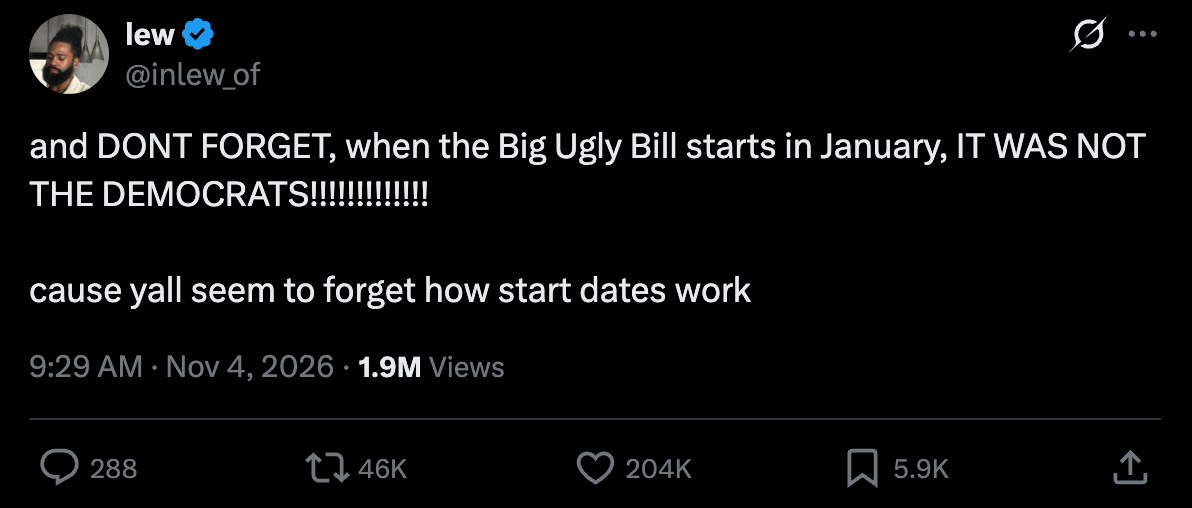
and DONT FORGET, when the Big Ugly Bill starts in January, IT WAS NOT THE DEMOCRATS!!!!!!!!!!!!! cause yall seem to forget how start dates work
The law's biggest coverage change, Medicaid work requirements, starts by Jan. 1, 2027, along with six-month eligibility checks. Much of the rest has already started or comes later. No Democrat voted for it, and Democrats can't undo it without the president's signature or a veto-proof majority. The real fight is whether work rules are a fair condition for coverage.
What the post says or clearly implies, checked one by one. How verdicts work
Its biggest coverage change, the work requirement, starts by Jan. 1, 2027, with six-month eligibility checks. But its tax breaks and broader SNAP work rules started in 2025, and more Medicaid changes phase in from 2027 into the 2030s.
The law, signed July 4, 2025, starts Medicaid work requirements by Jan. 1, 2027, for expansion adults ages 19 to 64: 80 hours a month of work, school, training or volunteering1,2. HHS can let a state delay, but no later than Dec. 31, 20283. Eligibility checks for expansion adults move to every six months on the same date. They have no waiver1.
Tax year 2025 brought a bigger standard deduction and new deductions for tips and overtime. Broader SNAP work rules took effect when the law was signed, and Medicaid limits for some immigrants on Oct. 1, 20261. The provider-tax ceiling in expansion states starts falling in October 2027, when most states with high SNAP error rates start paying part of benefits. Medicaid copays follow in October 20281.
CBO projects 5.2 million more uninsured in 2027 and 10 million in 20344. The expanded ACA subsidies that ended with 2025 weren't part of this law. The 2022 law that extended them set that end date, and a House-passed renewal has stalled in the Senate5,6,7.
Already in effect
January 2027
Later
No Democrat voted for it. It passed the House 218 to 214 and the Senate 51 to 50, with Vice President JD Vance breaking a tie. Five Republicans voted no.
On final passage July 3, 2025, House Republicans voted 218 to 2 for the bill and Democrats 0 to 212. Republicans Brian Fitzpatrick and Thomas Massie voted no8. In the Senate on July 1, Republicans Susan Collins, Rand Paul and Thom Tillis joined every Democrat and both independents against it, and Vance broke the 50-50 tie9.
The new majorities can't stop the January changes in time. The new Congress is sworn in Jan. 3, and any repeal or delay needs President Trump's signature or two-thirds of both chambers. House Democratic leader Hakeem Jeffries says Democrats will "fight to reverse these painful Medicaid cuts." The Hill reports any rollback "will likely be met with a veto from the White House"10.
Facts can't settle this part, so we don't rule on it.
Should adults on Medicaid who can work have to log 80 hours a month of work, school or service to keep coverage, and was the law's trade of tax cuts for Medicaid and SNAP savings the right one?
CBO estimates the law adds $3.4 trillion to deficits through 203411. Its Medicaid chapter reduces deficits by $886.8 billion over that period and leaves 7.5 million more people uninsured in 203412. In a 2025 KFF poll, 62% at first favored work requirements. Support fell to 32% when people heard most enrollees already work and many could lose coverage over paperwork. It rose to 77% when they heard it could ensure Medicaid is reserved for older people, disabled people and low-income children13.
Asking able-bodied adults without young children to put in 80 hours a month of work, school or service is a fair condition for taxpayer-funded coverage, and the law slows Medicaid and SNAP growth without ending either.
The rule asks expansion adults to work, study, train or volunteer 80 hours a month, and exempts pregnant women, the medically frail, caregivers and parents of children under 14. Washington pays $9 for every $1 states spend on expansion adults, which draws money away from the most vulnerable2. AEI's Kevin Corinth found nonworking, childless, nondisabled enrollees average 125 hours a month on TV and video games14.
In 1990s welfare-to-work trials, nearly every program raised work and earnings15. CBO says the Medicaid changes increase incentives to work, though it expects only a small number of people to join the labor force as a result16. From October 2027, SNAP will make most states with error rates of 6% or more share benefit costs. The national rate was 10.62% in fiscal 202517. About two-thirds of Americans, including half of Democrats, back the work rule18.
Most enrollees already work, so those who lose coverage will mostly lose it over paperwork. The savings helped pay for tax cuts that go mostly to the top.
Most Medicaid adults already work. KFF finds 64% have jobs and 92% are working, caregiving, ill or disabled, or in school19. Arkansas tried a work rule in 2018. The state dropped 18,000 people, though more than 95% of those targeted already met the rule or should have been exempt, and employment didn't rise20. Even CMS expects about 7% of people who meet the rule or qualify for an exception to lose coverage for procedural reasons, like unanswered notices3.
CBO projects the law's Medicaid changes will leave 7.5 million more people uninsured in 2034, with the work rule the largest piece12,4. Its SNAP work rules will cut participation by about 2.4 million people in an average month21. The trade is lopsided. CBO finds the poorest tenth of households lose about $1,200 a year while the richest tenth gain about $13,60022.
Every source was opened and read. Advocacy groups are labeled as such.
Think we got something wrong? Email editor@viewfromthegallery.com with a source. Corrections are made openly and logged on the page.
New breakdowns in your inbox: what was true, what wasn't, and what the argument is really about. No ads, no spin.