Read the post as text
The White House says $265 billion in fraud has been uncovered since January 2025. Good. Now show me the handcuffs. Fraud without consequences is just a business model.
Rep. Nancy Mace quotes the White House correctly. Its total estimates suspected fraud, and the hundreds charged account for far fewer dollars.
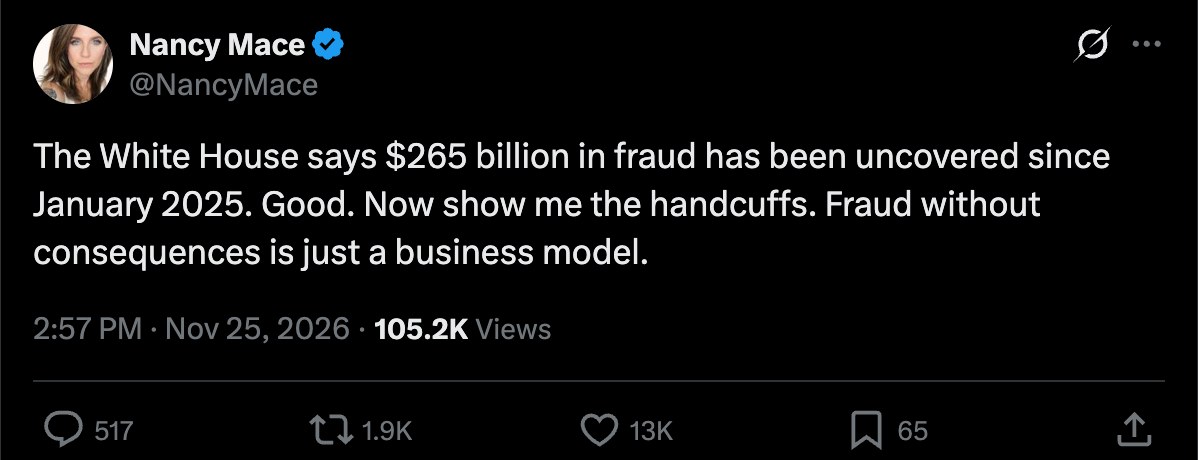
The White House says $265 billion in fraud has been uncovered since January 2025. Good. Now show me the handcuffs. Fraud without consequences is just a business model.
The White House fraud page totals $265.6 billion "uncovered" since January 2025, by our sum1. That's agencies' estimate of suspected fraud. $122.9 billion is SBA's count of suspected fraud in 2020–21 pandemic loans, including about $100 billion in loans the IRS is examining for tax discrepancies2,3. Hundreds have been charged, for a small share of it4.
What the post says or clearly implies, checked one by one. How verdicts work
The White House says it. But it's agencies' own estimates of suspected fraud. Nearly half is SBA's count from 2020–21 pandemic loans, programs where its watchdog estimated in 2023 that over $200 billion went to potentially fraudulent actors.
The page's nine agency figures add up to $265.6 billion as of Nov. 10, by our calculation. It defines "fraud uncovered" as "total estimated fraud identified through data analysis," counted since January 20251. The total was $229.9 billion when the page launched Aug. 65. The task force was created in March 20266.
The Small Business Administration accounts for $122.9 billion, or 46%. SBA describes its count as "approximately $122 billion": about $100 billion in pandemic loans where the IRS found "discrepancies" with tax records and opened examinations, plus about $22 billion sent to Treasury for collection2,3. SBA says the $22 billion was flagged for suspected fraud before 20257. Its inspector general estimated in 2023 that over $200 billion in pandemic loans, made in 2020–21, went to potentially fraudulent actors8,7.
The White House hasn't published how agencies reached their figures. HHS's $96.5 billion1 isn't broken down by program9. A senior official told The Washington Sun the figures are "data-driven calculations of misspent funds"10.
Prosecutors have charged hundreds, including 455 people in June's health care takedown. But charged amounts cover a small share of the $265.6 billion, partly because much of that total is suspected, not proven, fraud.
The page credits DOJ with charging 109 defendants with $5.4 billion in intended loss and 152 guilty pleas or convictions. It lists these among actions since January 2025, drawn from an August report, but doesn't say which cases they cover1. June's health care takedown alone charged 455 defendants over $6.5 billion in alleged false claims, and the page doesn't say whether the two overlap4. The June 2025 takedown charged 324 over $14.6 billion11.
The page's own $5.4 billion is about 2% of the uncovered total, whether August's or November's, by our calculation1,5. Of its $63.2 billion "enforced," SBA's share is $23.5 billion1. If its $22.2 billion Treasury referral is in it, about 94% is debt sent for collection, not money recovered, by our calculation. A former GAO official made that point when the figure was $22.6 billion10,7.
According to The Washington Sun, three of the four captured fugitives on the page were charged in 2019 and 2024, and the White House didn't clarify whether pre-2025 schemes are in the $5.4 billion10.
Facts can't settle this part, so we don't rule on it.
Should the government act fast on suspected fraud, cutting off payments and publicizing big estimates, or count and punish only what it can prove?
Mace wants consequences12. Few dispute that fraud is large. GAO estimates direct fraud losses at $233 billion to $521 billion a year, based on 2018–2022 data, not counting fraud on federal revenue13. The fight is over how to find it and what to count. Vance told a crowd the task force found "$250 billion of fraud just since the president made me the fraud czar," though the page dates its count to January 202510.
Years of inaction let fraudsters keep billions. Flagging, suspending and collecting now is how you stop the next wave.
SBA says the previous administration never sent 560,000 borrowers tied to $22.2 billion in suspected pandemic fraud to Treasury for collection, and fewer than 1,000 had been investigated by its inspector general7. Rep. Roger Williams, who chairs the House Small Business Committee, says Biden's SBA put the fraud nearer $36 billion than its watchdog's $200 billion, and floated ending collections on about $11 billion in small loans14. SBA's own inspector general estimated in 2023 that over $200 billion in pandemic loans went to potentially fraudulent actors8.
Prosecutions follow the data. June's takedown charged 455 people and seized over $182 million in assets, and CMS suspended 1,079 providers4. Cutting off past fraudsters is "perhaps the most proactive thing that we can do," Vance said, adding that flagged borrowers can appeal15.
Estimates with no published method and withheld funds aren't fraud findings, and treating them as such punishes eligible people and states.
Georgetown's Andy Schneider notes that its top-listed action, $2.5 billion in Medicaid funds deferred from California and Minnesota, is money withheld while CMS reviews claims, not documented fraud. Of 11 Medicaid items in the White House's August list, only two describe actual convictions, totaling $277 million, by his count9. The ledger is "primarily a piece of propaganda that provides very little, if any, meaningful information," said Linda Miller, a former GAO official10.
Withholding Medicaid funds "does not identify a fraudulent provider," two former state health secretaries wrote9. SBA's 870,000 new suspensions include people Vance said were "tagged as having a high likelihood of committing fraud for other actions," without specifics15. The page says CMS's "war room" is saving $200 million1. CMS's own release, as Georgetown quotes it, called them "potentially improper" payments, a category that includes errors and missing paperwork9,16.
Every source was opened and read. Advocacy groups are labeled as such.
Think we got something wrong? Email editor@viewfromthegallery.com with a source. Corrections are made openly and logged on the page.
New breakdowns in your inbox: what was true, what wasn't, and what the argument is really about. No ads, no spin.