Read the post as text
Donald Trump doesn’t want you to know this. Nearly $1 TRILLION in cuts to Medicaid will start to take effect in January. We have to reverse these cuts.
Nearly $1 trillion matches CBO's gross outlay cut, about $900 billion net. By our math $568 billion sits in rules dated before 2027.
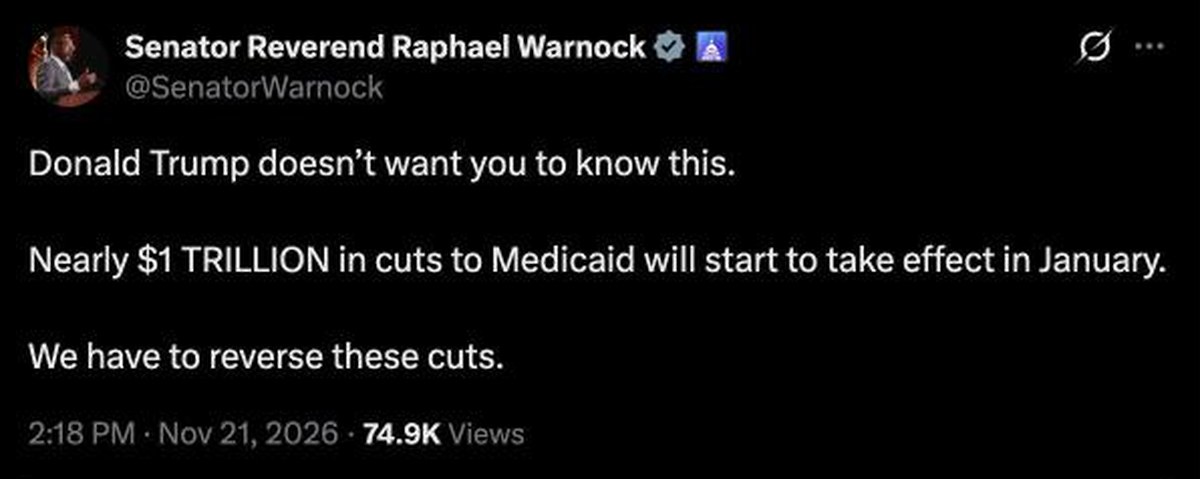
Donald Trump doesn’t want you to know this. Nearly $1 TRILLION in cuts to Medicaid will start to take effect in January. We have to reverse these cuts.
CBO's net figures put the Medicaid cuts near $900 billion. Gross outlays are $989.7 billion, so nearly $1 trillion fits that measure. By our math $568 billion sits in rules dated before 2027, though provider taxes and state directed payments phase in from 2028. CMS has offered an optional pause on work-rule denials, which states must elect and CMS approve.
What the post says or clearly implies, checked one by one. How verdicts work
CBO's Medicaid provisions cut outlays by $989.7 billion over 2025-2034, so "nearly $1 trillion" fits the gross figure. The net figures are lower: $911 billion after interactions (KFF) and $886.8 billion in deficit reduction.
CBO's cost estimate for the law's Medicaid chapter puts the ten-year deficit reduction at $886.8 billion and the increase in people without health insurance at 7.5 million in 20341. CRS reports CBO's estimate that the Medicaid provisions cut federal outlays by $989.7 billion and revenues by $25.9 billion over fiscal 2025 to 20342. Our own sum of CRS's provision-by-provision table matches that total.
KFF's figure is $911 billion. That is CBO's outlay reduction after subtracting $79 billion of estimated interactions between provisions3,4. CBO's $886.8 billion is a net deficit figure for the chapter. On those two, "about $900 billion" is closer, so the post's number rests on the gross outlay total.
The baseline matters. CBO measured the law "relative to CBO's January 2025 baseline updated to reflect enacted legislation"5, and all three figures rest on that comparison3. Against CBO's newer baseline, which other factors pushed up, projected federal Medicaid spending over 2025 to 2035 is $503 billion below the January 2025 path6.
Jan. 1, 2027 brings the single biggest piece, the work requirement. But by our math from CBO's provision estimates, about $568 billion of the $989.7 billion sits in provisions with effective dates before 2027, not in savings already banked.
CRS lists every Medicaid provision with its effective date and CBO's ten-year estimate2. Grouped by date, provisions effective July 4, 2025, led by the $149.4 billion state directed payment limit, account for about $329 billion. Ending the five-point bonus for states implementing the ACA Medicaid expansion after Dec. 31, 2025, on Jan. 1, 2026, is worth $13.6 billion. Provisions effective Oct. 1, 2026, led by the $191.1 billion provider-tax limit, add about $226 billion.
That leaves about $413 billion starting Jan. 1, 2027: the work requirement at $325.6 billion, six-month eligibility checks at $62.5 billion, duplicate-enrollment checks at $17.4 billion, shorter retroactive coverage at $4.2 billion and waiver budget neutrality at $3.2 billion2. The duplicate-enrollment line actually carries two dates, 2027 and 2029. About $9 billion net arrives later.
Earlier dates are not savings already banked. Provider taxes phase down from fiscal 2028 (Oct. 1, 2027), state directed payments shrink from 2028, the uniform-tax waiver allows up to three transition years, and a state could start work rules early, as Nebraska did2,7,8.
Each point adds the ten-year outlay estimates for every Medicaid provision whose effective date has arrived. An effective date is not when the money is saved. The uniform-tax waiver rule allows an HHS transition period of up to three fiscal years, provider taxes and state directed payments phase in from 2028, and a state may start the work requirement before Jan. 1, 2027, as Nebraska did on May 1, 2026. The dip in July 2028 is a home and community-based services waiver option that raises spending by $6.6 billion.
| Month | Cumulative ten-year cut, by start date |
|---|---|
| July 2025 | 328.96 |
| Jan. 2026 | 342.59 |
| Oct. 2026 | 568.12 |
| Jan. 2027 | 981.06 |
| Jan. 2028 | 981.25 |
| July 2028 | 974.67 |
| Oct. 2028 | 982.12 |
| Oct. 2029 | 989.67 |
The post does not say it outright, but that is how it reads. CMS has offered states an optional pause on work-rule denials through June 30, 2027. Without it, and on CBPP's worked example, the first losses come April 1.
The law requires states to condition eligibility on 80 hours a month of work, school, training or service from Jan. 1, 20279. On Nov. 13, eight days before the post, CMS told state Medicaid directors they may suspend denials and disenrollments for applications and renewals through June 30, 202710,11.
The pause is optional, covers nothing but the community engagement requirement, and a state must get CMS approval for it in a mitigation plan10,12. States must still assess compliance, and CBPP says they keep asking questions and sending notices10,13. States wanting it from Jan. 1 are asked to tell CMS by Dec. 1110. Connecticut will use it14.
Without it, CBPP's worked example, a state that starts renewals three months before eligibility ends, has the first renewals processed in March 2027 and the first coverage losses effective April 1, 2027. Other states initiate renewals in the second or fourth month7. HHS can also approve a state's request to delay the requirement through Dec. 31, 2028, for states that demonstrate specified activities toward compliance2.
Facts can't settle this part, so we don't rule on it.
Is roughly $900 billion less than projected a cut to Medicaid, or slower growth plus changes to how states finance it?
Warnock calls the numbers cuts. Paragon Health Institute's Brian Blase calls the same numbers a slowdown in growth15. Both are describing CBO's estimate against its January 2025 baseline3. CBO projects federal Medicaid spending still rises, reaching $941 billion in 2035 instead of $1.03 trillion6. The coverage question sits alongside that one. CBO estimates 7.5 million more people without insurance in 2034 from the Medicaid chapter alone1.
The savings come out of coverage, the biggest piece is a reporting requirement, and a six-month pause does not change where this ends up.
CBO estimates the Medicaid chapter alone leaves 7.5 million more people without health insurance in 20341. KFF reads CBO's newer baseline as putting average annual Medicaid enrollment at 74 million by 2034, 13% below the pre-law projection6. The single largest line, $325.6 billion, is the work requirement2, which conditions coverage on reporting rather than changing what Medicaid covers.
CBPP's Jennifer Wagner calls the six-month pause "a welcome development" and still writes that "nothing can fix the Medicaid work requirement and prevent it from causing large coverage losses"13. She warns that states must keep asking the questions and sending the notices, which can push eligible people to stop applying or renewing13. CMS's letter describes states still fixing eligibility systems and notices as Jan. 1 nears10.
Federal Medicaid spending keeps rising, and much of the ten-year figure comes from closing financing arrangements rather than from taking coverage away.
Blase writes that "a reduction in the projected rate of spending growth is not the same as a reduction in spending," and notes CBO projects federal Medicaid spending of $845 billion in 2034, 37% above the 2024 level15. KFF's own baseline comparison says the same thing in milder words, that spending "will still grow but more slowly"6.
On this side's reading, a large share of the ten-year figure is state financing rather than benefits. Provider taxes at $191.1 billion, state directed payments at $149.4 billion and the uniform-tax waiver rule at $34.6 billion come to about $375 billion, roughly 38% of the $989.7 billion2. Blase describes the law as limiting "excessive state-directed Medicaid payments" and restricting provider-tax financing arrangements15. The work requirement asks adults aged 19 to 64 for 80 hours a month of work, school, training or service, with exclusions written into the statute9.
Every source was opened and read. Advocacy groups are labeled as such.
Think we got something wrong? Email editor@viewfromthegallery.com with a source. Corrections are made openly and logged on the page.
New breakdowns in your inbox: what was true, what wasn't, and what the argument is really about. No ads, no spin.