Health care · Medicare · Congress

Reconciliation could pass Sanders' Medicare plan. Trump could veto it

Budget rules let a simple majority expand Medicare if costs after the budget window are covered or benefits expire. Then Trump must sign it.

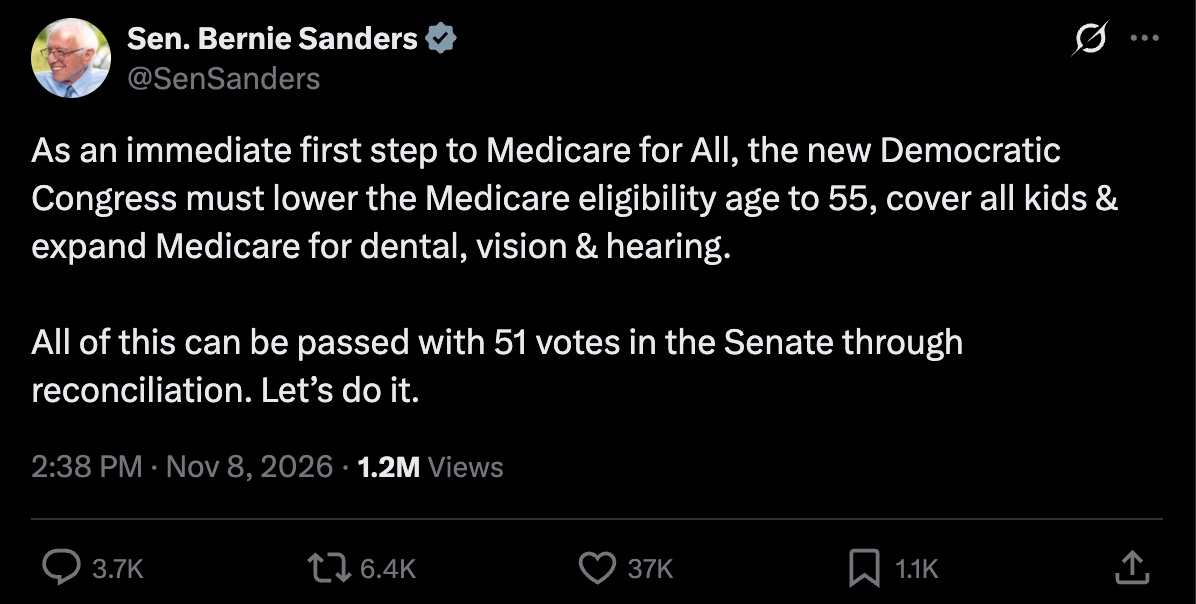
· @SenSanders · on XThe post we're checking
As an immediate first step to Medicare for All, the new Democratic Congress must lower the Medicare eligibility age to 55, cover all kids & expand Medicare for dental, vision & hearing.

All of this can be passed with 51 votes in the Senate through reconciliation. Let’s do it.
Screenshot of the post on X. Shown for commentary.
Read the post as text
As an immediate first step to Medicare for All, the new Democratic Congress must lower the Medicare eligibility age to 55, cover all kids & expand Medicare for dental, vision & hearing. All of this can be passed with 51 votes in the Senate through reconciliation. Let’s do it.

The bottom line

Reconciliation has expanded Medicare-related programs before, so a 51-vote path is plausible. But no ruling has tested these pieces, and a permanent expansion must be paid for after the budget window or expire. Passing isn't enacting. Trump has threatened to veto Democratic bills until they make a deal, and Democrats can't override. Underneath is a fight over Medicare's reach.

The claims

What the post says or clearly implies, checked one by one. How verdicts work

1

All of this can be passed with 51 votes in the Senate through reconciliation.

Missing context

Reconciliation can change Medicare by simple majority, and has before. But a permanent expansion must be paid for in every year after the budget window, or expire, and no parliamentarian has ruled on these pieces.

Reconciliation has amended Medicare, Medicaid and CHIP before1. It created CHIP in 19972,3, and the 2022 Inflation Reduction Act capped Medicare enrollees' drug costs4,1. A 2021 Commonwealth Fund analysis said lowering the Medicare age "may be allowed under the Byrd rule"5.

If a committee's title adds to deficits in any year after the budget window ("a single year suffices"), its costly provisions are out of order1. A permanent expansion needs later-year offsets or an end date6. In 2022, CBO put age 60 at $155 billion over 2026–2031 and said 55 would cost more7. Dental, vision and hearing in a 2019 House bill came to $358 billion over 10 years8. We found no CBO score for covering all kids. The post doesn't say how it would be paid for.

We found no ruling on lowering the age. Two 1990s provisions raising it were challenged as having no budget effect. The 1995 one was struck. The 1997 one survived the challenge after 62 senators voted to waive3, then was dropped in conference9.

2

Implied: 51 Senate votes are enough for the new Democratic Congress to make these changes.

Missing context

Congress can pass it, but a reconciliation bill still needs the president's signature. Trump has threatened to veto Democratic bills until they make a deal, and Democrats are far short of the two-thirds needed to override.

Reconciliation gets around the filibuster. Presidents can still veto it. President Obama vetoed a 2016 reconciliation bill that repealed parts of the Affordable Care Act10, and the House override failed, 241–18611. An override takes two-thirds of each chamber12.

Trump said in October that if a Democratic Congress meant gridlock, "I veto everything," and then "they want to make a deal"13. On election night he said he looks forward to working with Democrats, and predicted a deal after "a couple of months of vetoes"14. Asked about his Medicare for All bill, Sanders said Trump "has the constitutional right to veto," but that he is "not absolutely certain that Trump would not sign it"15.

By AP's count on Nov. 7, Democrats and allied independents will hold at least 54 seats in the new Senate and 254 in the House, with two Senate and 19 House races uncalled16,17. Even sweeping those leaves 56 senators and 273 House members, short of the 67 and 290 needed to override with every member voting, by our count.
The real disagreement

Facts can't settle this part, so we don't rule on it.

Should Medicare grow now toward covering everyone, with taxpayers taking on costs that employers and families carry today, or should coverage under 65 stay mostly private while Medicare's own finances are fixed first?

In 2025, 26.7 million people, 7.9% of the population, were uninsured all year18. Medicare's hospital trust fund is projected to run short in 203319. CBO found that lowering the age to 60 would mostly move people from other coverage into Medicare7. Supporters call that shift the point. Critics call it the cost.

Expand Medicare now

Medicare pays less for the same care, and coverage saves lives. Open it to people from 55 and to children, add the benefits seniors lack, and pay for it openly.

One study found Medicare eligibility cut the death rate of severely ill emergency patients in the week after admission "by 20 percent," almost one percentage point20. Before 65, nearly a third of adults 50 to 64 in employer plans said in a 2022 survey they had skipped or delayed care because of cost21. In 2019, 47% of Medicare beneficiaries, nearly 24 million people, had no dental coverage22.

A KFF review of 19 studies found private insurers paid 199% of Medicare rates for hospital services, on average23. CBO expects spending to fall for people leaving employer plans, "largely because Medicare generally has lower payment rates," and says part of the federal cost is spending shifted from employers and states7. House Democrats paired dental, vision and hearing with drug-price negotiation that CBO said would lower spending by about $456 billion, more than the benefits' $358 billion8.

Fix Medicare's finances first

Medicare already faces a shortfall. Moving millions of insured people onto it costs a lot and covers few new people.

Medicare is already on track to run short. Its hospital trust fund can pay full benefits only until 2033, then 89%19. CBO projects debt held by the public reaching 175% of GDP by 205624. CBO, which didn't model the trust fund, says added hospital-insurance spending from a lower age "would tend to place financial strain on the trust fund"7.

Expansion also buys little new coverage. CBO found that lowering the age to 60 would add $155 billion to deficits over 2026–2031 and make Medicare the main coverage for 7.3 million more people, but cut the uninsured by only about 0.4 million7. The American Action Forum calls that a shuffle of "those who already have coverage"25. Hospitals would feel it. The American Hospital Association says Medicare paid 82 cents per dollar of hospital costs in 202226.

Where they agree

  • Both sides work from CBO's estimate that lowering the age to 60 would add $155 billion to deficits over 2026–2031 while moving millions of people into Medicare from other coverage7.

What would change minds

  • A CBO score of lowering the age to 55, and of dental, vision and hearing at today's prices, would show the real size of the bill.
  • Evidence on how hospitals respond when patients move from private plans to Medicare rates would test both the savings case and the strain case.
  • A parliamentarian's ruling on a lower Medicare age would show whether the 51-vote path is open.

Sources

Every source was opened and read. Advocacy groups are labeled as such.

Show all 26 sources
  1. 1
    The Senate's Byrd Rule: Frequently Asked Questions (R48640)
    Congressional Research Service, via EveryCRSReport.com2025-08-21ResearchCongress's nonpartisan research service
  2. 2
    State Children's Health Insurance Program (CHIP): Legislative History (R40229)
    Congressional Research Service, via EveryCRSReport.com2009-02-18ResearchCongress's nonpartisan research service
  3. 3
    The Budget Reconciliation Process: The Senate's "Byrd Rule" (RL30862)
    Congressional Research Service, via EveryCRSReport.com2022-09-28ResearchCongress's nonpartisan research service. Table 2 lists reconciliation measures, Table 4 lists Byrd rule challenges
  4. 4
    Explaining the Prescription Drug Provisions in the Inflation Reduction Act
    KFF2023-01-24ResearchNonpartisan health-policy research and polling group
  5. 5
    The Role of Reconciliation in Advancing President Biden's Health Agenda
    The Commonwealth Fund2021-02-05Advocacy / think tankHealth-policy foundation that supports expanding coverage
  6. 6
    Reconciliation 101
    Committee for a Responsible Federal Budget2024-11-18Advocacy / think tankNonpartisan budget watchdog that favors deficit reduction
  7. 7
  8. 8
    H.R. 3, Elijah E. Cummings Lower Drug Costs Now Act
    Congressional Budget Office2019-12-10Data
  9. 9
    Medicare Provisions in the Balanced Budget Act of 1997 (BBA 97, P.L. 105-33) (97-802)
    Congressional Research Service, via EveryCRSReport.com1997-08-18ResearchCongress's nonpartisan research service
  10. 10
    Veto Message from the President: H.R. 3762
    The White House (archived)2016-01-08Primary document
  11. 11
    Roll Call 53: H.R. 3762, passage over the President's objections
    Office of the Clerk, U.S. House of Representatives2016-02-02Primary document
  12. 12
  13. 13
  14. 14
  15. 15
    Bernie Sanders thinks Medicare-for-all bill could pass, 'not absolutely certain' Trump would veto
    Fox News, via Yahoo News2026-11-06JournalismQuotes Sanders' Nov. 5 interview on MS NOW
  16. 16
    Where things stand Saturday in the uncalled Senate, House and governor's races (live blog entry)
    Yahoo News (live blog, citing the Associated Press)2026-11-07JournalismEntry by Jack Brewster, Nov. 7, 11:17 a.m. EST, citing the Associated Press. Live blog URL may change
  17. 17
    Democrats expand US House majority to 253 seats as midterm vote count continues
    Anadolu Agency2026-11-06JournalismCited for the two independents in the Senate count. Its House count is earlier than AP's Nov. 7 figure
  18. 18
  19. 19
  20. 20
    Does Medicare Save Lives? (Working Paper 13668)
    National Bureau of Economic Research2007-11ResearchDavid Card, Carlos Dobkin and Nicole Maestas. Covers severely ill patients admitted through the emergency room
  21. 21
    Can Older Adults with Employer Coverage Afford Their Health Care?
    The Commonwealth Fund2023-08-10Advocacy / think tankHealth-policy foundation that supports expanding coverage. Survey fielded by SSRS in 2022
  22. 22
    Medicare and Dental Coverage: A Closer Look
    KFF2021-07-28ResearchNonpartisan health-policy research and polling group
  23. 23
    How Much More Than Medicare Do Private Insurers Pay? A Review of the Literature
    KFF2020-04-15ResearchNonpartisan health-policy research and polling group
  24. 24
    Debt Rises to 175% of GDP Under CBO's Long-Term Outlook
    Committee for a Responsible Federal Budget2026-03-02Advocacy / think tankNonpartisan budget watchdog that favors deficit reduction
  25. 25
    Medicare at 60: Playing Musical Chairs with Sources of Coverage
    American Action Forum2022-05-20Advocacy / think tankCenter-right policy group
  26. 26
    Infographic: Medicare Significantly Underpays Hospitals for Cost of Patient Care
    American Hospital Association2024-01Advocacy / think tankHospital industry trade group

Think we got something wrong? Email editor@viewfromthegallery.com with a source. Corrections are made openly and logged on the page.