Health care · Medicare · Vaccines

Medicare's vaccine-reaction code is real. Visits were already paid

Medicare will pay about $32 per extra 15 minutes on a suspected vaccine reaction (national office rate, our math). It already paid for visits.

· @EricLDaugh · on XThe post we're checking
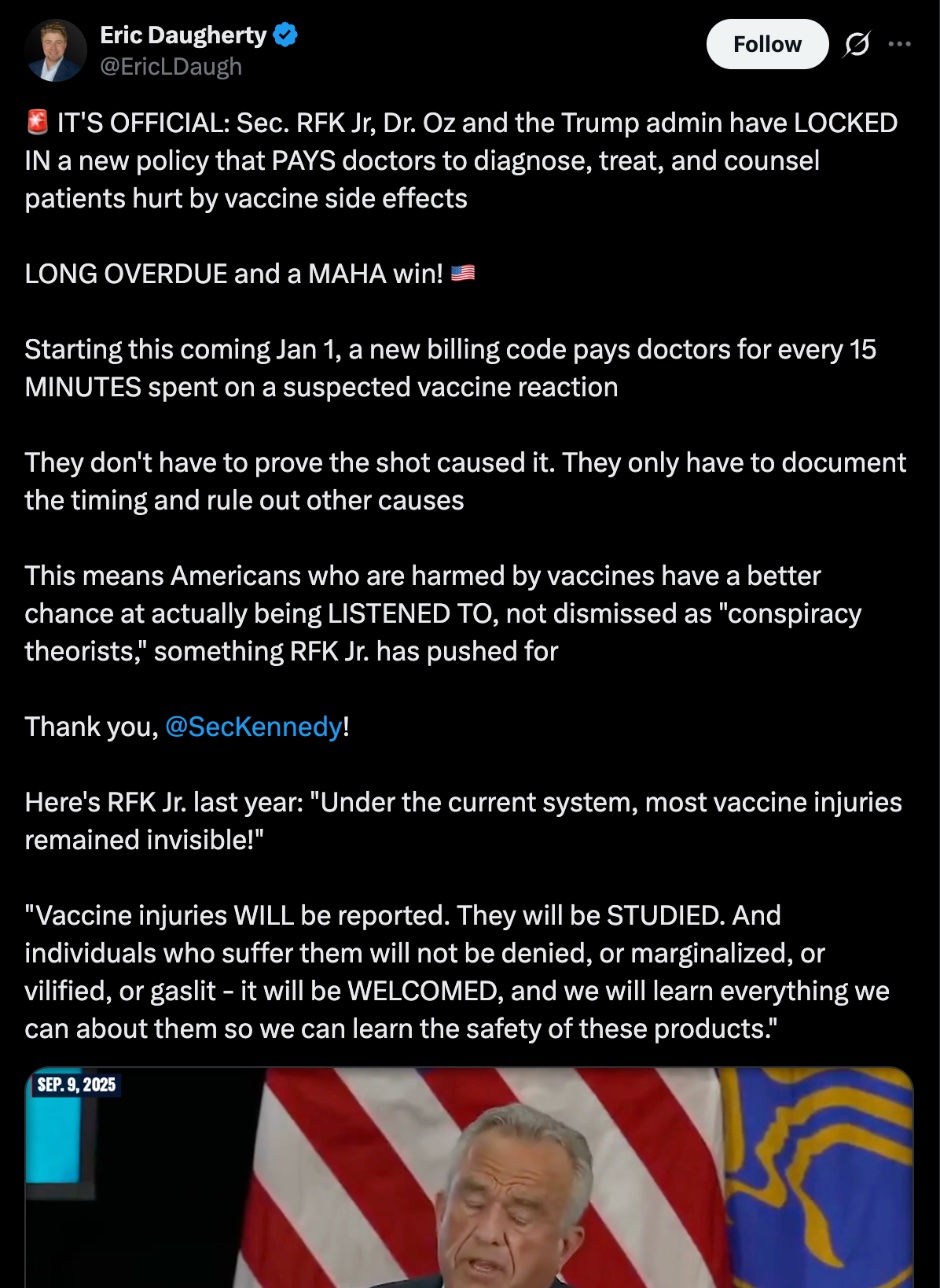
🚨 IT'S OFFICIAL: Sec. RFK Jr, Dr. Oz and the Trump admin have LOCKED IN a new policy that PAYS doctors to diagnose, treat, and counsel patients hurt by vaccine side effects

LONG OVERDUE and a MAHA win! 🇺🇸

Starting this coming Jan 1, a new billing code pays doctors for every 15 MINUTES spent on a suspected vaccine reaction

They don't have to prove the shot caused it. They only have to document the timing and rule out other causes

This means Americans who are harmed by vaccines have a better chance at actually being LISTENED TO, not dismissed as "conspiracy theorists," something RFK Jr. has pushed for

Thank you, @SecKennedy!

Here's RFK Jr. last year: "Under the current system, most vaccine injuries remained invisible!"

"Vaccine injuries WILL be reported. They will be STUDIED. And individuals who suffer them will not be denied, or marginalized, or vilified, or gaslit - it will be WELCOMED, and we will learn everything we can about them so we can learn the safety of these products."
Screenshot of the post on X. Shown for commentary.
Read the post as text
🚨 IT'S OFFICIAL: Sec. RFK Jr, Dr. Oz and the Trump admin have LOCKED IN a new policy that PAYS doctors to diagnose, treat, and counsel patients hurt by vaccine side effects LONG OVERDUE and a MAHA win! 🇺🇸 Starting this coming Jan 1, a new billing code pays doctors for every 15 MINUTES spent on a suspected vaccine reaction They don't have to prove the shot caused it. They only have to document the timing and rule out other causes This means Americans who are harmed by vaccines have a better chance at actually being LISTENED TO, not dismissed as "conspiracy theorists," something RFK Jr. has pushed for Thank you, @SecKennedy! Here's RFK Jr. last year: "Under the current system, most vaccine injuries remained invisible!" "Vaccine injuries WILL be reported. They will be STUDIED. And individuals who suffer them will not be denied, or marginalized, or vilified, or gaslit - it will be WELCOMED, and we will learn everything we can about them so we can learn the safety of these products."
Posted Nov 15, 2026About 239,000 views, 16,400 likes and 5,500 reposts on X as of Nov. 16. Daugherty has about 1.2 million followers.See the original

The bottom line

The code is real. From Jan. 1, Medicare pays about $32 per extra 15 minutes on a suspected vaccine reaction (national office rate, by our math), with no proof the shot caused it. It's Medicare only, and visits were already paid. Pay for the extra time is new. The disagreement is whether it gets patients heard or skews the diagnosis.

The claims

What the post says or clearly implies, checked one by one. How verdicts work

1

Starting Jan. 1, a new billing code pays doctors for every 15 minutes spent on a suspected vaccine reaction.

Missing context

CMS finalized code G0576, effective Jan. 1. It's a Medicare add-on to a regular visit, for time beyond what the visit covers. That's about $32 per 15 minutes in an office, $26 in a facility, national rates by our math.

CMS finalized add-on code G0576 for the "diagnosis and treatment of vaccine adverse effects," billed "each 15 minutes" by the doctor or another qualified clinician1. It takes effect Jan. 1, 2027, and works by telehealth1. CMS first proposed it in July, as GADV12.

It's billed with an office, outpatient or home visit, for work "above and beyond" that visit1. It carries 0.97 relative value units in an office and 0.79 in a facility3. At the 2027 conversion factor of $32.634, that's about $31.65 and $25.78 per 15 minutes before geographic adjustment, by our calculation. Patients usually owe 20% after the deductible5.

It's a Medicare code. The Defender reports that Medicaid and private insurers aren't required to pay it, though a CMS spokesperson said it's "available for other payers to use"6. In October, HHS said CMS proposed paying doctors to report suspected injuries to VAERS, a passive reporting system7,8. The final rule's G0576 section mentions VAERS only as background1.

2

Implied: doctors weren't paid for this care before.

Missing context

Visits about vaccine reactions were already billable to Medicare, with diagnosis codes dating to at least 2015. What's new is separate pay, tied to vaccine reactions, for time beyond a typical visit.

A patient with a suspected reaction could already see a doctor, and Medicare paid for the visit. CMS wrote that standard visit codes "may capture the work and clinical decision making" for "most vaccine adverse reactions"1. A common office visit (99213) carries 2.82 relative value units, about $92 in 2027 before geographic adjustment, by our calculation3.

Diagnosis codes for these reactions date to ICD-10's 2015 start. Flu, MMR and shingles reactions are indexed under T50.B95A, "adverse effect of other viral vaccines"9. Pediatrician Michelle Perro told The Defender there were no billable codes for vaccine adverse events6. Diagnosis codes existed. A separate, time-based payment didn't.

CMS's case is that rare, severe reactions take more time than a typical visit is priced for1. Until now, separate pay for extra time existed only on top of the highest-level office visits (99205, 99215) and a cognitive-care visit (99483), through prolonged-service code G2212. The new code copies G2212's 0.61 work units and direct practice-expense inputs1. Their office totals are 0.97 and 1.00 units3.

3

They don't have to prove the shot caused it. They only have to document the timing and rule out other causes.

Checks out

That's the rule's test: document a timing link to vaccination and do a "medically appropriate assessment" to rule out other causes. CMS also expects the record to show work beyond a normal visit.

CMS proposed paying the code when a clinician "establishes and documents a temporal relationship to vaccination" and "performs a medically appropriate assessment to rule out alternative causes"2. It finalized the code "as proposed" for a "suspected" reaction, and said it expects "sufficient evidence in the medical record" of work beyond a normal visit1.

A CMS spokesperson told The Defender that doctors "will not be paid based on whether a report is ultimately determined to be related to a vaccine"6. Commenters asked CMS for clearer documentation rules. CMS's response didn't spell them out1.

4

In 2025, Kennedy said, in substance, that vaccine injuries would be reported and victims wouldn't be gaslighted.

Checks out

The post closely paraphrases Kennedy's Sept. 9, 2025, remarks as CBS News quoted them, but changes "improve" to "learn." We didn't find its "invisible" line. In October 2026, Kennedy called vaccine injury "an invisible disease."

At what CBS News called the release of a children's health report on Sept. 9, 2025, Kennedy said, "Vaccine injuries will be reported. They will be studied. Individuals who suffer them will not be denied or marginalized or vilified or gaslighted. They will be welcome." HHS would learn what it could "so that we can improve the safety of these products," he said10. The post's version ends "learn the safety."

The same day, at a MAHA Commission meeting, Kennedy said doctors are "discouraged from reporting" injuries and "not compensated," and that "over 99 percent of vaccine injuries go unreported," The Hill reported. An author of the study he appeared to cite said that figure includes many mild, expected events11.

We searched CBS's and The Hill's coverage and the web for the post's line "most vaccine injuries remained invisible" and didn't find it. The closest documented words came in October 2026, at NIH: "Vaccine injury is an invisible disease, and it is purposely invisible," according to HHS footage cited by CNN12.
The real disagreement

Facts can't settle this part, so we don't rule on it.

Should Medicare pay doctors extra for time spent on suspected vaccine reactions?

CMS and the medical groups that opposed the code agree that regular visits may cover most vaccine reactions1,13. The split is over the hard cases, and whether extra pay tied to one suspected cause buys better care or bends the diagnosis.

Pay for the time these patients need

Suspected vaccine injuries take long, hard visits. Paying for that time gets patients heard and improves safety data.

Visit codes are priced for a typical case, CMS says, and miss the extra work severe reactions take: listening, answering questions, building trust and planning treatment1. HHS calls the code payment for "the dedicated clinical time required to diagnose, treat, and counsel" these patients14. Kennedy says HHS must listen to families who report vaccine injuries, "not dismiss or gaslight them"7.

Brianne Dressen of React19, a group for people who say vaccines injured them, calls these some of the hardest cases to treat. "All of that time costs money," she says, and the doctors she works with lose money seeing these patients6. Kennedy said in 2025 that doctors are "discouraged from reporting" injuries and "not compensated"11. CMS says payment doesn't hinge on a final finding that a vaccine caused the problem6. Pediatrician Michelle Perro says better documentation "could also improve safety monitoring"6.

Don't tie extra pay to one cause

Regular visits already pay for this care. Extra pay that turns on blaming the vaccine will inflate injury counts.

The Infectious Diseases Society of America told CMS the code is "neither clinically necessary nor advisable," because serious reactions are rare and visit codes already capture the work13. The American Academy of Neurology said severe reactions already justify a higher-level visit. That leaves vague symptoms like headache or fatigue, and extra pay "could create incentives to misattribute" them to a vaccine15.

Infectious disease doctor Jake Scott writes that the same 15 minutes earns the add-on only if the doctor blames the vaccine, not anemia or a new blood pressure pill. Each billed code becomes a count that will be "quoted as evidence," he argues16. IDSA warns the code risks signaling to patients and doctors that reactions are "more common or more clinically significant than the evidence supports"13.

Where they agree

  • Perro, a supporter, says the pay should not reward "a predetermined conclusion," which is the critics' worry too6,16.
  • A few commenters who backed the code asked CMS to watch for misuse and unnecessary tests1.

What would change minds

  • Medicare claims data on how often G0576 is billed, for which symptoms and vaccines, set against follow-up studies of those cases.
  • Studies of whether patients with suspected reactions get diagnosed and treated faster after the code than before it.

Sources

Every source was opened and read. Advocacy groups are labeled as such.

Show all 16 sources
  1. 1
    Medicare and Medicaid Programs; CY 2027 Payment Policies Under the Physician Fee Schedule and Other Changes to Part B Payment and Coverage Policies (final rule)
    Centers for Medicare & Medicaid Services, Federal Register2026-11-09Primary documentG0576 is discussed in section II.E.(55), pages 71111–71112. Effective Jan. 1, 2027.
  2. 2
    Medicare and Medicaid Programs; CY 2027 Payment Policies Under the Physician Fee Schedule (proposed rule)
    Centers for Medicare & Medicaid Services, Federal Register2026-07-16Primary documentProposed the code as GADV1, pages 43905–43906, with the two payment conditions.
  3. 3
    CY 2027 PFS Final Rule Addenda (Addendum B: Relative Value Units)
    Centers for Medicare & Medicaid Services2026-11-05DataG0576: 0.97 total non-facility RVUs, 0.79 facility. 99213: 2.82 non-facility RVUs.
  4. 4
    Calendar Year (CY) 2027 Medicare Physician Fee Schedule Final Rule (fact sheet)
    Centers for Medicare & Medicaid Services2026-11-04Primary documentGives the 2027 conversion factors: $32.63 for most clinicians, $32.95 for qualifying APM participants.
  5. 5
    Medicare costs
    Medicare.govPrimary documentPart B coinsurance is usually 20% of the Medicare-approved amount after the deductible.
  6. 6
    'Seismic Shift': Medicare to Reimburse Doctors for Diagnosing, Treating Vaccine Injuries
    The Defender (Children's Health Defense)2026-11-09Advocacy / think tankNews site of Children's Health Defense, an advocacy group critical of vaccine policy. Supports the code.
  7. 7
    HHS Launches Agency-Wide Actions to Strengthen Vaccine Injury Research, Reporting, and Patient Care
    U.S. Department of Health and Human Services2026-10-08Primary document
  8. 8
    About VAERS
    Vaccine Adverse Event Reporting System (CDC and FDA)Primary document
  9. 9
    ICD-10-CM Diagnosis Code T50.B95A: Adverse effect of other viral vaccines, initial encounter
    ICD10Data.comDataThird-party reference site that republishes the official ICD-10-CM code set. Code history shows it in use since Oct. 1, 2015.
  10. 10
  11. 11
  12. 12
  13. 13
    Comments on the CY 2027 Medicare Physician Fee Schedule proposed rule
    Infectious Diseases Society of America2026-09-09Advocacy / think tankProfessional society for infectious disease doctors. Opposed the code.
  14. 14
    CMS Finalizes CY 2027 Physician Fee Schedule to Shift from Sick Care to Healthcare and Curb Waste
    U.S. Department of Health and Human Services2026-11-04Primary document
  15. 15
    Comments on the CY 2027 Medicare Physician Fee Schedule proposed rule
    American Academy of Neurology2026-09-09Advocacy / think tankProfessional society for neurologists. Opposed the code.
  16. 16
    CIDRAP Op-Ed: HHS says it wants better evidence on vaccine injuries. It's building a system that will produce the opposite.
    CIDRAP, University of Minnesota2026-10-26JournalismOpinion piece by Jake Scott, an infectious disease physician. Written about the proposed code, which was finalized unchanged.

Think we got something wrong? Email editor@viewfromthegallery.com with a source. Corrections are made openly and logged on the page.