Read the post as text
It’s Veterans Day. And House Republicans just passed a bill to cut Veterans benefits by $57 billion, according to the VA’s own estimates. This is how they’re thanking our heroes for their service.
The House passed a bill writing VA's 2022 sleep apnea and tinnitus changes into law for new claims. Two later savings estimates are lower.
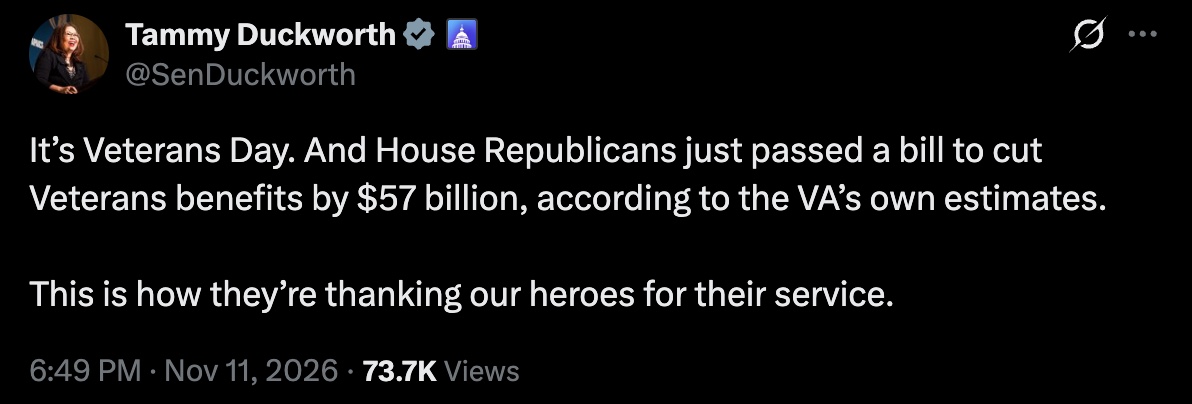
It’s Veterans Day. And House Republicans just passed a bill to cut Veterans benefits by $57 billion, according to the VA’s own estimates. This is how they’re thanking our heroes for their service.
The House passed the bill by voice vote on Veterans Day. The $57 billion over 10 years is VA's reported 2022 estimate for the sleep apnea and tinnitus changes the bill, as introduced, writes in for new claims. Two later estimates are lower: $38 billion in a Senate committee summary, $19 billion from NTU citing preliminary CBO numbers.
What the post says or clearly implies, checked one by one. How verdicts work
VA's reported $57 billion over 10 years is its 2022 estimate for the same sleep apnea and tinnitus changes. But the bill, as introduced, covers only new claims, and two later estimates of its savings are lower.
Section 108, as introduced, rewrites two ratings. Sleep apnea: 0% if symptom-free, 10% if treatment partly works, 50% only if treatment fails or can't be used, with no end-organ damage, 100% only with it. Tinnitus gets no separate rating unless tied to noncompensable service-connected hearing loss1.
The $57 billion over 10 years is VA's reported 2022 estimate for these changes2,3, but we couldn't open it. The 2022 rule, DAV says, would also reach reevaluations of existing claims2. The bill covers only later claims, including increase requests1,4. Others differ: $38 billion over 10 years in a Senate committee summary5, and $19 billion from NTU, citing a preliminary CBO estimate6. NTU said $58 billion in June7.
The bill also nearly triples a VA refinance fee, to 1.42% from 0.5%8,9. We don't assess its cost. In June VA said "no changes are planned or imminent" and the proposal "would need to undergo significant changes"2. On July 16: "We intend to continue moving forward with the audiology rulemaking"10. No final rule exists yet11.
The Republican-led House passed it on Nov. 11 by voice vote, so no one's vote was recorded. Democrats say they had no chance to ask for a recorded vote, and Republicans say Democrats didn't ask. It still needs the Senate.
The House passed H.R. 9237 by voice vote at about 2:46 p.m. on Nov. 11, so individual positions weren't recorded12. Its sponsor is Mike Bost, the Republican chairman of the House Veterans' Affairs Committee1,12. In July it stalled after a motion to send it back to committee failed by one vote10.
Takano says Democrats lost their chance to ask for a recorded vote because floor staff had been drawn away to negotiate technical changes9. Republicans say Democrats simply neglected to ask13. Republican Rep. Steve Scalise said he "was proud to support it"13.
Rep. Jared Golden, a Democrat, praised the vote, and his office said it passed "with bipartisan support"14. But on July 16 all 207 Democrats who voted backed a motion to send it back to committee, as did three Republicans15. Twenty-three veterans and military-family organizations backed the bill, while calling its offset "not an approach we would support" in ordinary times4. In the Senate, Democrats blocked Moran's July 29 request to pass it by unanimous consent16.
Facts can't settle this part, so we don't rule on it.
Should Congress pay for new veterans' benefits by lowering what future veterans get for sleep apnea and tinnitus?
Both camps back many of the bill's 60-plus provisions, including the Major Richard Star Act16, and the administration supports the bill17. The fight is over the offset. Takano calls it the largest cut to veterans' benefits in history8, the VFW the largest net cut since the Great Depression18. We found no published comparison behind either, and Duckworth's post doesn't repeat it.
Earned benefits for one group of veterans should never be cut to pay for another group's.
The VFW warns that writing rating changes into law to raise savings, a first, invites future Congresses to trim earned benefits18. Takano says a veteran who files tomorrow for the same tinnitus or sleep apnea "will receive less compensation, and in many cases none at all." He adds: "That is a cut."3 The VFW notes troops on active duty now would be subject to it when they leave2.
In a DAV online survey of more than 4,200 veterans and families, mostly DAV members, 80% opposed Section 108 and 1% favored cutting future compensation to pay for the Star Act19. Forty-six Senate Democrats and independents told VA these cuts "should be rejected outright"10. Blumenthal says unobligated defense money could pay for the package instead16. Takano says Democrats are ready to pass a clean Star Act8.
VA proposed the rating update itself, so Congress should use the savings for veterans.
VA proposed the rating changes in 2022, saying the old sleep apnea criteria pay more for a CPAP prescription than for the impairment left after treatment20. Bost told Task & Purpose the bill would not cut disability payments for sleep apnea and tinnitus3. He says the changes rest on "modern medicine, effective treatment, and recommendations from VA's own doctors"10. Compensation already being paid is protected in the bill1.
Moran notes the rule was never withdrawn, and that if the change isn't enacted the savings "will return to the Treasury"21. The American Legion calls it "use it or lose it"22. Twenty-three veterans and military-family organizations call the package "a net expansion of benefits"4. The Star Act had stalled over how to pay for it2, and Moran says CBO has confirmed the defense-funds alternative isn't a viable offset21.
Every source was opened and read. Advocacy groups are labeled as such.
Think we got something wrong? Email editor@viewfromthegallery.com with a source. Corrections are made openly and logged on the page.
New breakdowns in your inbox: what was true, what wasn't, and what the argument is really about. No ads, no spin.