Read the post as text
BREAKING: The U.S. budget deficit hit a record $404 billion in October, the largest in U.S. history for the month. So. Much. Winning.
Treasury's October deficit is the biggest for the month on record. About $119 billion of it, by our subtraction, is November payments made early.
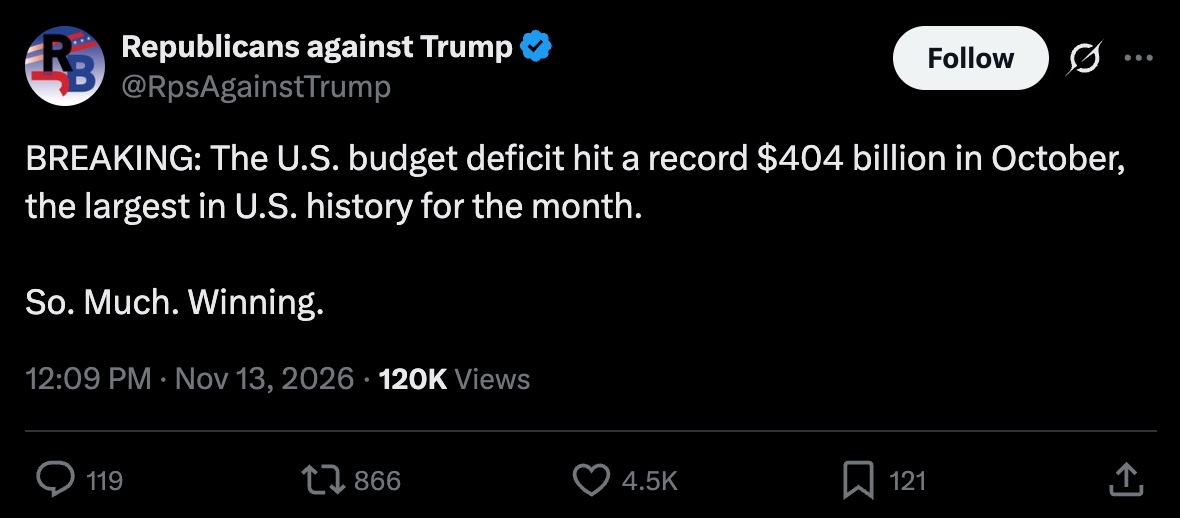
BREAKING: The U.S. budget deficit hit a record $404 billion in October, the largest in U.S. history for the month. So. Much. Winning.
October's $404 billion deficit is the largest for the month on record, and the largest since at least 1979 after inflation. Nov. 1 fell on a Sunday, so November payments went out early, about $119 billion by our subtraction. Treasury's adjusted $285 billion is 49% above last year's. Deficits are rising, though one-time items inflate October's jump.
What the post says or clearly implies, checked one by one. How verdicts work
Treasury reports $404.1 billion, the most for any October on record and, after inflation, since at least 1979. November payments made early inflated this October and last. Against GDP, October 2020 was bigger.
Treasury puts the deficit at $404.06 billion1. The previous October high was $284.3 billion in 2025, just above 2020's $284.1 billion. No October from 1979 to 1997 topped $50 billion2. Before 1980, no year's outlays reached $505 billion, so beating $404 billion would have taken over 80% of a year's spending in one month3. After inflation it's the largest since at least 1979, by our calculation4.
Nov. 1 was a Sunday, so military pay, veterans' benefits, SSI and Medicare plan payments went out in October1. Treasury's adjusted figure is $285 billion5, about $119 billion less by our subtraction. Last October had a shift too6: about $105 billion as first reported7, or about $93 billion implied by Treasury's latest comparison5. October 2020 had one8, but our sources don't size it.
Against each year's third-quarter GDP at an annual rate, October 2020's deficit was 1.31% and this October's 1.22%, about tied with 2009, by our calculation9. June 2020's $864.1 billion is still the record for any month2,10.
Not adjusted for inflation. Each year's point is that October's deficit.
| Year | Billions of dollars | Billions of Oct. 2026 dollars |
|---|---|---|
| 1998 | $32.44 | $66.80 |
| 1999 | $26.33 | $52.90 |
| 2000 | $11.32 | $22.00 |
| 2001 | $7.66 | $14.50 |
| 2002 | $54.07 | $100.70 |
| 2003 | $69.55 | $126.90 |
| 2004 | $57.30 | $101.30 |
| 2005 | $47.28 | $80.10 |
| 2006 | $49.32 | $82.40 |
| 2007 | $56.84 | $91.70 |
| 2008 | $155.53 | $241.90 |
| 2009 | $176.36 | $274.90 |
| 2010 | $140.43 | $216.40 |
| 2011 | $98.47 | $146.50 |
| 2012 | $120.00 | $174.80 |
| 2013 | $90.58 | $130.80 |
| 2014 | $121.71 | $173.00 |
| 2015 | $136.56 | $193.90 |
| 2016 | $45.83 | $64.00 |
| 2017 | $63.21 | $86.50 |
| 2018 | $100.49 | $134.20 |
| 2019 | $134.47 | $176.50 |
| 2020 | $284.07 | $368.30 |
| 2021 | $165.06 | $201.40 |
| 2022 | $87.87 | $99.50 |
| 2023 | $66.56 | $73.00 |
| 2024 | $257.45 | $275.30 |
| 2025 | $284.33 | $295.60 |
| 2026 | $404.06 | $404.10 |
Deficits are rising. Fiscal 2026 ran $2.0 trillion, up 12%. But one-time items inflate October's jump, including a military trust fund payment delayed by last year's shutdown and California tax payments that swelled October 2025.
Adjusted for the payment shifts, the October deficit rose $94 billion, or 49%, Treasury said5. CBO, which put October at $409 billion, estimated the adjusted increase at more than $100 billion, according to CRFB11,12. Fiscal 2026 ran a $2.0 trillion deficit, 6.2% of GDP, a level matched or exceeded only eight times since 194613.
Some of the gap won't repeat. Military outlays rose $28 billion, including an October payment to military trust funds that was delayed by last year's shutdown. Non-withheld individual tax payments fell $29 billion from a year swelled by California wildfire filers' delayed payments5,7. Farm relief added $14 billion and gross interest $11 billion5.
Tariff money is shrinking. Net customs receipts fell to $19.2 billion from $31.4 billion1. After the Supreme Court struck down the emergency tariffs, Washington paid about $130 billion of $166 billion in eligible refunds by Sept. 30, by the count of the American Action Forum, a center-right group14. Our earlier piece covers the debt and interest15.
Facts can't settle this part, so we don't rule on it.
Should closing the deficit start with the revenue Washington gave up, or with spending that keeps growing faster than revenue?
The figures themselves aren't the fight. In fiscal 2026 revenue rose 3% and spending 6%, and October started fiscal 2027 deeper in the red13,1. The question is which side of the ledger to fix first.
Washington cut taxes it couldn't pay for, and lost tariff money besides. Closing the gap starts with revenue.
CBO and the Joint Committee on Taxation estimate that the 2025 tax and spending law adds $3.4 trillion to deficits from 2025 to 2034, and $4.1 trillion once $718 billion in added interest is counted16. Its effects already show up. A Treasury official tied flat corporate tax receipts in October 2025 to the law's corporate tax breaks7, and corporate receipts fell over fiscal 202613.
Tariffs were a new source of revenue. After the Supreme Court ruling, customs receipts fell in fiscal 2026 as refunds went out14. They fell again in October1. Every dollar borrowed adds interest, which reached $1.1 trillion last year and topped defense spending14. Revenue the law gave up is borrowed, and the interest on it compounds16.
Revenue is growing. Spending, led by the biggest benefit programs and interest, is growing faster, and that's the gap.
Revenue rose $169 billion in fiscal 2026, CBO says, while outlays rose $386 billion, led by the largest mandatory programs, net interest and defense13. The center-right American Action Forum counts $305 billion more in program spending and $81 billion more in interest, against $169 billion in new revenue14. October's outlays hit a record $773 billion5, though about $119 billion of that was November payments made early, by our subtraction.
The White House argues the 2025 law is being scored against the wrong benchmark. Measured against extending the 2017 tax cuts, OMB says the law cuts deficits by $1.4 trillion over 10 years17. Interest already takes about a fifth of revenue (our division of AAF's $1.1 trillion by $5.4 trillion)14.
Every source was opened and read. Advocacy groups are labeled as such.
Think we got something wrong? Email editor@viewfromthegallery.com with a source. Corrections are made openly and logged on the page.
New breakdowns in your inbox: what was true, what wasn't, and what the argument is really about. No ads, no spin.