The Pentagon fails audits. That doesn't mean $2 trillion is missing.
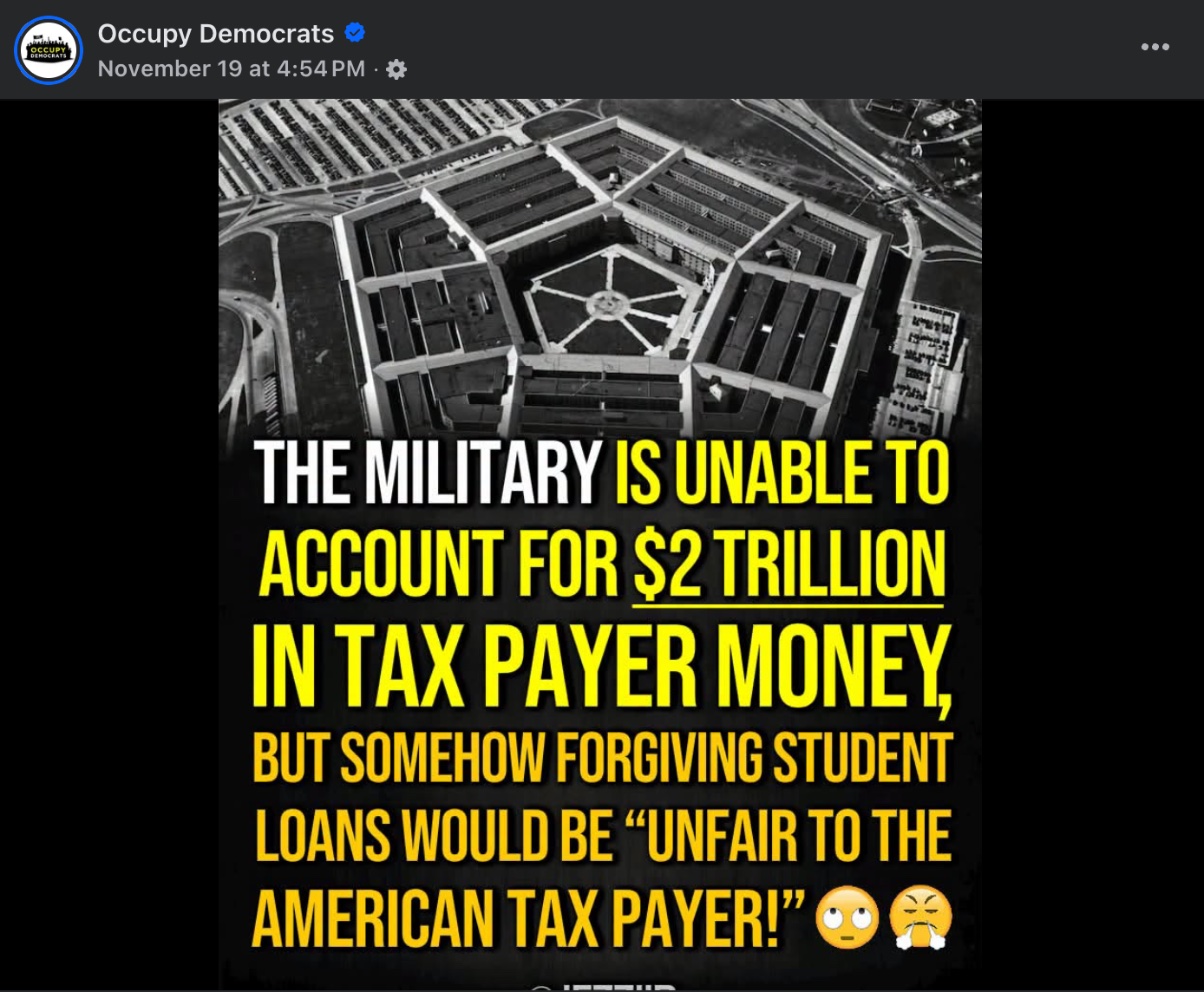
A viral meme says the military can't account for $2 trillion in taxpayer money. The audit failure is real. The $2 trillion is unverified assets.
The bottom line
The Pentagon has failed nine straight full audits, so "unable to account" fits. The roughly $2 trillion is assets lacking clean opinions, even counting ones expected by February 2027. Auditors couldn't verify them, which is not the same as finding them lost. In FY2025, books auditors couldn't verify held at least 64% of the Pentagon's budgetary resources1,2,3.
The claims
What the post says or clearly implies, checked one by one. How verdicts work
The military can't account for its money: it can't pass an audit.
Checks outAccurate. Auditors issued a ninth straight disclaimer: the Pentagon couldn't give them enough evidence to judge its books1. It's the only one of the 24 CFO Act agencies never to get a clean opinion3.
The Pentagon's inspector general issued the fiscal 2026 disclaimer on Nov. 16. It means management "could not provide sufficient evidence to the auditors to support an opinion on the reliability of the financial statements"1. Full-scope audits began in fiscal 2018, and every one has ended in a disclaimer3,1.
As of fiscal 2025, the Pentagon was the only one of the 24 agencies covered by the Chief Financial Officers Act never to get a clean opinion. GAO has listed its financial management as high-risk since 19953.
Parts of the Pentagon do pass. The Marine Corps has had clean opinions since fiscal 20233, and a retiree health fund got its first this year1. The inspector general also says the drop in material weaknesses, from 26 to 14, "stems from consolidation, not resolution"1.
The military can't account for $2 trillion in taxpayer money.
MisleadingRoughly the right number, wrong description. It's assets not covered by clean opinions, even counting ones expected by February 20272. Auditors couldn't verify them, which is not the same as finding the money lost1.
The Pentagon, which now also goes by the Department of War, said clean opinions "will cover more than 56 percent" of assets, counting "audit opinions expected in January and February of FY 2027"2. The audit covered more than $4.8 trillion1, so by our calculation about $2.1 trillion isn't covered. A Nov. 17 Responsible Statecraft column made the same $2 trillion point4.
Assets are what the Pentagon owns, at values on its books, and what they cost when bought can differ from what they're worth now5. In FY2024, nearly all assets in parts with disclaimers belonged to the Army, Navy and Air Force6. The 2018 audit's samples found no evidence of fraud, which doesn't rule it out7.
By another measure the gap is wider. In FY2025, entities with disclaimers held at least 43% of the Pentagon's assets but at least 64% of its budgetary resources, the money it has available to spend3.
The real disagreement
Facts can't settle this part, so we don't rule on it.
Should Congress hold back Pentagon money until it can pass an audit, or fund the military while it fixes its books?
The post pairs the audit with student debt relief, a separate argument about who deserves federal help. The audit fight is narrower. Congress has ordered a clean opinion by the end of 20283, and the White House wants a record $1.5 trillion for defense in fiscal 20278.
No clean books, no raises
A Pentagon that can't show auditors its records shouldn't get record budget increases until it can.
Ben Freeman of the Quincy Institute puts it plainly: "if the Pentagon can't tell us where our money has gone, why should we give them more money?" The budget passed $1 trillion this year, he notes, and more than half of Pentagon spending goes to contractors4. GAO warns that the Pentagon's new audit plan "potentially risks limiting accountability and transparency" for the parts being folded together3.
Supporters say patience hasn't worked. The Pentagon is the only one of 24 CFO Act agencies never to get a clean opinion, and it has made "only limited progress" on its material weaknesses since 2021, GAO says3. This year's lower count of weaknesses reflects consolidation, not fixes, the inspector general says1. Until the Pentagon can "show us the receipts," Freeman writes, "they should stop asking us for more of it"4.
Fix the books, fund the force
The audit is an accounting test, not a waste detector, and readiness shouldn't wait on the grade.
A disclaimer says records can't be verified, not that money was stolen. The 2018 audit's samples found no evidence of fraud, and military pay and major weapons checked out7. Retired Lt. Gen. Thomas Spoehr, director of the Heritage Foundation's Center for National Defense, argued in 2018 that the audit tests whether spending is recorded correctly, not whether it was wise9. In 2019 the House Armed Services Committee said the audit "did not identify any areas of large-scale waste" and that the budget follows threats10.
Backers of this view point to progress. The Pentagon expects clean opinions on most of its assets and over 90% of its liabilities by February2. Audit inventory work turned up more than $16 billion in untracked assets from 2019 to 20233. In 2018 the committee's chairman warned the audit "should not be used as an excuse for arbitrary cuts"7.
Where they agree
What would change minds
- The component opinions due in early 2027, which will show whether clean opinions really cover more than half of assets2.
- Standalone audits the inspector general plans to keep for the Air Force, Navy, Marine Corps, Army Corps of Engineers civil works and Military Retirement Fund would show whether the services' records can be verified, though the Army Working Capital Fund will stop issuing its own statements in fiscal 20273.
Sources
Every source was opened and read. Advocacy groups are labeled as such.
Show all 10 sources
- 1
- 2
- 3
- 4
- 5
- 6
- 7
- 8
- 9
- 10
Think we got something wrong? Email editor@viewfromthegallery.com with a source. Corrections are made openly and logged on the page.
Get new breakdowns by email
New breakdowns in your inbox: what was true, what wasn't, and what the argument is really about. No ads, no spin.