Read the post as text
Former Obama advisers are openly calling for foreign countries to pursue criminal cases against Secretary Hegseth. Their proposal: “quietly gather evidence” now and wait until Trump leaves office to issue indictments.
Two of its three authors held Obama-era posts. It names Hegseth. As of Nov. 16, no country had opened a criminal case against U.S. officials.
Former Obama advisers are openly calling for foreign countries to pursue criminal cases against Secretary Hegseth. Their proposal: “quietly gather evidence” now and wait until Trump leaves office to issue indictments.
A May 27 Just Security essay does say affected countries could "quietly gather evidence" and indict after Trump leaves office, naming Hegseth among three potential perpetrators1. It's about the officials and commanders involved in the boat strikes. Two authors held Obama-era posts2,3. No country had opened a criminal case against U.S. officials, as of Nov. 16.
What the post says or clearly implies, checked one by one. How verdicts work
Two of the three authors held Obama-era posts, at Homeland Security from 2015 to 2017 and at State from 2013 to 2017. None of the bios lists White House work, and the third author's bio gives no dates.
The essay has three authors1. Sarah Harrison was counselor to the secretary of Homeland Security from 2015 to 2017. She also spent more than four years as an associate general counsel in the Pentagon's Office of General Counsel, with no dates given2. Benjamin R. Farley was a senior adviser to the State Department's special envoy for Guantanamo closure from June 2013 to August 20173.
Farley's bio describes thirteen years as a career national security lawyer. After the envoy job he spent four years defending a 9/11 defendant for the Pentagon's Military Commissions Defense Organization, then led State's Office of Terrorist Detentions3. Tracey Begley is a former senior adviser in State's Office of Global Criminal Justice, with no dates given4.
So "Obama adviser" fits two of the three if it means any adviser in the administration, and Farley's post ran into Trump's first months. None of the three bios lists a job in the Obama White House2,3,4.
They do, openly, naming Hegseth. But the essay ran May 27, covers the officials and commanders involved, and says the U.S. should prosecute too. No country had opened a criminal case against U.S. officials, as of Nov. 16.
Just Security published the essay May 27. A Wayback copy from that day has the same text1,5. It calls the strikes "murder" and names Hegseth, Adm. Frank Bradley and Gen. Francis Donovan as "at least three high-level potential perpetrators"1.
Its subject is "the U.S. government officials and military commanders involved." The authors say the United States "can and should hold its own personnel accountable," but call near-term U.S. justice "extremely remote"1. It resurfaced Nov. 14, days after the House voted 211-204 to send Massie's impeachment articles to committee6,7,8.
As of Nov. 16, we found no criminal case against U.S. officials in any of the five countries whose citizens appear among the dead. Ecuador's prosecutors have a disappearance probe into eight missing fishermen, but hadn't formally asked the U.S. for information as of Amnesty's July report9. Saint Lucia treats its case as missing persons10. Petro proposed a commission of lawyers11. Venezuela's attorney general asked the UN to investigate12. Trinidadian families are suing in U.S. court13.
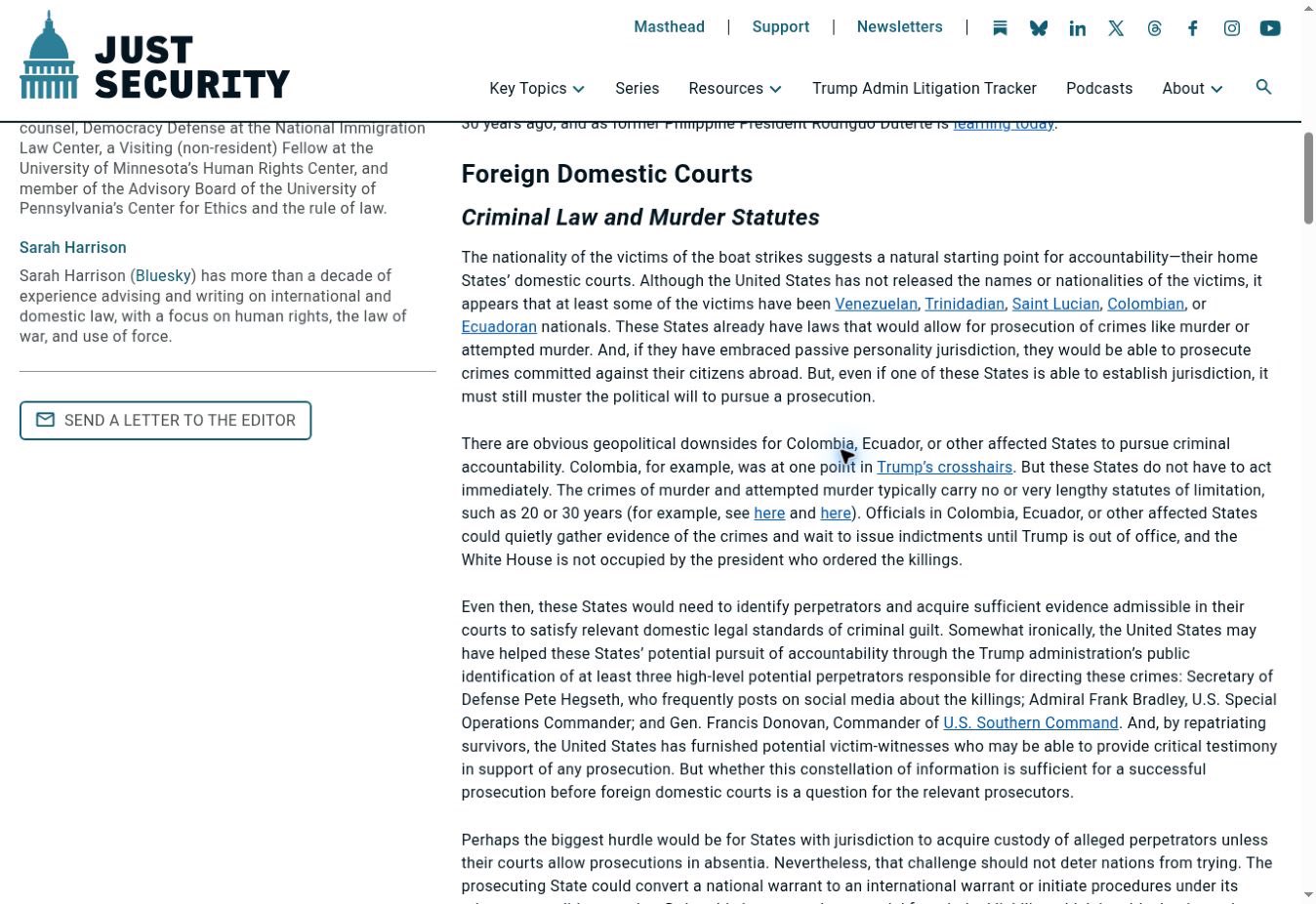
The quote is exact. The essay says officials in Colombia, Ecuador or other affected countries could gather evidence quietly and indict once Trump is out of office, since "these States do not have to act immediately."
The full sentence: "Officials in Colombia, Ecuador, or other affected States could quietly gather evidence of the crimes and wait to issue indictments until Trump is out of office, and the White House is not occupied by the president who ordered the killings"1. The authors cite "obvious geopolitical downsides" to acting, and say murder charges "typically carry no or very lengthy statutes of limitation, such as 20 or 30 years"1.
It's offered as an option ("could"). The conclusion repeats it: foreign courts "can still begin collecting evidence and pursue charges later"1. The authors call custody of any defendant perhaps the biggest hurdle1.
Facts can't settle this part, so we don't rule on it.
Should Americans urge foreign governments to prosecute U.S. officials over military strikes that, by some accounts, killed those countries' citizens?
The dispute starts with the legal premise. The essay's authors call the strikes murder1. Hegseth calls his campaign "100 percent lawful under the laws of armed conflict"14.
Americans shouldn't recruit foreign prosecutors to build cases against U.S. officials over a military policy voters can judge.
Supporters point by analogy to the U.S. stance on the ICC, since the essay's main route is foreign national courts. A 2025 executive order says the ICC and its member states "must respect the decisions of the United States" not to subject its personnel to the ICC15. A 2002 law authorizes "all means necessary and appropriate" to free covered U.S. and allied persons held by or for the ICC16.
Hegseth says the strikes are lawful and have cut narco-vessel movements at least 65 percent in the Western Caribbean14. As supporters see it, advising foreign prosecutors to build cases in secret and file them once Trump is out of office makes criminal exposure turn on who holds the White House. Reitz called it "seditious meddling"17. Families of two victims are suing in U.S. federal court, so a domestic forum exists1.
When the U.S. kills foreign citizens outside any war, their countries have a lawful claim, and saying so is legal analysis.
The essay says the U.S. hasn't released nationalities but some victims appear to be Colombian, Ecuadoran, Venezuelan, Trinidadian or Saint Lucian, and those countries outlaw murder1. The Washington Office on Latin America counted at least 221 killed by July and called it "murder under domestic law"14. A Colombian family has filed a complaint naming Hegseth with the Inter-American Commission. Their lawyer calls the dead man a fisherman11.
The authors say the U.S. "can and should" prosecute its own people, and that outside courts matter because near-term U.S. justice is "extremely remote"1. They point to Augusto Pinochet and Rodrigo Duterte, who faced charges after political winds changed1. As supporters see it, mapping which courts have jurisdiction is legal analysis, and whether to charge anyone is for those countries' prosecutors.
Every source was opened and read. Advocacy groups are labeled as such.
Think we got something wrong? Email editor@viewfromthegallery.com with a source. Corrections are made openly and logged on the page.
New breakdowns in your inbox: what was true, what wasn't, and what the argument is really about. No ads, no spin.