Social Security · Taxes · Economy

The Social Security cap is real. Lifting it alone won't fix the gap

Wages above $184,500 escape the tax in 2026. But the 75-year fix Sanders cites also taxes investment income, and it rests on 2022 projections.

· @SenSanders · on XThe post we're checking
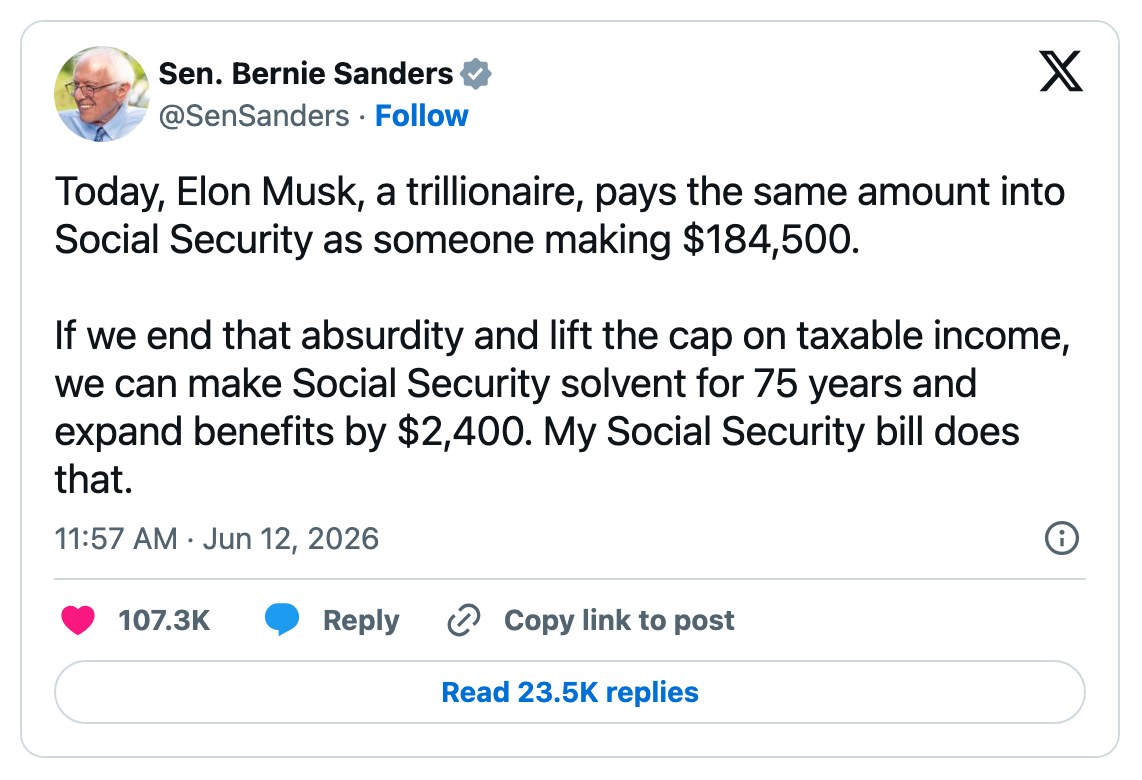
Today, Elon Musk, a trillionaire, pays the same amount into Social Security as someone making $184,500.

If we end that absurdity and lift the cap on taxable income, we can make Social Security solvent for 75 years and expand benefits by $2,400. My Social Security bill does that.
Screenshot of the post on X. Shown for commentary.
Read the post as text
Today, Elon Musk, a trillionaire, pays the same amount into Social Security as someone making $184,500. If we end that absurdity and lift the cap on taxable income, we can make Social Security solvent for 75 years and expand benefits by $2,400. My Social Security bill does that.

The bottom line

Wages above $184,500 escape Social Security tax in 2026, though Musk likely pays less than the maximum. Lifting the cap alone would close a bit over half the shortfall. An earlier version of Sanders' bill was scored solvent for 75 years, but only with new investment taxes and 2022 projections. The deeper choice is taxing high earners or slowing benefits.

The claims

What the post says or clearly implies, checked one by one. How verdicts work

1

Elon Musk, a trillionaire, pays the same amount into Social Security as someone making $184,500.

Missing context

Wages above $184,500 escape the tax in 2026. But the cap isn't the main reason Musk pays little. His known salary is $54,080, and his stock gains aren't wages, so lifting the cap alone wouldn't reach them.

In 2026 workers pay 6.2% on wages up to $184,500, and employers match it1. That caps a worker's share at $11,439, by our arithmetic. The cap rises with wages yearly. For 2027 it is $192,3002.

Musk takes no salary from Tesla, and SpaceX's IPO filing shows a $54,080 salary, about $3,353 in Social Security tax by our arithmetic3,4. In 2021, when he exercised stock options, he did hit the cap3. Capital gains and other investment income escape Social Security tax3. PolitiFact rated the line Mostly True. It said the post "accurately reflects a real feature of Social Security taxes" but that Musk "could pay even less"3. Forbes put his fortune at about $1.1 trillion that day5.

About 6% of workers earned above the cap in 2023, by our arithmetic from SSA's counts6. The Trustees estimate that 82.9% of covered earnings were taxable in 2024, down from 88.6% in 19847. The 1977 amendments aimed for 90%8. Sanders' bill would tax gains Musk cashes in through a separate investment tax9.
2

Lifting the cap on taxable income would make Social Security solvent for 75 years, and Sanders' bill does that.

Misleading

SSA's actuaries estimate that lifting the cap closes about 57% of the shortfall. The bill's 75-year score also counted new investment taxes, and it covers a 2023 version under 2022 projections, before the gap grew.

Sanders' bill taxes wages above $250,000 without counting them toward benefits9,10. Scored alone under 2026 projections, that closes 57% of the 75-year shortfall, and the trust funds run dry around 2057 instead of 203411,12. Scrapping the cap entirely closes 58%11.

The bill also adds a 12.4% tax on investment income for filers earning over $200,000, or $250,000 for couples, plus a business-income tax9,10. In 2023 the chief actuary wrote that the full package "would extend the ability of the OASDI program to pay scheduled benefits in full and on time throughout the 75-year projection period." In that score the investment and business taxes raised more than the cap did10.

That score used 2022 assumptions, when the gap was 3.42% of taxable payroll. It is now 4.42%10,13. SSA hasn't scored the 2025 bill, whose launch release cites the 2023 analysis14,15. So no one has tested whether the new version lasts 75 years against today's bigger gap. It also sends only 62% of its expanded investment tax to Social Security9.

Taxing wages over $250,000 pushes the run-out from 2034 to 2057

0%50%100%150%200%20262029203220352038204120442047205020532056205920622065

Runs out in 2034. Shown as zero after that.

Social Security's trust fund reserves at the start of each year, as a share of that year's costs, under SSA's 2026 projections12. We show zero once the money runs out. Benefits would then be cut to what taxes bring in, about 83% at first under current law13.
Show the numbers
Taxing wages over $250,000 pushes the run-out from 2034 to 2057: the numbers
YearCurrent lawTaxing wages over $250,000
2026151.0%151.0%
2027131.0%131.0%
2028111.0%123.0%
202992.0%117.0%
203074.0%112.0%
203157.0%108.0%
203240.0%104.0%
203323.0%102.0%
20347.0%101.0%
20350.0%101.0%
20360.0%100.0%
20370.0%99.0%
20380.0%98.0%
20390.0%96.0%
20400.0%94.0%
20410.0%91.0%
20420.0%89.0%
20430.0%86.0%
20440.0%82.0%
20450.0%78.0%
20460.0%74.0%
20470.0%70.0%
20480.0%65.0%
20490.0%60.0%
20500.0%54.0%
20510.0%48.0%
20520.0%42.0%
20530.0%35.0%
20540.0%27.0%
20550.0%19.0%
20560.0%10.0%
20570.0%1.0%
20580.0%0.0%
20590.0%0.0%
20600.0%0.0%
20610.0%0.0%
20620.0%0.0%
20630.0%0.0%
20640.0%0.0%
20650.0%0.0%
3

Sanders' Social Security bill would expand benefits by $2,400 a year.

Checks out

The bill's formula change adds roughly $200 to $220 a month at full retirement age for most workers, in line with the actuaries' estimates. In the 2023 score, the bill's investment and business taxes paid for it.

The bill raises the first step of the benefit formula9. SSA's actuaries estimated the 2023 version as an "approximate $200 increase" in the full-retirement-age benefit "for most workers"10. The 2025 version trims the formula change. For workers first eligible in 2027 it comes to about $219 a month, or roughly $2,630 a year, by our calculation from SSA's bend points9,16. SSA puts the original design at about $250 a month for the same workers17.

Not everyone would get the full amount. Claiming at 62 cuts benefits by 30% for people born in 1960 or later, and the raise shrinks the same way18. Low earners with long careers can get more from the bill's higher minimum benefit10.

The raise isn't free. In the 2023 score, the benefit increases and a more generous cost-of-living formula added about 2% of taxable payroll to the shortfall, by our sum of the actuaries' figures10. CRFB, a budget watchdog, counted the expansions as using "nearly two-fifths" of the bill's new revenue19.

The real disagreement

Facts can't settle this part, so we don't rule on it.

Should Social Security's shortfall be closed mainly by having high earners pay more, or mainly by slowing the growth of benefits?

Under the 2026 Trustees Report, the combined trust funds can pay full benefits until the third quarter of 2034 and about 83% at that point, falling to 65% by 210013. Closing the 75-year gap takes the equivalent of 4.42% of taxable payroll13. Most plans mix taxes and benefit changes, and the two sides split on the mix.

High earners should pay more

The money went to the top of the pay scale, and benefits keep millions out of poverty. High earners and investors should close most of the gap.

The 1977 amendments aimed to tax 90% of earnings8. The Trustees' taxable ratio has since slipped to an estimated 82.9%, as top earners' pay grew much faster than for everyone else7. Taxing wages above $250,000 closes 57% of the gap11. SSA's separate estimates for taxing investment income (30%) and some business income (21%) would more than cover the rest, before the bill's benefit increases, by our rough sum20.

The benefits are worth protecting. Social Security moved 28.8 million people out of poverty in 2025 under the Census Bureau's supplemental measure, 20.9 million of them 65 or older21. Bigger future checks replace about the same share of past earnings as today's, around 40% for a medium earner22. In a 2024 NORC survey co-sponsored by groups including AARP and the U.S. Chamber of Commerce, 68% of respondents favored eliminating the cap, including 65% of Republicans23.

Slow benefit growth and keep the earned-benefit link

Taxes on the top can't close the gap alone. Future benefits are already scheduled to grow well past today's, so slow that growth where it's least needed.

Even scrapping the cap closes only 45% to 58% of the gap11. Chief Actuary Karen Glenn said in June that it "by itself would not solve the solvency issue"24. Sanders' version taxes pay above $250,000 without crediting it toward benefits11. That turns a slice of Social Security into a tax with no benefit attached.

Meanwhile, scheduled benefits keep rising after inflation. A medium earner turning 65 in 2060 is scheduled to get $47,948 a year at full retirement age, in 2026 dollars, against $30,003 for one turning 65 this year22. AEI's Andrew Biggs argues that for middle and high earners, bigger benefits increasingly "replace savings that would have taken place anyway"24. Progressive price indexing, which protects the bottom 30% of earners, closes 38% of the gap25. Tying the retirement age to life expectancy closes 16% on its own26.

Where they agree

  • Both sides work from the same SSA projections: full benefits until the third quarter of 2034 without changes, and no change to the cap alone that closes the whole gap13,11.

What would change minds

  • An updated SSA score of Sanders' 2025 bill under the 2026 Trustees Report would show whether the full package still reaches 75 years.
  • Evidence on how much high earners shift pay into untaxed forms when payroll taxes rise would test the revenue estimates both sides use.
  • Better data on how life-expectancy gains differ by income would answer who bears the cost of a later retirement age.

Sources

Every source was opened and read. Advocacy groups are labeled as such.

Show all 26 sources
  1. 1
  2. 2
    Contribution and Benefit Base
    Social Security Administration, Office of the Chief ActuaryData
  3. 3
  4. 4
  5. 5
  6. 6
  7. 7
    2026 OASDI Trustees Report, V.C: Program-Specific Assumptions and Methods
    Social Security Board of Trustees2026Primary document
  8. 8
    Social Security Taxable Earnings Base: An Overview (IF12360)
    Congressional Research Service2023-03-27ResearchCongress's nonpartisan research service
  9. 9
    S. 770, Social Security Expansion Act (119th Congress), as introduced
    U.S. Government Publishing Office2025-02-27Primary document
  10. 10
    Estimate of the financial effects on Social Security of the Social Security Expansion Act (letter to Sen. Sanders)
    Social Security Administration, Office of the Chief Actuary2023-02-13Primary documentScores the 2023 version of the bill under the 2022 Trustees Report
  11. 11
    Provisions affecting payroll taxes (estimates under the 2026 Trustees Report)
    Social Security Administration, Office of the Chief ActuaryData
  12. 12
    Provision E2.5: trust fund ratio by year
    Social Security Administration, Office of the Chief ActuaryData
  13. 13
    A Summary of the 2026 Annual Reports
    Social Security and Medicare Boards of Trustees2026Primary document
  14. 14
    Proposals to Change Social Security: letters and memoranda
    Social Security Administration, Office of the Chief ActuaryPrimary document
  15. 15
    Hoyle, Sanders, Warren, Schakowsky Introduce Social Security Expansion Act
    Office of Rep. Val Hoyle (joint release with Sen. Sanders)2025-02-27Primary document
  16. 16
    Benefit Formula Bend Points
    Social Security Administration, Office of the Chief ActuaryData
  17. 17
    Provisions affecting the level of monthly benefits (estimates under the 2026 Trustees Report)
    Social Security Administration, Office of the Chief ActuaryData
  18. 18
    Starting Your Retirement Benefits Early
    Social Security AdministrationPrimary document
  19. 19
    Senate Budget Committee Holds Hearing on Raising Revenue to Save Social Security
    Committee for a Responsible Federal Budget2023-08-16Advocacy / think tankNonpartisan budget watchdog that favors deficit reduction
  20. 20
  21. 21
    Poverty in the United States: 2025 (P60-290)
    U.S. Census Bureau2026-09-15Data
  22. 22
  23. 23
    Social Security at 90: A Bipartisan Roadmap for the Program's Future
    National Academy of Social Insurance2025-01Advocacy / think tankNonprofit of social insurance experts that generally supports the program. NORC fielded the survey
  24. 24
    Social Security's Road Ahead: A Discussion of the 2026 Trustees' Report (transcript)
    American Enterprise Institute2026-06-12Advocacy / think tankRight-of-center think tank. Quotes from SSA's chief actuary (a guest) and AEI's Andrew Biggs
  25. 25
    Provision B1.2: progressive price indexing above the 30th percentile
    Social Security Administration, Office of the Chief ActuaryData
  26. 26
    Provision C1.3: index the normal retirement age to life expectancy
    Social Security Administration, Office of the Chief ActuaryData

Think we got something wrong? Email editor@viewfromthegallery.com with a source. Corrections are made openly and logged on the page.