Economy · Inequality · Labor · Taxes

Sanders' wage and billionaire numbers hold up, with context

The federal minimum hasn't moved since 2009. Billionaire wealth rose sevenfold, 4.7-fold after inflation. But 30 states pay more, and 2009 was a crash year.

· @SenSanders · on XThe post we're checking
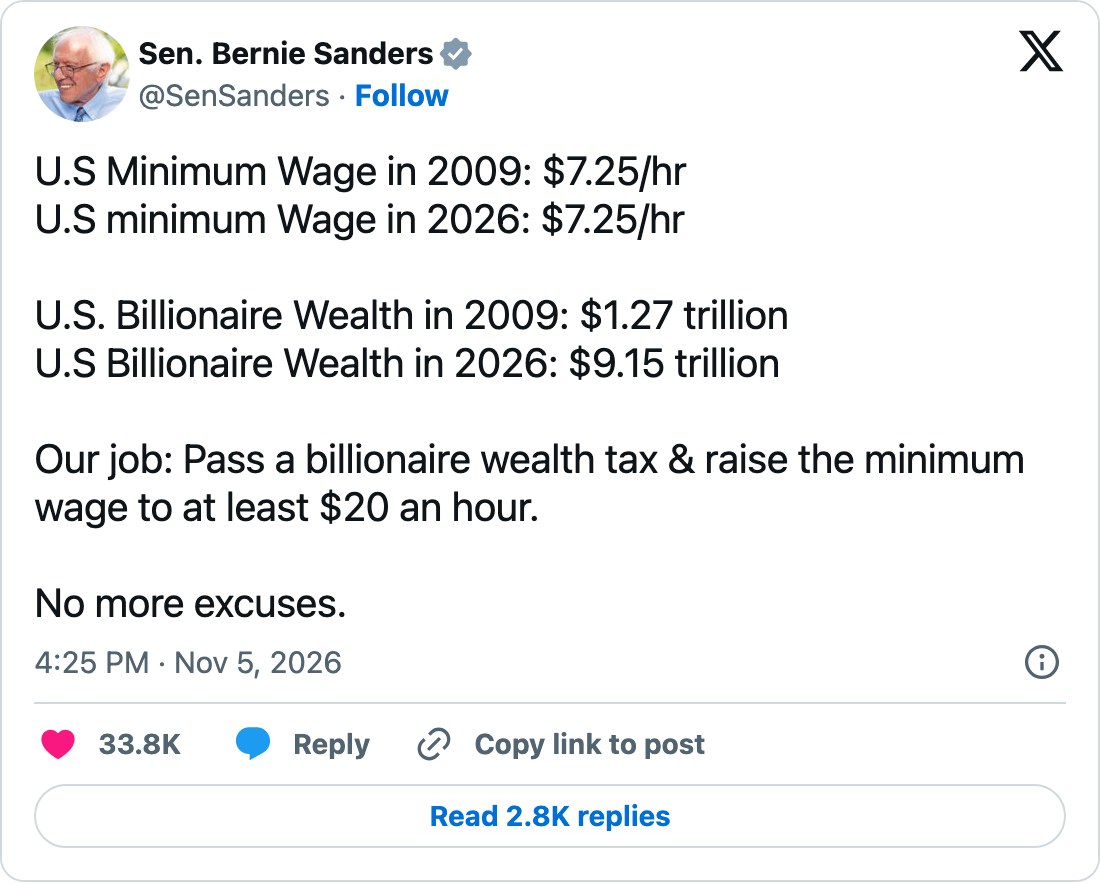
U.S Minimum Wage in 2009: $7.25/hr
U.S minimum Wage in 2026: $7.25/hr

U.S. Billionaire Wealth in 2009: $1.27 trillion
U.S Billionaire Wealth in 2026: $9.15 trillion

Our job: Pass a billionaire wealth tax & raise the minimum wage to at least $20 an hour.

No more excuses.
Screenshot of the post on X. Shown for commentary.
Read the post as text
U.S Minimum Wage in 2009: $7.25/hr U.S minimum Wage in 2026: $7.25/hr U.S. Billionaire Wealth in 2009: $1.27 trillion U.S Billionaire Wealth in 2026: $9.15 trillion Our job: Pass a billionaire wealth tax & raise the minimum wage to at least $20 an hour. No more excuses.

The bottom line

All four numbers hold up. The federal minimum has been $7.25 since July 2009 and buys about 35% less now, though 30 states and DC set higher floors1. Billionaire wealth went from $1.27 trillion, Forbes's 2009 tally2, to roughly $9 trillion3. The open question is whether a wealth tax and a $20 floor would help.

The claims

What the post says or clearly implies, checked one by one. How verdicts work

1

The federal minimum wage was $7.25 an hour in 2009 and is still $7.25 in 2026.

Checks out

The federal floor hasn't moved since July 2009 and buys about 35% less. Thirty states and DC set higher minimums, and about 1% of hourly workers earn $7.25 or less.

The $7.25 rate took effect July 24, 20094. That's more than 17 years without a raise, the longest stretch since the federal minimum began in 19385. Prices have risen about 55% since 2009, so $7.25 now buys what $4.68 did then, by our calculation from the consumer price index6,7.

Thirty states and DC set minimums above $7.251. In 2024, 843,000 hourly workers earned $7.25 or less, 1.0% of hourly workers, down from 4.9% in 2009. Nearly three in four were in service jobs, where tips may add to pay8.

The frozen floor still sets the minimum in 20 states, among them Texas and Georgia, that either match it or have no higher minimum of their own1. About 55 million people work in those states9.

The $7.25 floor has lost about 35% of its buying power since 2009

$0$1$2$3$4$5$6$7$8$9$10$11$122009201120132015201720192021202320252009: $11.232026: $7.25

$7.25 times the ratio of the January–September 2026 average CPI-U (332.243) to each year's annual average. Our calculation, rounded to the cent. EPI, using a different price index, puts the loss at 30%.

The federal minimum wage, and its value in 2026 dollars by our calculation from BLS's consumer price index, annual averages, with 2026 as January–September6,7. $7.25 took effect July 24, 20095.
Show the numbers
The $7.25 floor has lost about 35% of its buying power since 2009: the numbers
YearIn 2026 dollarsAs paid
2009$11.23$7.25
2010$11.05$7.25
2011$10.71$7.25
2012$10.49$7.25
2013$10.34$7.25
2014$10.17$7.25
2015$10.16$7.25
2016$10.04$7.25
2017$9.83$7.25
2018$9.59$7.25
2019$9.42$7.25
2020$9.31$7.25
2021$8.89$7.25
2022$8.23$7.25
2023$7.91$7.25
2024$7.68$7.25
2025$7.48$7.25
2026$7.25$7.25
2

U.S. billionaire wealth in 2009 was $1.27 trillion.

Checks out

It's Forbes's figure for its 2009 list of the 400 richest Americans. That year the cutoff was $950 million, so the list took in every U.S. billionaire Forbes tracked.

Forbes put the combined worth of the 2009 Forbes 400 at $1.27 trillion, as of Sept. 10, 2009, and the price of admission fell to $950 million2. Anyone worth $1 billion cleared that bar, so the list counted every U.S. billionaire on Forbes's books, plus anyone worth between $950 million and $1 billion.

It was a bad year for fortunes. The same list had been worth $1.57 trillion a year earlier2. But 2009 is when the minimum wage last rose, so the start year has a reason. Nor was it the bottom. Forbes's March 2009 world list gave Americans 44% of $2.4 trillion, about $1.06 trillion by our math10.

These are nominal dollars. In 2026 dollars, $1.27 trillion is about $1.97 trillion, by our calculation6,7.

3

U.S. billionaire wealth in 2026 is $9.15 trillion.

Checks out

We couldn't find the exact figure published. But Forbes's September data puts all U.S. billionaires between $8.6 trillion and $10.6 trillion, and one June tally hit $9.24 trillion.

Americans for Tax Fairness counted 977 U.S. billionaires worth $9.24 trillion on June 16, using Forbes data3. Forbes's September list put the 400 richest at a record $8 trillion, with 590 more U.S. billionaires below its $4.4 billion cutoff11. Each of those 590 is worth between $1 billion and $4.4 billion, so all U.S. billionaires together held between about $8.6 trillion and $10.6 trillion as of Sept. 4, by our calculation. Sanders' office used an all-billionaires count in March, too: 938 billionaires worth $8.2 trillion12.

So the post most likely compares 400 people in 2009 with all billionaires in 2026. In 2009 those were nearly the same group. Like for like, the Forbes 400 alone went from $1.27 trillion to $8 trillion, about 6.3-fold, or about fourfold after inflation, by our calculation2,11,6,7.

After inflation, the post's own figures show about 4.7-fold growth, using annual-average prices, by our calculation6,7.
The real disagreement

Facts can't settle this part, so we don't rule on it.

Should Washington tax billionaires' wealth every year and raise the wage floor to $20, or would that do more harm than good?

Sanders' pending bills would tax billionaires 5% of their net assets each year13 and raise the minimum to $17 over five years14. The $20 in his post goes further. Both sides can accept the numbers above. They split on whether these remedies work.

Tax top fortunes, lift the floor

Wealth this concentrated distorts democracy, and a frozen minimum has let the lowest-paid fall behind, so both should change.

The top 0.1%'s share of U.S. wealth rose from under 10% in 1980 to almost 20% by the late 2010s, Saez and Zucman estimate15. Across 1,779 policy issues, Gilens and Page found economic elites and business groups had "substantial independent impacts" on policy, and average citizens little or none16. Saez and Zucman put Sanders' 5% tax at $4.4 trillion over a decade, his office says12. Europe's taxes failed for fixable reasons like low thresholds and offshore evasion, they argue, and the U.S. taxes citizens wherever they live15.

California's $20 fast-food minimum, about 74% of the state median, showed little to no job effect, EPI says. A $20 federal minimum in 2030 would raise pay for 39.6 million workers, EPI estimates9. Across 138 state increases, low-wage jobs "remained essentially unchanged" five years on17. CBO projected $15 would lift 1.3 million people out of poverty18.

Let states set wages, skip the wealth tax

One national $20 floor would cost low-wage jobs in poorer states, and wealth taxes have a poor record abroad and an uncertain one in court.

A $20 floor today would top the typical wage in poorer states: Mississippi's median was $19.29 in May 202519. CBO projected $15 would cost 1.3 million jobs, with a likely range of about zero to 3.7 million18, and $17 by 2029 about 1 million by 203320. Neumark and Shirley found 79% of U.S. job-effect estimates negative21. High-cost states already set higher minimums1.

Twelve OECD countries taxed net wealth in 1990, and four did by 2017. The OECD found most raised very little, and repeals often cited their failure to meet redistributive goals22. Penn Wharton scored Warren's 2019 wealth tax, a different design, at about $2.7 trillion over a decade, below her campaign's $3.75 trillion, and found it would cut GDP in 2050 by about 1 to 2 percent23. The Supreme Court has expressly left open whether a federal wealth tax is constitutional24.

Where they agree

  • Support for a higher federal floor crosses party lines: Republican Sen. Josh Hawley and Democratic Sen. Peter Welch proposed $15, indexed to inflation25.
  • CBO's 2019 analysis, which both sides cite, found $15 would directly raise pay for 17 million workers. They split over its job-loss range, from about zero to 3.7 million18.

What would change minds

  • More evidence from minimums at or above two-thirds of the local median wage, beyond the 59% top of the increases Cengiz and coauthors studied17.
  • A Supreme Court ruling on whether a federal tax on net worth must be apportioned among the states by population.
  • An official score of Sanders' 5% tax from Congress's Joint Committee on Taxation, with avoidance and valuation problems built in.

Sources

Every source was opened and read. Advocacy groups are labeled as such.

Show all 25 sources
  1. 1
    Consolidated Minimum Wage Table
    U.S. Department of Labor, Wage and Hour Division2026-07-01Data
  2. 2
    The Forbes 400
    Forbes2009-09-30DataForbes's annual estimate of the 400 richest Americans, as of Sept. 10, 2009
  3. 3
    Billionaire Wealth Surges Past $9 Trillion for First Time
    Americans for Tax Fairness2026-06-16Advocacy / think tankGroup that campaigns for higher taxes on the wealthy; its tally of Forbes real-time data
  4. 4
    Minimum Wage
    U.S. Department of Labor, Wage and Hour DivisionPrimary document
  5. 5
  6. 6
    Consumer Price Index for All Urban Consumers (CUUR0000SA0), 2009–2017
    U.S. Bureau of Labor Statistics, Public Data APIData
  7. 7
    Consumer Price Index for All Urban Consumers (CUUR0000SA0), 2018–2026
    U.S. Bureau of Labor Statistics, Public Data APIDataMonthly data through September 2026. October 2025 was never published.
  8. 8
    Characteristics of minimum wage workers, 2024
    U.S. Bureau of Labor Statistics2025-06DataThe 2009 share is from the report's historical table (Table 10)
  9. 9
    Setting high standards for a federal minimum wage
    Economic Policy Institute2026-05-21Advocacy / think tankLabor-aligned think tank; by Ben Zipperer
  10. 10
    The World's Billionaires
    Forbes2009-03-11Data
  11. 11
    Forbes Releases Its 45th Annual Forbes 400 Ranking Of Richest Americans
    Forbes2026-09-15DataForbes press release; a snapshot as of Sept. 4, 2026
  12. 12
    Sanders and Khanna Introduce Legislation to Tax Billionaire Wealth and Invest in Working Families
    Office of Sen. Bernie Sanders (via Internet Archive)2026-03-02Primary document
  13. 13
    S. 3956, Make Billionaires Pay Their Fair Share Act (introduced)
    U.S. Congress, via GovInfo2026-03-02Primary document
  14. 14
    S. 1332, Raise the Wage Act of 2025 (introduced)
    U.S. Congress, via GovInfo2025-04-08Primary document
  15. 15
    Progressive Wealth Taxation
    Brookings Papers on Economic Activity (conference draft)2019-09ResearchBy Emmanuel Saez and Gabriel Zucman (UC Berkeley), who designed wealth taxes for Warren and Sanders
  16. 16
    Testing Theories of American Politics: Elites, Interest Groups, and Average Citizens
    Perspectives on Politics2014-09ResearchPeer-reviewed; by Martin Gilens and Benjamin Page
  17. 17
    The Effect of Minimum Wages on Low-Wage Jobs: Evidence from the United States Using a Bunching Estimator
    National Bureau of Economic Research2019-01ResearchBy Doruk Cengiz, Arindrajit Dube, Attila Lindner and Ben Zipperer; later published in the Quarterly Journal of Economics
  18. 18
  19. 19
  20. 20
    How Increasing the Federal Minimum Wage Could Affect Employment and Family Income
    Congressional Budget Office2024-01-30ResearchInteractive tool; default option is $17 by 2029
  21. 21
    Myth or Measurement: What Does the New Minimum Wage Research Say about Minimum Wages and Job Loss in the United States?
    National Bureau of Economic Research2022-03ResearchBy David Neumark and Peter Shirley; later published in Industrial Relations
  22. 22
  23. 23
    Senator Elizabeth Warren's Wealth Tax: Projected Budgetary and Economic Effects
    Penn Wharton Budget Model2019-12-12ResearchNonpartisan budget model at the University of Pennsylvania
  24. 24
    Moore v. United States, No. 22-800 (slip opinion)
    Supreme Court of the United States2024-06-20Primary document
  25. 25

Think we got something wrong? Email editor@viewfromthegallery.com with a source. Corrections are made openly and logged on the page.