Read the post as text
Hitler was a left-wing socialist
The name and the anti-capitalist talk were real. The record in power mostly points the other way. We also check a reply from the left.
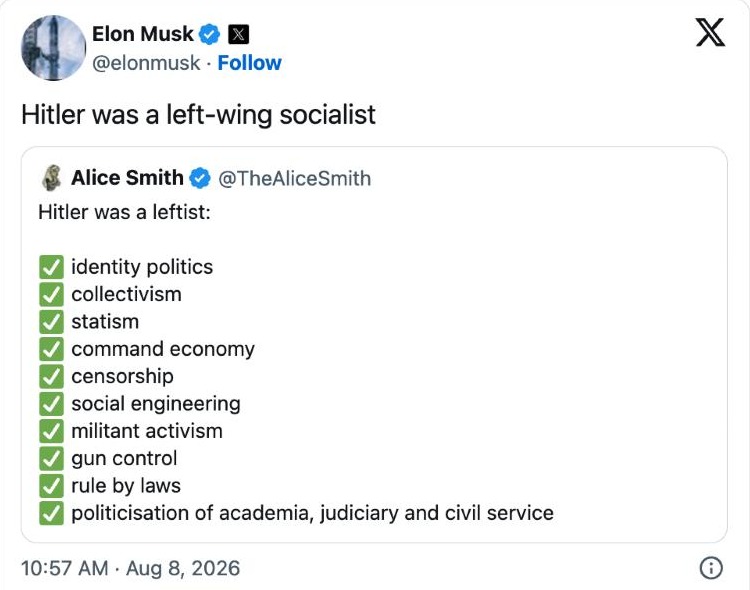
Hitler was a left-wing socialist
Hitler called himself a socialist, and his party's name said so. But he took power with the conservative right and jailed the left first. Most industry stayed private, under tight state control. Major history institutions place Nazism on the far right1,2. The real fight is over what left and right measure: state power, or equality.
What the post says or clearly implies, checked one by one. How verdicts work
Hitler took power in coalition with the conservative right, and his regime jailed communists, Social Democrats and union leaders first. The Holocaust Museum and the German Historical Institute both classify Nazism as far right.
In January 1933 Hitler took power heading what the U.S. Holocaust Memorial Museum calls "a right-wing coalition government" with the conservative German National People's Party3. Dachau's first prisoners were "primarily German Communists, Social Democrats, trade unionists"4. With the Communist deputies barred, only the Social Democrats voted against the Enabling Act5,6.
The museum calls the party "radical far-right," and the German Historical Institute calls it "extreme right-wing"1,2. The historian Richard Evans writes that calling the Nazis socialist mislabels "what is better seen as populism"7. Rainer Zitelmann, who argues Hitler was anti-capitalist, agrees that "the Communists and the Social Democrats had to bear the greater sacrifices," though not, he says, out of any preference for the right8.
A reply from the left, shared on Reddit, said Hitler "crushed unions, backed billionaires, and put socialists in Dachau"9. Unions and Dachau check out10,4. His policies favored big industry, through arms contracts and growing employer rights11. But Henry Turner's research found it mostly funded his right-wing rivals before 193312. We rate that reply missing context.
The name and some early planks were real. But the program was built on race, and in 1928 Hitler declared the party "stands on the platform of private ownership." Otto Strasser, who wanted "a more radical national socialism," was expelled.
In another post, seen in a screenshot on Reddit, Musk called Hitler "a far left socialist. Literally in the name of his party!"9 The party was founded in 1919 as the German Workers' Party and took its longer name in February 192013. That year's program demanded "the nationalization of all (previous) associated industries (trusts)," profit-sharing in heavy industry, the abolition of "unearned" incomes and land expropriation14.
Its core was racial: "Only a member of the race can be a citizen," and "no Jew can be a member of the race." In 1928 Hitler declared that the party "stands on the platform of private ownership" and that the land plank was aimed "primarily against the Jewish land-speculation companies"14. He told an American interviewer in 1923 that "Marxism is not Socialism" and that his socialism "does not repudiate private property"15.
Otto Strasser, who pushed "a more radical national socialism," was expelled in 193016. His brother Gregor, who in 1932 had sought a deal that would have kept Hitler from power, was killed in the 1934 purge17.
State control was real, from forced cartels to a central plan in 1936. But most firms stayed in private hands, and the regime moved state stakes in banks and industry back to private hands.
The post Musk quoted cites a "command economy"18. A 1933 law let the state force firms into cartels19. From 1936 a Four-Year Plan steered production11, and prices were frozen by decree20. Hitler told industry that if it couldn't deliver, "then I will take that over myself"8. The economic historian Peter Temin concluded "the National Socialists were socialist in practice as well as in name"20.
Ownership stayed mostly private20, with exceptions such as the state-run Reichswerke Hermann Göring11. Temin notes the state directed firms "without acquiring direct ownership of enterprises"20. In the mid-1930s it "transferred public ownership to the private sector," Germà Bel found21. Rearmament brought firms "hohe Renditen" (high returns), while workers' real wages stayed at or below 1928 levels. Sources differ on how far11,20.
Where the regime did take property, it often took it from Jews. Under terror and boycotts, many Jewish owners sold for "only 20 or 30 percent of the actual value." After the 1938 Kristallnacht pogrom, the transfer became compulsory22.
Facts can't settle this part, so we don't rule on it.
What puts a movement on the left or the right: how much power the state takes, or whether it seeks equality?
Hitler claimed to stand above both camps. Zitelmann quotes him recalling in 1944 that he had gone "right in between these two fighters"8. Major institutions such as the Holocaust Museum place Nazism on the far right1,2. A smaller group of writers, including free-market economists such as Hayek, see it as a cousin of socialism.
Judge a regime by how much it controls people and property, and Nazism sits with the planned economies.
Writing in 1944, F.A. Hayek traced Nazism to thinkers who had started as socialists. He wrote that "the union of the anti-capitalist forces of the right and the left" drove liberalism out of Germany23. In power, the state set prices, wages and investment20,11. Temin concluded the Nazis "were socialist in practice as well as in name"20. Hitler said Soviet planning was "only exceeded by our own Four-Year Plan"8.
Owners kept title but lost control. Temin writes that the Nazis "viewed private property as conditional on its use"20. The historian Götz Aly argues the regime bought loyalty with welfare funded by plunder and heavy taxes on business, and urges a focus on "the socialist aspect of National Socialism"24. Jailing rival socialists proves little, Zitelmann argues, because Stalin killed fellow communists25. To Hayek, both camps' "real enemy" was "the liberal of the old type"23.
The left-right line is about equality, and Nazism was built on racial hierarchy, so it sits at the far right.
The philosopher Norberto Bobbio argued that left and right divide over equality: one side thinks people "more equal than unequal," the other "more unequal than equal"26. Nazism's core was inequality by race. Hitler wrote that "the Jewish doctrine of Marxism repudiates the aristocratic principle of Nature"27. Evans writes that "real socialist regimes were very different in their basic political thrust"7.
The historian Robert Paxton calls the left "fascism's principal enemy" and says fascists' only route to power "passes through cooperation with conservative elites"28. That is what happened in Germany. Hitler governed with the conservative right and jailed the left3,4. State control served rearmament and race, not equality, and the regime privatized state firms when it suited it21. Employers' rights over workers grew steadily11.
Every source was opened and read. Advocacy groups are labeled as such.
Think we got something wrong? Email editor@viewfromthegallery.com with a source. Corrections are made openly and logged on the page.
New breakdowns in your inbox: what was true, what wasn't, and what the argument is really about. No ads, no spin.