Energy · Economy · 2026 Election

There's no data center mandate. Your bill depends on your grid

Trump's "mandate" is a voluntary pledge. On PJM, data centers raised capacity costs that reach bills. Elsewhere evidence is mixed. Ad claims fall short too.

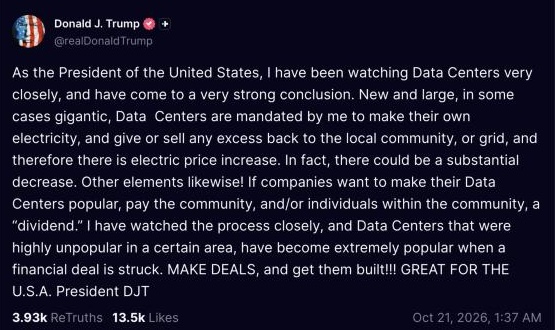
· @realDonaldTrumpThe post we're checking
As the President of the United States, I have been watching Data Centers very closely, and have come to a very strong conclusion. New and large, in some cases gigantic, Data  Centers are mandated by me to make their own electricity, and give or sell any excess back to the local community, or grid, and therefore there is electric price increase. In fact, there could be a substantial decrease. Other elements likewise! If companies want to make their Data Centers popular, pay the community, and/or individuals within the community, a “dividend.” I have watched the process closely, and Data Centers that were highly unpopular in a certain area, have become extremely popular when a financial deal is struck. MAKE DEALS, and get them built!!! GREAT FOR THE U.S.A. President DJT
Screenshot of the post on Truth Social. Shown for commentary.
Read the post as text
As the President of the United States, I have been watching Data Centers very closely, and have come to a very strong conclusion. New and large, in some cases gigantic, Data Centers are mandated by me to make their own electricity, and give or sell any excess back to the local community, or grid, and therefore there is electric price increase. In fact, there could be a substantial decrease. Other elements likewise! If companies want to make their Data Centers popular, pay the community, and/or individuals within the community, a “dividend.” I have watched the process closely, and Data Centers that were highly unpopular in a certain area, have become extremely popular when a financial deal is struck. MAKE DEALS, and get them built!!! GREAT FOR THE U.S.A. President DJT
Posted Oct 21, 202613,559 likes and 3,942 ReTruths on Truth Social as of Nov. 2See the original

The bottom line

We found no federal rule making data centers generate their own power, and the nearest thing, a pledge, is voluntary. Do they raise your bill? On the PJM grid, yes, by available estimates. Elsewhere, studies conflict and other costs loom larger. Brown's Ohio ad has the direction right. Talarico's Texas ad claims a cause we couldn't find measured on bills.

The claims

What the post says or clearly implies, checked one by one. How verdicts work

1

New and large data centers "are mandated by me to make their own electricity" and give or sell any excess.

Wrong

We found no federal order, rule or law that does this. The March pledge says companies "will voluntarily negotiate" rates, and its terms let them buy power rather than make it.

The closest thing is the Ratepayer Protection Pledge of March 4. It has companies "build, bring, or buy" power, so buying new-plant power counts1. Trump's best evidence is that day's proclamation. It says companies "must pay" their full costs and calls the pledge national policy. Seven companies accepted, and in July the White House said more than 200 more joined2,3. The proclamation names no penalty or enforcer. "Compliance is not being monitored or enforced by anyone," Harvard's Ari Peskoe told FactCheck.org, which reached the same ruling on Oct. 294.

The White House's list of presidential actions, read Nov. 2, shows no data center order since Oct. 21, and a Federal Register search of executive orders since Oct. 1 finds none5,6. Bisnow called it "unclear" whether executive action would come7.

Twelve days before the post, FERC rejected most of PJM's plan to have new large loads bring capacity or face curtailment, calling key parts outside its authority or unjustified8. The GRID Act would require off-grid power for new data centers. It hasn't left committee9,4.
2

So "there is electric price increase" (apparently meaning no increase), and "could be a substantial decrease."

Misleading

The promise leans on a mandate that doesn't exist, and PJM customers already pay billions more because of data centers, by the monitor's estimate. Bring-your-own power and cost-covering deals can help, and real prices have fallen in places.

As posted, the sentence says "there is electric price increase." The next sentence only makes sense if "no" was intended, and Bisnow marked it "(sic)"10,7. We rule on that reading.

PJM, serving more than 65 million people, is the counterexample4. Its market monitor calls data center growth "the primary reason" for high capacity prices and attributes to it $7.27 billion in 2026/27 and $6.50 billion in 2027/2811. Those are market-wide wholesale charges, not household bills. Capacity is about 10% to 20% of a bill4.

Elsewhere the record is mixed. LBNL and Brattle found high-growth states usually saw real prices fall from 2019 to 2025, though the link is weaker for households12. Energy Secretary Chris Wright said data centers "almost always" come with "a multiyear freeze," as FactCheck.org quoted him4. By the same standard, that's misleading too. Some deals promise freezes, by the White House's account, and PJM shows the opposite3.

3

Not in the post. Brown's Ohio ad: "no one here is getting a damn thing from it except higher electric bills."

Missing context

Ohio is on PJM, and the higher-bills part holds up. But data centers are one cause among several, and capacity costs spread across the region. We did not test the ad's claim that nobody gets anything else.

The ad's line comes from Sherrod Brown's Senate campaign13. Ohio home electricity averaged 12.38 cents per kWh in 2019 and 16.90 in 2025. That's up 36.5%, or 8.4% after inflation, by our calculation14,15. Through August 2026 it ran 13.0% above a year earlier, against 6.8% nationally and 3.3% inflation, by our calculation16,15. Sanya Carley told FactCheck.org capacity costs added about $16 a month in Ohio, with an estimated 63% due to data centers4.

That's roughly $10 a month, by our arithmetic. The monitor's own deck says "not all" of the capacity increase came from data centers, and LBNL calls capacity prices "one but not the only" contributor17,12. Gas and grid upkeep matter too4.

PJM's capacity costs fall on customers across the market, so a bill doesn't trace to one nearby center11. AEP Ohio's tariff makes new data centers above 25 MW pay for at least 85% of subscribed capacity, which guards against underused wires, not PJM capacity charges18. We did not test the ad's tax claims or Ohio's jobs and revenue.

4

Not in the post. Talarico's Texas ad: data centers mean Texans are "paying the price with skyrocketing utility bills."

Unsupported

Texas home electricity prices rose about as fast as the nation's, and ERCOT has no PJM-style capacity market19. We found no estimate of a data center share of Texas bills. Transmission costs could change that.

Talarico's ad targets Ken Paxton20. Texas home power went from 11.76 cents in 2019 to 15.40 in 2025: up 31.0%, or 4.0% after inflation. The U.S. rose 32.4%, or 5.2%14,15. Through August 2026, Texas ran 5.6% above a year earlier, below the nation's 6.8% but above 3.3% inflation16,15. These are electricity prices per kWh, not total utility bills.

A preliminary Dallas Fed working paper modeled data centers adding under $1 per MWh to ERCOT wholesale prices ($1.24 in its high case), despite the region's second-most data centers21. That excludes wires. FactCheck.org's experts said it's "not entirely clear" but that large increases "would not be expected" in the same way4.

The ad's case is in those wires. ERCOT's market monitor says transmission costs fall on existing ratepayers, and that large flexible customers can avoid their "fair share" of a Permian plan costing "more than $13 billion" that also serves oil and gas19. Texas's SB 6 makes loads above 75 MW contribute to interconnection costs18. We did not test the ad's tax-break or donation claims.

Texas home power prices rose about as fast as the nation's

10121416182019202020212022202320242025

Mostly the ERCOT grid. Cents per kWh, residential.

Average residential price in cents per kWh, not adjusted for inflation, from EIA14. By our calculation with BLS's CPI, 2019 to 2025 increases were Texas 31.0% (4.0% real), U.S. 32.4% (5.2%) and Ohio 36.5% (8.4%)15. Prices alone don't show cause.
Show the numbers
Texas home power prices rose about as fast as the nation's: the numbers
YearTexasUnited StatesOhio
201911.7613.0112.38
202011.7113.1512.29
202112.1113.6612.77
202213.7615.0413.85
202314.461615.38
202414.9416.4815.99
202515.417.2316.9

The real disagreement

Facts can't settle this part, so we don't rule on it.

Should data centers keep building while contracts and tariffs sort out who pays, or should binding rules come first, even if that slows projects?

PJM versus elsewhere is a rough map. Virginia, on PJM, rose just 0.5% after inflation from 2019 to 2025, and LBNL says vertically integrated utilities are partly shielded. Oregon, outside PJM, rose 11.5%. North Dakota fell 8.9%, by our calculation14,15,12. Through August 2026 the picture shifts: Virginia ran 13.0% above a year earlier, Oregon 0.6% and North Dakota 6.8%16. National studies point different ways. An MIT working paper, not peer-reviewed, finds residential rates up 2.1% from 2010 to 2024, about $3.21 a month, and 5.2% at investor-owned utilities. It says future effects could be larger, or "smaller, zero, or negative"22. A preprint led by EPRI researchers, an institute FactCheck.org describes as largely utility-funded, finds rates fell modestly, about 6% for a customer with average data center growth from 2019 to 2024 (its estimate using only those years is about half that), and warns that supply constraints "could reverse the effect"23,4. Neither sample reaches the 2025 PJM jump. Looking ahead, the Dallas Fed working paper models wholesale prices rising 20% to 50% through 2028, depending on how much gets built and how heavily it runs21.

Build, and make them pay by contract

Grids are mostly fixed costs, so durable new demand can lower rates when customers pay their way. PJM's problem is scarce supply, and the fix is more of it.

Spread fixed costs over more kilowatt-hours and average rates can fall. The EPRI preprint estimates residential rates fell as data center capacity grew from 2015 to 202423. LBNL and Brattle tie growth to lower real average prices in most high-growth states12.

PJM is the exception, and it argues for faster supply. Columbia's Douglas Arent says that market is being driven by "anticipated data center load, not real data center load"4. The market monitor itself wants new data center load to bring its own generation11. Deals show the alternative. The White House cites NiSource arrangements set to return at least $1.4 billion to Indiana customers over 15 years, and a Georgia base-rate freeze through 20293. AI infrastructure was about 0.8% of U.S. GDP in early 202624. Stopping it wouldn't touch gas prices or aging wires.

Binding rules first, then build

Households are already carrying this risk. Pledges can't protect them, so write enforceable rules on who pays, and slow projects on tight grids until those rules exist.

PJM's market monitor attributes $29.4 billion, or 46.2% of capacity charges over four auctions running through 2028/29, to data center load, and says data centers should "pay for their own capacity"17. Where data centers entered, MIT's working paper finds residential rates up 5.2% at investor-owned utilities, about $7 a month22.

Harvard researchers reviewing nearly 50 regulatory proceedings warn that secret contracts "could be transferring" Big Tech's energy costs to the public25. Against that stands a pledge whose companies "voluntarily negotiate"1. Past studies may also undersell the risk. Peskoe calls them "largely irrelevant" because today's sites use "10 to 100x more electricity"4. Binding terms can be written: the Hawley-Blumenthal GRID Act, as introduced, requires off-grid power for new data centers and sets civil penalties of at least $1 million a day9. A narrower rule on who pays would delay only projects leaning on other customers.

Where they agree

  • Both sides say data centers should cover the costs they cause, and the White House pledge, the House-passed Ratepayer Protection Act and the GRID Act all start from that idea1,4.
  • Much of the decision will land with state utility commissions, whatever Washington does4,26.

What would change minds

  • Studies with 2025 and 2026 data, by grid, separating measured data center costs from gas and grid upkeep, would replace today's estimates.
  • A Texas estimate of how much transmission spending traces to data centers, and who pays it, would settle the Talarico question.
  • Bills in places with new large-load tariffs, compared with similar places without them, would test whether contracts protect households.

Sources

Every source was opened and read. Advocacy groups are labeled as such.

Show all 26 sources
  1. 1
    Ratepayer Protection Pledge
    The White House2026-03-04Primary document
  2. 2
    Ratepayer Protection Pledge Proclamation
    The White House2026-03-04Primary document
  3. 3
    President Trump's Ratepayer Protection Pledge Secures American AI Dominance, Protects Consumers
    The White House2026-07-23Primary documentThe White House's own account of company and utility deals
  4. 4
  5. 5
    Presidential Actions (list, read Nov. 2, 2026)
    The White HousePrimary document
  6. 6
  7. 7
  8. 8
    FERC Accepts Elements of PJM Proposal Tied to Large Loads, Rejects Others
    American Public Power AssociationJournalismTrade group for public utilities. Quotes FERC's Oct. 9 order in Docket ER26-3515
  9. 9
    S. 3852, GRID Act (119th Congress), as introduced
    U.S. Government Publishing Office2026-02-11Primary document
  10. 10
  11. 11
    Analysis of the 2027/2028 RPM Base Residual Auction, Part A
    Monitoring Analytics, PJM's independent market monitor2026-01-05Primary document
  12. 12
    Retail Electricity Price Trends and Drivers: Data Update, 2026 Edition, July update (slides 51, 52, 54)
    Lawrence Berkeley National Laboratory and Brattle (archived copy, Internet Archive)2026-07ResearchFederal lab and a consulting firm. The lab's own server blocks automated downloads, so we read and link the archived copy
  13. 13
  14. 14
    Electricity retail sales: annual residential price by state, 2019–2025
    U.S. Energy Information AdministrationDataEIA's public data API, using its demonstration key
  15. 15
    Consumer Price Index for All Urban Consumers, U.S. city average, not seasonally adjusted (CUUR0000SA0)
    U.S. Bureau of Labor StatisticsDataAnnual averages (tick "include annual averages" on the page): 255.657 (2019), 321.943 (2025). January to August averages, our calculation: 321.050 (2025), 331.655 (2026)
  16. 16
    Electric Power Monthly, Table 5.6.B: price by state, year to date through August 2026 and 2025
    U.S. Energy Information Administration2026-10-23DataThis page updates monthly. We read the August 2026 data
  17. 17
    Market Monitoring Report, presentation to the PJM Members Committee
    Monitoring Analytics, via PJM2026-07-27Primary document
  18. 18
  19. 19
    2025 State of the Market Report for the ERCOT Electricity Markets
    Potomac Economics, ERCOT's independent market monitor2026Primary document
  20. 20
  21. 21
    Processing Power: The Effect of Data Centers on Wholesale Electricity Markets (Working Paper 2606)
    Federal Reserve Bank of Dallas2026-03-17ResearchPreliminary working paper. Models wholesale prices only
  22. 22
    Who Pays for Growth? Evidence from Data Centers and the Grid (CEEPR WP 2026-13, revised)
    MIT Center for Energy and Environmental Policy Research2026-10-23ResearchWorking paper by Meeks, Pless, Qi and Wang. CEEPR says it posts papers without peer review
  23. 23
    Have Data Centers Raised Your Electric Bill? Causal Evidence from the United States
    arXiv2026-06-18ResearchUnreviewed preprint. Two of its three authors work at EPRI, which FactCheck.org describes as largely funded by electric utilities
  24. 24
    The AI boom has doubled computing infrastructure's share of US GDP
    Epoch AI2026-06-05ResearchAI research nonprofit
  25. 25
    Extracting Profits from the Public: How Utility Ratepayers Are Paying for Big Tech's Power
    Harvard Electricity Law Initiative2025-03ResearchMartin and Peskoe. Predates the pledge and many recent large-load tariffs
  26. 26

Think we got something wrong? Email editor@viewfromthegallery.com with a source. Corrections are made openly and logged on the page.