Read the post as text
🚨 BREAKING: Montana has now completely banned corporate spending in politics. Republicans are now suing to reverse it. [The post attaches a photo of a smiling man beside a blue panel with the word MONTANA and the state seal.]
I-194 reaches nonprofits and, backers say, unions too. It starts Jan. 1, and the state GOP and four conservative groups have sued to stop it.
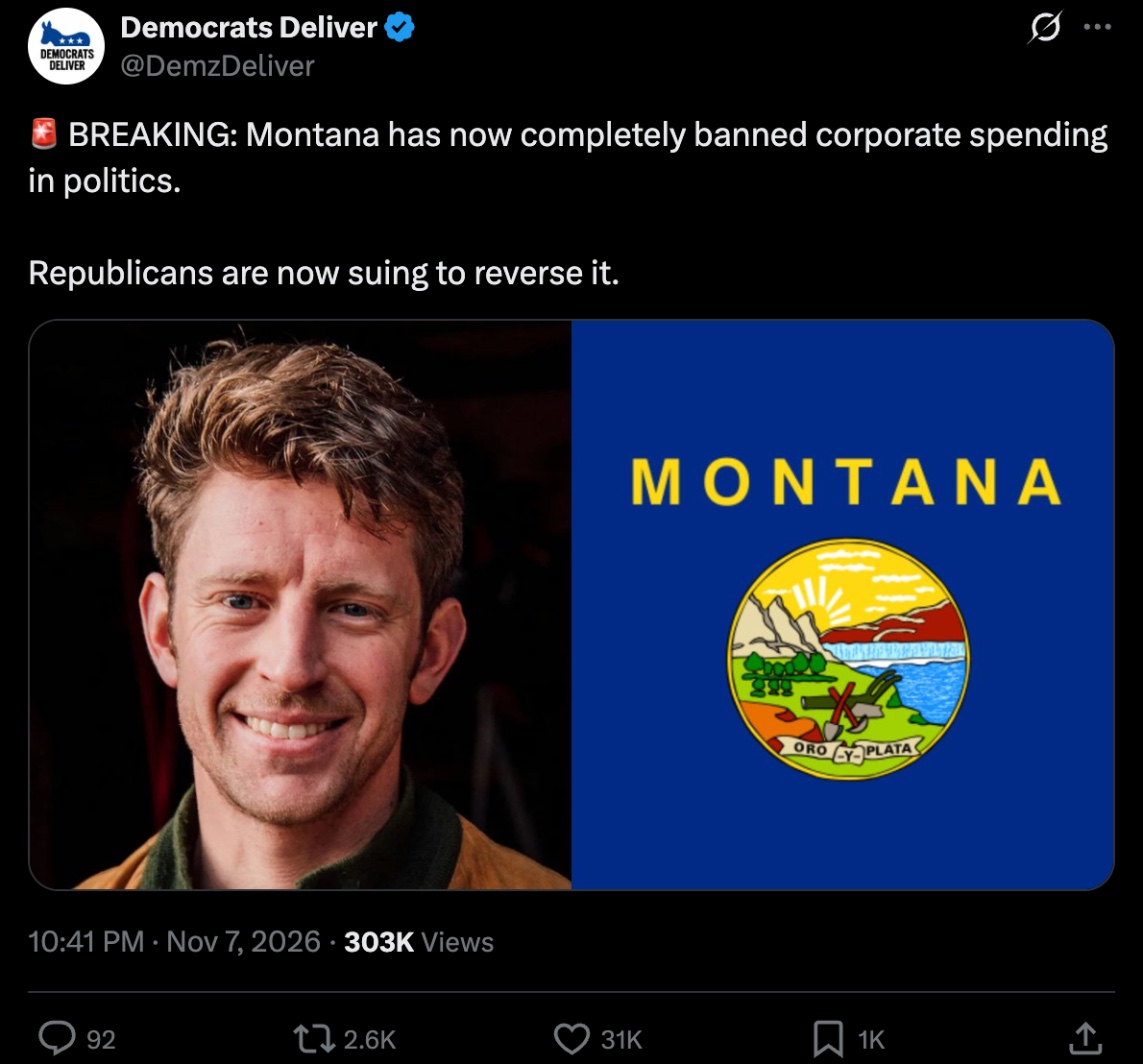
🚨 BREAKING: Montana has now completely banned corporate spending in politics. Republicans are now suing to reverse it. [The post attaches a photo of a smiling man beside a blue panel with the word MONTANA and the state seal.]
Montana voters approved I-194 on Nov. 3, about 65 percent to 35. Starting Jan. 1, it would strip corporations, nonprofits, unions and other entities of the power to spend on Montana elections. The state Republican Party and four conservative nonprofits have sued to block it. The real fight is over Citizens United: whether groups' election spending is protected speech.
What the post says or clearly implies, checked one by one. How verdicts work
Voters did approve a sweeping limit that reaches nonprofits and unions too. But it doesn't take effect until Jan. 1, its backers say it leaves lobbying alone, and the Supreme Court struck down Montana's last corporate spending ban in 2012.
I-194 passed 302,179 to 159,491, about 65.5 percent unofficially1. A state board certifies within 27 days2. The law takes effect Jan. 1, 20273.
It covers nonprofits, trusts, trade associations, unincorporated associations and out-of-state entities doing business in Montana3, and, its backers say, unions4. It bars their spending on Montana candidates, parties, committees and ballot measures. Backers say that includes federal races and money passed through PACs4. Individuals aren't covered3. Backers say lobbying isn't either4. It works by removing election spending from the powers Montana grants these entities. Violators forfeit every privilege Montana grants them, including limited liability, and the spending is void. Out-of-state entities keep what their home states grant3.
Montana voters banned corporate spending on candidates by initiative in 19125. In 2012 the U.S. Supreme Court struck that law down, 5–4, saying there could be "no serious doubt" that Citizens United applied6. Backers say a charter rule is a different tool7. No court has yet ruled on the merits. Hawaii's version is in federal court8,9.
The Montana Republican Party is one of five plaintiffs in a federal suit, filed on election night, that asks a judge to block I-194 and declare it void. The other four plaintiffs are conservative nonprofits.
The suit, Frontier Institute v. Knudsen, was filed in federal court in Helena at 11:15 p.m. on Nov. 39,10. Some outlets reported Nov. 4, but the court's stamp reads Nov. 310. The plaintiffs are the Montana Republican State Central Committee and four conservative nonprofits: the Frontier Institute, Frontier Action Fund, Montana Family Institute and Montana Family Foundation10.
Its five counts, brought by lawyers from the Institute for Free Speech and Valley Law, say I-194 violates the First Amendment's speech, association, assembly, petition and press protections and is overbroad and vague. It calls the law "flatly unconstitutional" under Citizens United and asks for preliminary and permanent injunctions10,11. The defendants are Attorney General Austin Knudsen, whose office must defend the law though he opposed putting it on the ballot, and Secretary of State Christi Jacobsen8.
Industry groups also petitioned the state Supreme Court before the vote12. The Montana Chamber of Commerce says it also sued and the court ruled the case "could not yet proceed" and that it expected "to bring the case back later"13.
Facts can't settle this part, so we don't rule on it.
Should groups like corporations and unions be free to spend their own money on elections, or should that be left to people spending theirs?
I-194's backers say it "takes a different legal approach" from the limits Citizens United struck down in 20109. The challengers' lawyers answer that "calling censorship a restriction on corporate privileges doesn't make it constitutional"11.
Corporations and other entities exist by the state's permission, and their treasuries shouldn't steer elections that belong to voters.
Corporations "are not actually members" of society, Justice John Paul Stevens wrote in his Citizens United dissent. "They cannot vote or run for office"14. Montana learned the cost early: in 1899 copper magnate W.A. Clark won a U.S. Senate seat from the legislature by bribing legislators, a Senate committee concluded5.
Dark money spending in federal elections grew "from less than $5 million in 2006 to more than $1 billion in the 2024 presidential elections alone," the Brennan Center found15. When the Court struck Montana's law, Justice Breyer wrote that Montana's experience "casts grave doubt" on the idea that independent spending doesn't corrupt6. And the state never had to grant that power in the first place: "nowhere in any case did it ever say that a state has to give the capacity to spend in politics," said Tom Moore, whose work helped inspire the plan9.
Corporations and unions are associations of people, and silencing the group silences the people in it.
"If the First Amendment has any force," Justice Kennedy wrote for the Citizens United majority, "it prohibits Congress from fining or jailing citizens, or associations of citizens, for simply engaging in political speech." Most corporations it reached were small ones "without large amounts of wealth"16. The ACLU said the answer to money in politics is not to ban political speech. It noted the ruling also protected nonprofits like Planned Parenthood and the NRA17.
I-194 reaches "nonprofits, trade associations, cooperatives, and other civic groups, even unincorporated associations," the challengers' lawyers note, and Montana-based groups face harsher penalties than out-of-state ones11. The state party says even its newsletter could be swept in18. Curbing corporate money wouldn't stop ultra-wealthy donors spending alone12. "Montana cannot condition the privilege of doing business in Montana on the loss of First Amendment rights," the industry groups' petition argued12.
Every source was opened and read. Advocacy groups are labeled as such.
Think we got something wrong? Email editor@viewfromthegallery.com with a source. Corrections are made openly and logged on the page.
New breakdowns in your inbox: what was true, what wasn't, and what the argument is really about. No ads, no spin.