Read the post as text
Just thinking about the remarkable fact that Elon Musk will have dropped nearly a half a billion dollars on this election with no return... wow.
Federal filings show Musk gave about $446 million through Oct. 14, nearly all of it to help Republicans. Democrats won the House and Senate anyway.
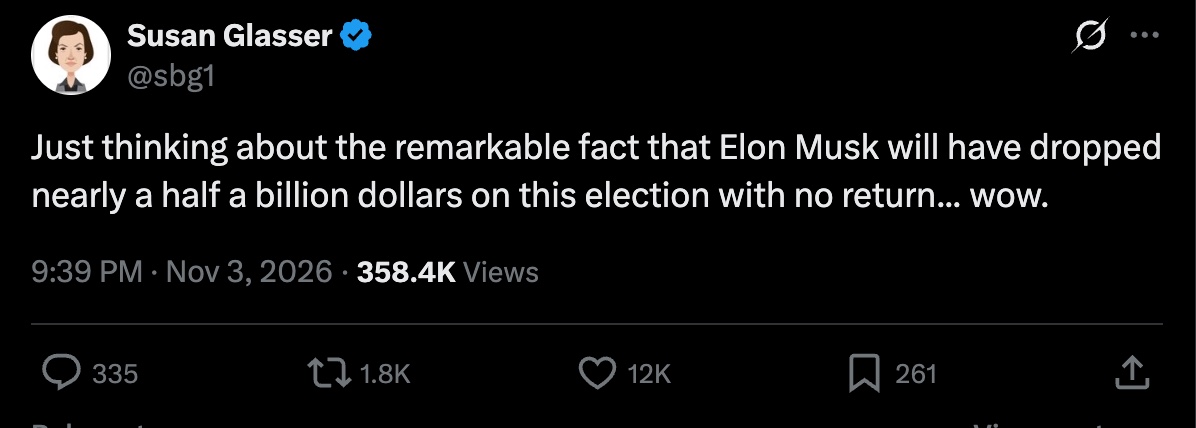
Just thinking about the remarkable fact that Elon Musk will have dropped nearly a half a billion dollars on this election with no return... wow.
Glasser is right on both counts. Federal filings show Musk gave $445.6 million this cycle through Oct. 14, by our count, and the New York Times counts $474 million. He spent to keep Republicans in charge of Congress. Democrats won both chambers, and Ken Paxton, whom he backed with more than $200 million in Texas, lost.
What the post says or clearly implies, checked one by one. How verdicts work
Federal filings show Musk gave $445.6 million to political committees from January 2025 through Oct. 14, by our calculation. Counts that add state races and other groups reach $474 million.
The total counts what Musk gave, in cash and about $38 million in in-kind help attributed to him. What groups spent is a separate number. Filings with the Federal Election Commission show about $216 million to America PAC, his own super PAC, $168 million to the Senate Leadership Fund and $30 million to its House counterpart, the Congressional Leadership Fund. With smaller gifts, that's $445.6 million through Oct. 14, by our calculation1. OpenSecrets has $445.5 million, more than three times the next-largest individual donor2.
The New York Times, adding state races and other groups, counted $474 million and called it "almost certainly an undercount"3. CNBC says "at least $474 million"4.
The totals start in January 2025, so they include $48.2 million Musk gave America PAC that year, by our calculation, when it spent about $47 million on a Wisconsin court race1,3. Gifts dated 2026 alone come to $372 million, by our calculation1.
By our calculation from FEC filings, rounded to the dollar. Includes in-kind gifts reported by America PAC. Leaves out memo entries for gifts passed through WinRed, which would double-count, and one duplicate $17,425 entry. Excludes money to state campaigns and to groups that don't file with the FEC.
| Month | Running total, dollars |
|---|---|
| Jan. 2025 | 0 |
| Feb. 2025 | 8,204,737 |
| March 2025 | 14,849,137 |
| April 2025 | 18,126,462 |
| May 2025 | 18,126,462 |
| June 2025 | 60,476,061 |
| July 2025 | 60,476,061 |
| Aug. 2025 | 60,876,061 |
| Sept. 2025 | 60,876,061 |
| Oct. 2025 | 60,876,061 |
| Nov. 2025 | 60,876,061 |
| Dec. 2025 | 73,355,768 |
| Jan. 2026 | 83,355,768 |
| Feb. 2026 | 83,355,768 |
| March 2026 | 84,997,216 |
| April 2026 | 84,997,216 |
| May 2026 | 89,997,216 |
| June 2026 | 90,463,814 |
| July 2026 | 93,963,814 |
| Aug. 2026 | 144,263,814 |
| Sept. 2026 | 368,830,184 |
| Oct. 2026 | 445,612,189 |
Musk money backed candidates in 106 House and Senate races. By 2:30 a.m., 18 had won, all in seats Republicans were expected to hold. Another 44 had lost and 44 were uncalled. His central aims, Congress and Texas, both failed.
Musk's pinned X post warned that Democratic wins in the midterms and 2028 would mean "the end of democracy in any meaningful sense of the word"5. Glasser posted at 9:39 p.m. Eastern6, hours before AP's House call at 1:27 a.m.7, so it was a forecast.
Texas got the most. He gave the Senate Leadership Fund $158 million in September, and it passed matching sums to a super PAC backing Paxton1,5. Forbes, adding America PAC's spending and $10 million to another pro-Paxton PAC, puts his Texas total at $215 million5. Paxton lost8. Of the nearly $87 million America PAC spent on 44 federal races, CNBC found 93% went to races Republicans lost4.
Forbes's 2:30 a.m. count found 18 wins, "all in seats Republicans were expected to win anyway"5. Forbes reports Musk also gave $10 million to the Republican Governors Association and $2 million to a group backing Republican attorneys general. Republicans had won 6 of 22 competitive governor races and 1 of 11 attorney general races, with 6 and 7 still uncalled5.
Facts can't settle this part, so we don't rule on it.
Is unlimited election spending by the very rich free speech that voters can weigh for themselves, or outsized influence that should be limited?
Since 2010, court rulings have let individuals give unlimited sums to super PACs that spend independently of candidates9,10. Super PACs name their donors, but nonprofits that give to them needn't name theirs2. Both parties' top super PACs depend on big checks. Donors giving $1 million or more supplied $4.2 billion to super PACs this cycle, more than 70% of what they raised11. Conservative groups did 53% of the cycle's $4.09 billion in outside spending, and liberal groups 43%12.
Independent spending is political speech, and disclosure lets voters judge it, as they did this week.
The Supreme Court held in 1976 that restricting some voices "to enhance the relative voice of others is wholly foreign to the First Amendment"13. Because the Supreme Court had held that independent spending can't buy a candidate's favors, gifts to groups that only spend independently "cannot corrupt," a federal appeals court ruled in 20109. The safeguard is disclosure, which lets voters "give proper weight to different speakers and messages"10.
Musk outgave every donor, and his side lost both chambers5. Michael Bloomberg spent $936 million on a 2020 presidential run that ended after Super Tuesday14. A House-rematch study found spending "has an extremely small impact on election outcomes, regardless of who does the spending"15. Limits protect incumbents, who get attention free while challengers must buy it. And the access studies critics cite measure capped gifts to candidates, not ads voters can see and reject16.
Even when its candidates lose, unlimited money buys the very rich access and sway that voters don't have, and it should be limited for everyone.
Political equality means one citizen's money shouldn't drown out millions of voices. The line between donor and campaign is thin. The Senate Leadership Fund passed Musk's $158 million to a super PAC backing one candidate, Paxton1,5. When a field experiment told congressional offices that constituents were donors, "senior policy makers made themselves available between three and four times more often"16. Across 1,779 policy issues, economic elites had "substantial independent impacts" while average citizens had "little or no independent influence"17.
Money also works as a threat. In 2025, Musk said members of Congress "who campaigned on reducing government spending" and then voted for Trump's bill would "lose their primary next year if it is the last thing I do on this Earth"18. Limits should bind big donors on the left as well. In 2023, 72% of Americans said there should be limits on campaign spending19.
Every source was opened and read. Advocacy groups are labeled as such.
Think we got something wrong? Email editor@viewfromthegallery.com with a source. Corrections are made openly and logged on the page.
New breakdowns in your inbox: what was true, what wasn't, and what the argument is really about. No ads, no spin.