Read the post as text
BREAKING: Senate Republicans voted to continue Donald Trump's war with Iran AGAIN. Americans want this war to end NOW. It's time for Republicans in Congress to listen.
Warren has the vote right, and polls favor ending it. The White House calls such resolutions nonbinding, and strikes resumed after one passed in June.
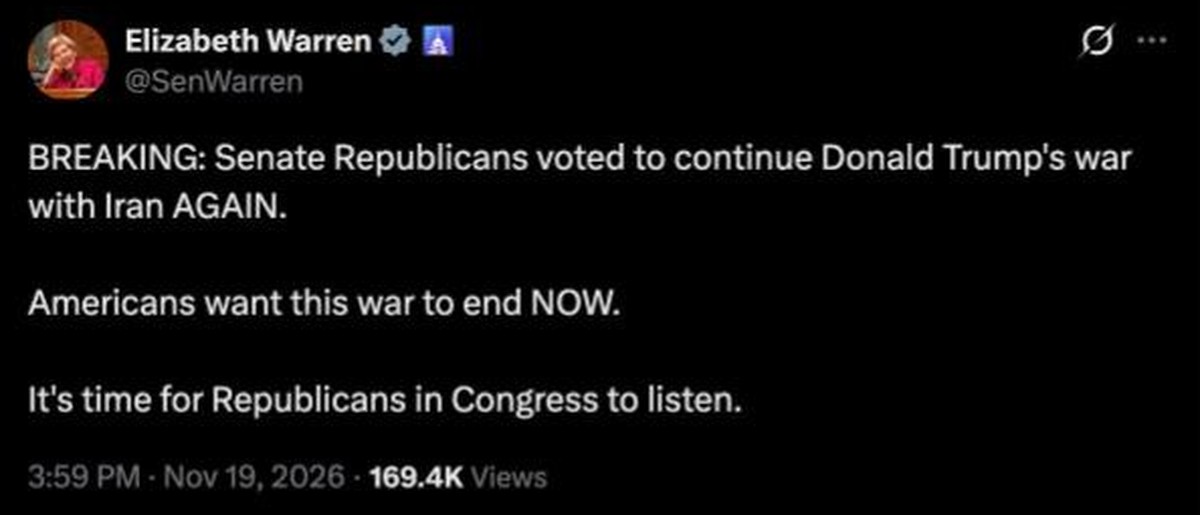
BREAKING: Senate Republicans voted to continue Donald Trump's war with Iran AGAIN. Americans want this war to end NOW. It's time for Republicans in Congress to listen.
Fifty of 53 Republicans voted down a measure directing Trump to withdraw from Iran hostilities, the Senate's 13th failed Iran war powers vote this year by our count1,2. Most Americans want the war ended3. But the White House says such resolutions lack legal force4, and U.S. strikes resumed in July after one passed in June5.
What the post says or clearly implies, checked one by one. How verdicts work
Fifty of 53 Republicans voted no, and the measure failed 48-51. But it was a concurrent resolution, which the White House says lacks the force of law. Congress passed one in June, and U.S. strikes resumed in July.
H.Con.Res. 93, from Rep. Seth Moulton, would have directed the president to remove U.S. forces from hostilities with Iran, except those needed against imminent attack6,7. Collins, Murkowski and Paul voted yes. Fetterman voted no, and Chris Murphy didn't vote1. Tillis and Cassidy, who backed earlier measures, voted no8,9.
A concurrent resolution never goes to the president. The 1973 War Powers Resolution says one can order troops out, but CRS notes a later Supreme Court decision called that into question10. That was INS v. Chadha, in 198311. The White House says such measures lack the force of law and should be deemed "unconstitutional legislative vetoes"4. No court has ruled11. Both chambers adopted one in June12. By late July, U.S. strikes were answering Iranian missile attacks on U.S. forces5.
"War" fits the record. Congress never authorized it13. The administration's own statement on this resolution cites "the ongoing international armed conflict with Iran"4, and U.S. jets struck an Iranian missile site on Nov. 1714.
By our count, it was the Senate's 15th vote this year on ending U.S. hostilities with Iran, 12 of them procedural motions. Thirteen failed. One motion passed in May, and a House resolution was adopted in June.
Senate records list Iran war powers roll calls from March 4 through Nov. 192. None drew more than 50 yes votes. A May 19 motion passed 50-47 with three Republicans absent, and that bill stalled after Trump met with GOP senators8,15. On June 23 the Senate adopted a House concurrent resolution, H.Con.Res. 86, by 50-488.
Three failed by a single vote, 49-50: May 13, July 30 and Sept. 24, when Tillis voted yes2,16. Fetterman voted no on all 15. Paul voted yes on all but two: he voted present June 24 and didn't vote July 238,1. A June 2025 Iran measure, before this war began, failed 47-5317.
Most do want it ended: 71% in a November Reuters/Ipsos poll want Congress to pass a law ending it, including 51% of Republicans. But neither poll we found asked about an immediate withdrawal.
Warren's post cites no poll18. The Reuters/Ipsos poll of 1,705 adults, finished Nov. 9, found 93% of Democrats in favor of legislation ending the war3.
A YouGov poll for Eurasia Group's Institute for Global Affairs, taken Oct. 29 to Nov. 2, found 56% would rather avoid higher prices even if U.S. military goals in Iran aren't fully met. Twenty-two percent would put the goals first. Republicans leaned the other way, 50% to 32%19.
In the same poll, 53% said Congress, not Trump, should have the final say on ending the war. Sixty percent of Republicans said Trump should19.
Facts can't settle this part, so we don't rule on it.
Should Congress force an end to a war the president began without its approval, or leave its conduct to the commander in chief while U.S. forces are under fire?
Congress never voted to authorize this war13, and the Pentagon put its cost at $48.3 billion as of Nov. 1320. The split is over who decides when it ends.
The Constitution gives Congress the war power, polls show most Americans want the war ended, and the Senate should say so plainly.
Congress never voted for this war, and the War Powers Resolution lets it order forces out of unauthorized hostilities10,13. Kaine called it "a costly and illegal war in Iran that has led to the death and injury of Americans, higher gas prices, and a depleted munitions stockpile"21. More than 100 international law experts called its start "a clear violation" of the UN Charter22.
No court has held a section 5(c) resolution void. Lawfare argues that even a nonbinding one is clear evidence of congressional opposition, which undercuts the executive branch's own legal case for acting alone11. Voters made the war's unpopularity "absolutely manifestly clear" on Nov. 3, Kaine said15, and 71% want Congress to end it3. "Nine months in, defunding the war is the only way to force Trump to end it," said Sen. Tammy Duckworth9.
The president has the constitutional duty to defend U.S. forces, and a vote to withdraw in the middle of a conflict would embolden Iran, the White House says.
The administration says the president has Article II authority to defend Americans and keep Iran from getting a nuclear weapon, given "the ongoing international armed conflict with Iran"4. It says such resolutions "lack the force of law" and are unconstitutional legislative vetoes under INS v. Chadha4. Risch says every president of both parties has refused to call the War Powers Act constitutional23. State's top lawyer calls it lawful self-defense22.
In June the White House said an "imminent attack" exception would keep the president from disrupting attack preparations24. It says this resolution would embolden Iran4. Iran attacked Bahrain three times in under a week before the Nov. 17 U.S. strike25. Sen. Tim Sheehy said the U.S. should "finish the job, protect this nation and protect our allies"26. Tillis, a no vote, called it "just a statement from Congress" he'd already made20.
Every source was opened and read. Advocacy groups are labeled as such.
Think we got something wrong? Email editor@viewfromthegallery.com with a source. Corrections are made openly and logged on the page.
New breakdowns in your inbox: what was true, what wasn't, and what the argument is really about. No ads, no spin.