Child safety · California · Transportation

California's 2027 booster rule is real. It's a seat belt fit test.

From 2027, kids 8 through 15 need a child seat or booster unless the seat belt passes a five-step fit test.

· @Brendan_Duke · on XThe post we're checking
Didn’t realize California passed this until my brother in law told me just now.

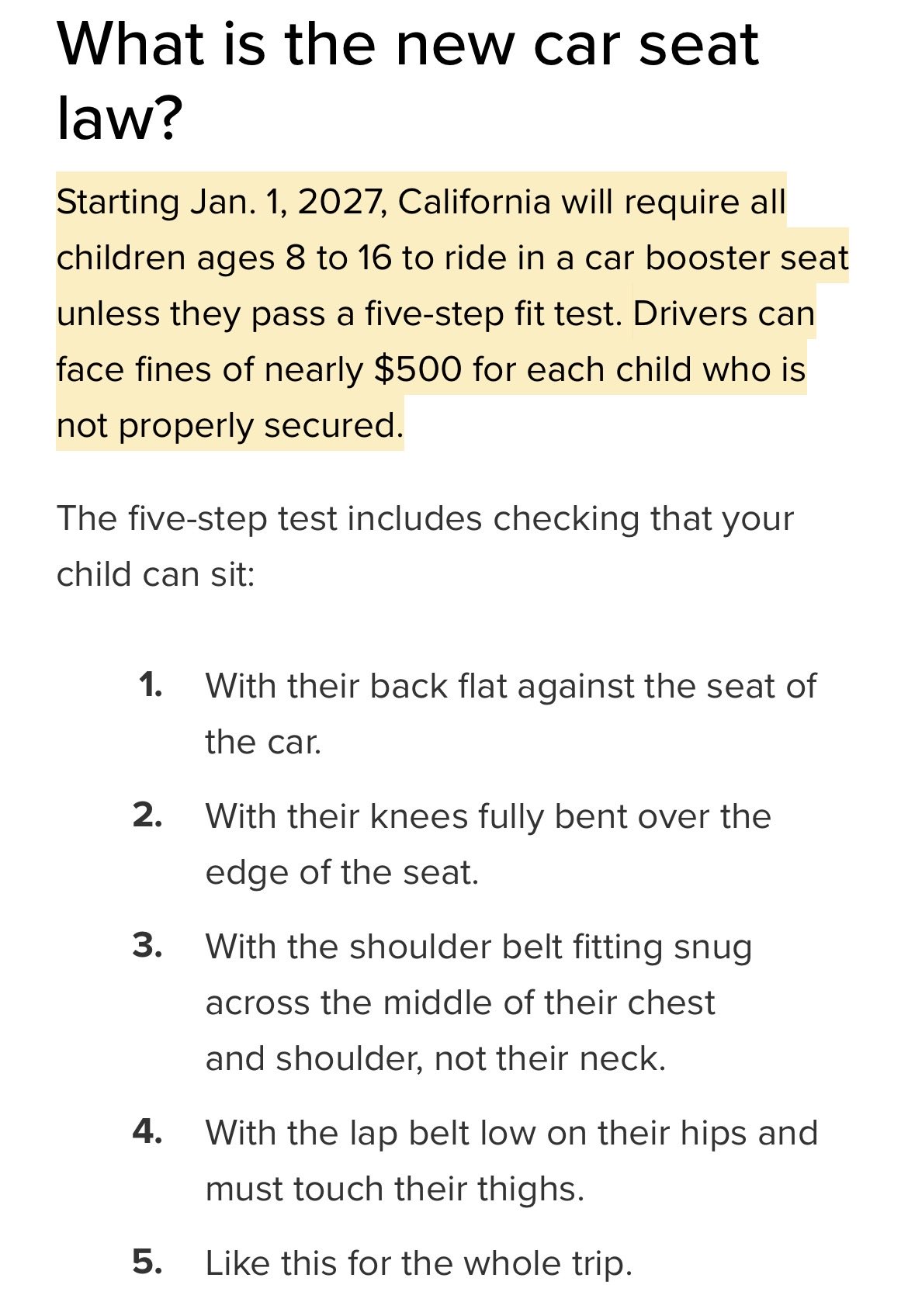
[Attached: a screenshot of a UC Davis Health web page headed "What is the new car seat law?" with this text highlighted: "Starting Jan. 1, 2027, California will require all children ages 8 to 16 to ride in a car booster seat unless they pass a five-step fit test. Drivers can face fines of nearly $500 for each child who is not properly secured." Below it, the page lists the five steps.
Image attached to @Brendan_Duke's post on X: a screenshot of a UC Davis Health blog post (November 2026). Shown for commentary.
Read the post as text
Didn’t realize California passed this until my brother in law told me just now. [Attached: a screenshot of a UC Davis Health web page headed "What is the new car seat law?" with this text highlighted: "Starting Jan. 1, 2027, California will require all children ages 8 to 16 to ride in a car booster seat unless they pass a five-step fit test. Drivers can face fines of nearly $500 for each child who is not properly secured." Below it, the page lists the five steps.]
Posted Nov 25, 2026About 4.13M views, 6,623 likes and 657 reposts on X as of Nov. 28, 2026. Duke, a former Biden-Harris National Economic Council staffer, has about 10,800 followers.See the original

The bottom line

The screenshot, from a UC Davis Health blog, gets the law mostly right. From 2027, kids 8 through 15 must ride in a booster or other child seat unless the belt passes a five-step test1. A first ticket runs about $485 with fees2. The test is belt fit, not height.

The claims

What the post says or clearly implies, checked one by one. How verdicts work

1

From Jan. 1, 2027, California requires kids 8 to 16 to ride in a booster seat unless they pass a five-step fit test.

Missing context

Close. The law already covers kids 8 through 15. What's new in 2027 is a five-step belt-fit test1. Height isn't the test, but more than 9 in 10 kids top 4'9" by 13 (our math, CDC charts)3.

AB 435, signed in October 2025, rewrites Vehicle Code 27360.5 starting Jan. 1, 2027. A child "eight years of age or older, but less than 16" must ride in a child passenger restraint system "or unless the child or ward is properly restrained by a safety belt," which now means passing all five steps1.

The age range isn't new, and "8 to 16" is how CalMatters put it too4. Current law covers 8- to 15-year-olds but only asks that the belt meet federal standards1. The first version would have required boosters for every child under 10. Lawmakers dropped that and a front-seat ban4.

Pediatricians say most children won't fit a belt alone until 10 to 125. By our calculation from CDC's 2000 growth charts, the median child passes 4 feet 9 inches between 11 and 123. Alaska already requires boosters for kids 4 through 15 "who are either shorter than 57 inches or who weigh more than 20 but less than 65 pounds," per IIHS6.
2

Drivers can face fines of nearly $500 for each child who is not properly secured.

Missing context

About $485 for a first offense is right: a $100 base fine plus penalty assessments and fees in the courts' 2026 schedule7,2. The sources we read don't show that courts count each child separately.

The fine isn't new. It already applies to 27360.5 violations today7. A second offense carries a $250 base fine7. The schedule lists only the first-offense line, so our estimate of roughly $1,100 assumes the same penalty rates and fees apply to a $250 base2. The $485 includes a $40 court operations fee and a $35 conviction assessment. Counties with a night court add $1, making it $486, and the schedule lists one point on the driver's record2. An older Office of Traffic Safety page and CalMatters say $4908,4.

Courts can reduce or waive the fine for defendants who show they are economically disadvantaged and complete a car seat class7. The rule applies to a parent, guardian or driver, but a driver is off the hook when a parent rides along as a passenger1. The statute is written around "a child or ward," and UC Davis Health says the fine applies "for each child"1,9. The sources we read don't show how courts count several children in one car.

The real disagreement

Facts can't settle this part, so we don't rule on it.

Should state law decide when a child is big enough for a seat belt alone, with a fine behind it, or should parents?

Duke's post10 drew a quote post from Katie Miller, a podcaster married to White House chief of staff Stephen Miller, who wrote that "the fastest way to kill the birth rate is mandating more car seats"11,12. Snopes confirmed the post was hers12. A 2024 Journal of Law and Economics paper found car seat laws reduced births of third children, and it predates California's law13. We don't rule on her post here.

Belt fit, not a birthday, should decide

Adult belts don't fit most young children, boosters prevent injuries, and a clear legal test gets parents to keep kids in them.

Seat belts are built for a 165-pound adult man, the CHP says14. In a study of more than 7,000 children in crashes, kids 4 to 8 in boosters had 45% lower injury risk than those in belts alone15. Pediatricians say most children won't fit a belt alone until 10 to 125. In a 2014 Safe Kids survey of 1,000 parents of booster-age children, 9 in 10 had moved their child out of a booster before belts fit16.

AAA says federal regulators and the state health department promote the test, which the bill's author says accounts for each car's interior17. AAA clubs, a children's hospital and a juvenile products trade group backed the original bill, with no opposition on file at its first hearing17. The final version passed the Senate unanimously4. Sixty percent of fines fund local health department education and assistance programs7.

Parents should judge, and mandates have costs

The evidence for boosters covers younger kids, the test hands officers a judgment call, and each new car seat rule makes raising kids harder.

The booster study covers children 4 to 8, not preteens15. The fifth step asks whether a child "can stay seated like this for the whole trip," which a parent judges better than an officer at the roadside1. The author said that once the original bill drew attention, people started saying they didn't want their 10-year-olds in boosters, and its first Assembly vote fell short, 35 votes to the 41 needed4.

Car seat rules carry real costs. Economists Jordan Nickerson and David Solomon estimated that car seat mandates reduced births by about 8,000 in 2017 because many cars can't fit three seats in back, while preventing an estimated 57 child deaths13. Miller says car seats make motherhood "significantly more complicated and difficult"11. A first ticket costs a family about $4852.

Where they agree

  • Seat belts are made for adults, and a booster raises a child so the belt fits over the strongest parts of the body5.
  • The Legislature dropped the original bill's front-seat ban and booster rule for every child under 10, and the final version passed the Senate unanimously4.

What would change minds

  • Crash studies comparing injuries for 9- to 12-year-olds in boosters and in belts alone.
  • California data after 2027 on tickets issued under the new test and on injuries to children 8 to 15.

Sources

Every source was opened and read. Advocacy groups are labeled as such.

Show all 17 sources
  1. 1
    AB 435 (Wilson), Vehicles: child passenger restraints. Chapter 434, Statutes of 2025
    California Legislative Information2025-10-07Primary documentChaptered text. Section 6 adds the version of Vehicle Code 27360.5 that takes effect Jan. 1, 2027.
  2. 2
    Uniform Bail and Penalty Schedules, 2026 edition
    Judicial Council of California (Superior Court of Plumas County copy)2026Primary documentLists Vehicle Code 27360.5(a) at a $100 base fine and $485 total bail for a first offense (including $40 court operations and $35 conviction assessment), with one DMV point. Its sample calculation gives $486 with a $1 night court assessment. The 2025 edition lists the same $485.
  3. 3
    CDC growth charts: stature-for-age data, ages 2 to 20
    Centers for Disease Control and PreventionData2000 reference charts. Heights converted from centimeters by us. Share taller than 57 inches is our calculation from the L, M and S columns: about 93% of boys and 96% of girls at 13 years. At exactly 13 years (interpolated between the 155.5- and 156.5-month rows), the 10th percentile is about 57.5 inches for boys and 58.4 for girls. The median passes 57 inches between 11 and 12.
  4. 4
  5. 5
    Car Seats: Information for Families
    American Academy of Pediatrics (HealthyChildren.org)ResearchGuidance from the national association of pediatricians.
  6. 6
    Seat belt and child seat laws
    Insurance Institute for Highway Safety2026-11DataInsurer-funded safety research group.
  7. 7
    California Vehicle Code, Article 3.3 (Sections 27360, 27360.5 and 27360.6)
    California Legislative InformationPrimary document27360.6 sets the fines: $100 for a first offense, $250 for a second or later one.
  8. 8
    Click It or Ticket
    California Office of Traffic SafetyPrimary documentOlder page; its text appears to date from about 2018. CalMatters links to it for its $490 figure.
  9. 9
    California's 2027 booster seat laws and what parents should know about the new rules
    UC Davis Health, Cultivating Health blog2026-11Primary documentThe source of the screenshot in Duke's post. Hospital system blog, reviewed by a certified child passenger safety technician. Its summary box and text say "ages 8 to 16."
  10. 10
    Post with screenshot of UC Davis Health blog
    Brendan Duke (@Brendan_Duke) on X2026-11-25Primary document
  11. 11
    Quote post replying to Brendan Duke
    Katie Miller (@KatieMiller) on X2026-11-25Primary documentAbout 2.89M views as of Nov. 28, 2026.
  12. 12
  13. 13
    Car Seats as Contraception
    Journal of Law and Economics (Jordan Nickerson and David Solomon)2024Research
  14. 14
    Child Safety Seats
    California Highway PatrolPrimary document
  15. 15
    Effectiveness of belt positioning booster seats: an updated assessment
    Pediatrics (Arbogast, Jermakian, Kallan and Durbin, Children's Hospital of Philadelphia)2009-11ResearchChildren 4 to 8 in rear seats, crashes from 1998 to 2007. Adjusted relative risk of injury in boosters vs. belts alone: 0.55.
  16. 16
    Many kids using safety belts should ride in booster seats
    Insurance Institute for Highway Safety2014-11ResearchInsurer-funded safety research group, reporting a 2014 Safe Kids Worldwide online survey of 1,000 parents of booster-age children.
  17. 17
    Bill analysis, AB 435 as introduced, hearing of March 24, 2025
    California Assembly Committee on Transportation2025-03-24Primary documentAnalyzes the original, broader bill. Includes the author's statement and the list of registered support.

Think we got something wrong? Email editor@viewfromthegallery.com with a source. Corrections are made openly and logged on the page.