Immigration · Economy

Mass deportation wouldn't cut prices. One model sees narrow pay gains

A viral list says deporting everyone would raise wages and cut the cost of living. We checked four items on it, not the attached video.

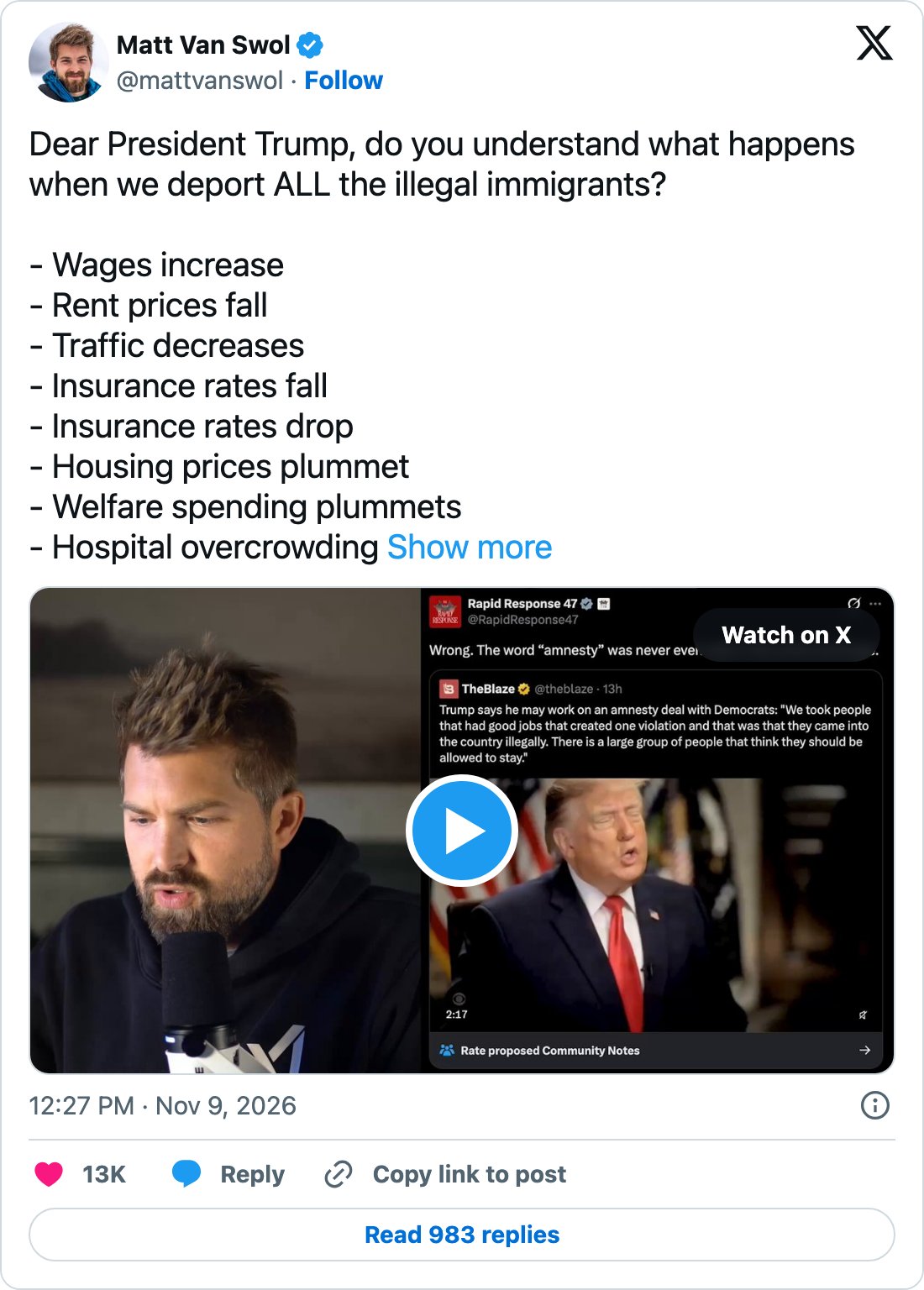
· @mattvanswol · on XThe post we're checking
Dear President Trump, do you understand what happens when we deport ALL the illegal immigrants?

- Wages increase
- Rent prices fall
- Traffic decreases
- Insurance rates fall
- Insurance rates drop
- Housing prices plummet
- Welfare spending plummets
- Hospital overcrowding eases
- Crime dramatically decreases
- Classrooms become less crowded
- Teenagers can get good jobs again
- Court systems become less burdened
- Competition for starter homes drops
- Emergency rooms become less strained
- Nearly all prices on everything drops
- All government services are less strained

Literally every single thing in life gets better for Americans if you just deport them all…

NO AMNESTY!!!!!
Screenshot of the post on X. Shown for commentary.
Read the post as text
Dear President Trump, do you understand what happens when we deport ALL the illegal immigrants? - Wages increase - Rent prices fall - Traffic decreases - Insurance rates fall - Insurance rates drop - Housing prices plummet - Welfare spending plummets - Hospital overcrowding eases - Crime dramatically decreases - Classrooms become less crowded - Teenagers can get good jobs again - Court systems become less burdened - Competition for starter homes drops - Emergency rooms become less strained - Nearly all prices on everything drops - All government services are less strained Literally every single thing in life gets better for Americans if you just deport them all… NO AMNESTY!!!!!
Posted Nov 9, 2026122.4K views, 13.4K likes and 4,104 reposts on X as of Nov. 10See the original

The bottom line

One model projects mass deportation would lower average pay, with gains for legal workers without college. Forecasts see prices rising. Fewer renters can ease rents a little, but a study of an earlier enforcement program found home prices rose as builders left. Welfare spending wouldn't plummet: most programs already bar immigrants in the country illegally.

The claims

What the post says or clearly implies, checked one by one. How verdicts work

1

Deporting all immigrants in the country illegally would raise wages and let teenagers get good jobs again.

Misleading

One model projects a 5.0% raise by 2034 for legal workers with a high school diploma or less, if removals continue, and losses for others. Past enforcement programs lifted low-wage pay in places but cut US-born employment in better-paid jobs.

Penn Wharton modeled removing all "unauthorized" immigrants, including DACA and TPS holders, over 10 years. Legal workers with a high school diploma or less gain 5.0% by 2034 and 4.7% by 2054, "only if the deportation policy is permanently sustained." Workers with some college lose 1.5% by 2034 and 2.8% by 2054, and the average wage falls 0.4%, then 1.7%1. George Borjas found the 1980 Mariel boatlift cut Miami dropouts' pay 10% to 30%, a disputed finding2.

Actual enforcement programs raised low-wage pay in some places but cut US-born employment in better-paid jobs3,4. Where 2025's ICE surges hit, a working paper finds 1.3% fewer US-born men without college working, and no higher wages5,6.

Since outflows began, real hourly pay fell about 0.5% in the year to September amid an energy spike, and teen unemployment averaged 14.4% over the past year, versus 12.7% in 2024, by our calculation7,8,9. The Center for Immigration Studies counts 1.4 million more native-born workers from January 2025 to June 2026, but warns its survey links native and immigrant counts "mechanically"10.
2

Rent prices would fall and housing prices would plummet.

Misleading

Fewer people can ease rents a little, studies show. "Plummet" overshoots every estimate. After an earlier enforcement program, home prices rose as builders left. Since outflows began, rent growth has slowed and lately trailed inflation. No index shows a plunge.

Albert Saiz found immigration equal to 1% of a city's population raises rents and home values about 1%11. Fed economists credit unauthorized immigrant workers with about 20% of market-rent growth from March 2021 to March 2024 in the average local market. For the median metro, they call it "relatively modest"12.

Removals also take builders. Foreign-born workers were 26.3% of construction workers in 202413. A study of counties under Secure Communities found home prices first dipped 2% to 4%. By year three, as homebuilding fell, they were about 10% higher than in counties not yet covered14.

Net unauthorized migration turned negative by February 202512. CPI rent outpaced overall prices every month through February 2026. In the year to September it rose 2.78%, above core inflation but below the overall rate, by our calculation15,16. Apartment List's rents, which fell for over three years amid a "historic surge in multifamily construction," are up 0.1%, "still declining in inflation-adjusted terms"17. Home prices rose 2.1% to 2.4% in the year to August but fell in real terms18,19.

Rent growth cooled, then leveled off, after net outflows began

After net outflows began0%2%4%6%8%10%20192020202120222023202420252026Rent peak, Mar. 2023: 8.8%Feb. 2025: 4.1%Sept. 2026: 2.8%

Percent change from the same month a year earlier, CUUR0000SEHA, rounded to 0.01.

Year-over-year change in CPI rent and all items, unadjusted, our calculation from BLS data15,16. October 2025 missing. CPI rent lags new leases. Shading: net unauthorized migration negative (Dallas Fed, data through July 2025). Brookings expects total net migration to be very low or negative in 202612,22.
Show the numbers
Rent growth cooled, then leveled off, after net outflows began: the numbers
MonthRentAll items
Jan. 20193.4%1.6%
Feb. 20193.5%1.5%
March 20193.7%1.9%
April 20193.8%2.0%
May 20193.7%1.8%
June 20193.9%1.6%
July 20193.8%1.8%
Aug. 20193.7%1.8%
Sept. 20193.8%1.7%
Oct. 20193.7%1.8%
Nov. 20193.7%2.0%
Dec. 20193.7%2.3%
Jan. 20203.8%2.5%
Feb. 20203.8%2.3%
March 20203.7%1.5%
April 20203.5%0.3%
May 20203.5%0.1%
June 20203.2%0.7%
July 20203.1%1.0%
Aug. 20203.0%1.3%
Sept. 20202.7%1.4%
Oct. 20202.7%1.2%
Nov. 20202.5%1.2%
Dec. 20202.3%1.4%
Jan. 20212.0%1.4%
Feb. 20212.0%1.7%
March 20211.8%2.6%
April 20211.8%4.2%
May 20211.8%5.0%
June 20211.9%5.4%
July 20211.9%5.4%
Aug. 20212.1%5.3%
Sept. 20212.4%5.4%
Oct. 20212.7%6.2%
Nov. 20213.0%6.8%
Dec. 20213.3%7.0%
Jan. 20223.8%7.5%
Feb. 20224.2%7.9%
March 20224.4%8.5%
April 20224.8%8.3%
May 20225.2%8.6%
June 20225.8%9.1%
July 20226.3%8.5%
Aug. 20226.7%8.3%
Sept. 20227.2%8.2%
Oct. 20227.5%7.8%
Nov. 20227.9%7.1%
Dec. 20228.3%6.5%
Jan. 20238.6%6.4%
Feb. 20238.8%6.0%
March 20238.8%5.0%
April 20238.8%4.9%
May 20238.7%4.0%
June 20238.3%3.0%
July 20238.0%3.2%
Aug. 20237.8%3.7%
Sept. 20237.4%3.7%
Oct. 20237.2%3.2%
Nov. 20236.9%3.1%
Dec. 20236.5%3.4%
Jan. 20246.1%3.1%
Feb. 20245.8%3.1%
March 20245.7%3.5%
April 20245.4%3.4%
May 20245.3%3.3%
June 20245.1%3.0%
July 20245.1%2.9%
Aug. 20245.0%2.5%
Sept. 20244.8%2.4%
Oct. 20244.6%2.6%
Nov. 20244.4%2.8%
Dec. 20244.3%2.9%
Jan. 20254.2%3.0%
Feb. 20254.1%2.8%
March 20254.0%2.4%
April 20254.0%2.3%
May 20253.8%2.4%
June 20253.8%2.7%
July 20253.5%2.7%
Aug. 20253.5%2.9%
Sept. 20253.4%3.0%
Nov. 20253.0%2.7%
Dec. 20252.9%2.7%
Jan. 20262.8%2.4%
Feb. 20262.7%2.4%
March 20262.6%3.3%
April 20262.8%3.8%
May 20262.9%4.3%
June 20262.8%3.5%
July 20262.9%3.4%
Aug. 20262.8%3.4%
Sept. 20262.8%3.7%
3

Nearly all prices on everything would drop.

Wrong

None of the forecasts we found project prices falling. Models treat mass removal as a supply shock that pushes prices up. The best case for any price drop covers housing alone.

The Peterson Institute modeled deporting 8.3 million workers and found the price level 9.6% higher by 2028. It calls even a 1.3 million removal "a classic supply shock, where prices rise and output falls"20. The Labor Department warned in 2025 that the near halt in illegal immigration, with too few legal workers, was "threatening the stability of domestic food production and prices." In a 2021–22 survey, about 42% of crop workers lacked work authorization21.

A Brookings analysis expects only a small effect on inflation, since people who leave also stop buying things22. Steven Camarota of the Center for Immigration Studies links a 5-point rise in a metro's recent-immigrant share to rents 12% higher relative to US-born households' income. He says the link needs "more analysis"23.

None of the eight major consumer price groups fell in the year to September. Overall prices rose 3.74%, by our calculation from BLS data. Without food and energy they rose 2.56%, while energy jumped 20.45% amid Middle East oil disruptions16,24.

4

Welfare spending would plummet.

Wrong

Immigrants in the country illegally are barred from federal SNAP, SSI, TANF and non-emergency Medicaid. Many households get benefits, often through US-citizen children. The Center for Immigration Studies, which favors less immigration, puts it at 4% of eight programs' costs.

Federal law bars immigrants in the country illegally from "most federal benefits," with exceptions such as emergency medical care25. Emergency Medicaid for noncitizens cost $3.8 billion in fiscal 2023, 0.4% of Medicaid spending26.

The Center for Immigration Studies estimates 59% of households headed by immigrants in the country illegally use a welfare program, including on behalf of US-born children. It puts the cost at about $42 billion in 2021, 4% of the eight programs it studied23. FAIR, which also favors less immigration, counts $13.6 billion in welfare. Add its medical lines and it's about $55 billion, by our calculation27.

Penn Wharton projects about $9 billion a year in federal savings, including on emergency Medicaid, after four years of removals. Its 10-year scenario, deporting everyone, still adds about $862 billion to primary deficits before economic feedback, from lost taxes and new enforcement spending1.

The real disagreement

Facts can't settle this part, so we don't rule on it.

How far should the US go to remove immigrants in the country illegally, and should long-settled ones get a path to legal status?

The post ends "NO AMNESTY!!!!!"28. The facts above don't settle this. They put a price on removal. Pew counts 14 million "unauthorized" immigrants in 2023, its term, and about 6 million of them had some protection from deportation, such as a pending asylum claim29. MPI counts about 980,000 deportations from January 2025 through July 2026, including about 340,000 people turned back at the border30.

Enforce the law fully, no amnesty

Laws that go unenforced invite more lawbreaking, and the workers who compete with immigrants pay the price.

The 1986 law legalized about 2.7 million people. Washington "was unsuccessful in enforcing employer sanctions vigorously," and by 2007 the unauthorized population hit 12 million. Critics said the law raised "the incentive for people to migrate in hopes of future amnesties"31. Meanwhile 4,034,061 people waited on State Department visa lists in 2023, following the rules32.

The costs of low-skilled immigration land on the least-paid. Borjas writes that a 10% rise in workers with a given skill set "probably lowers the wage of that group by at least 3 percent." High school dropouts' earnings "dropped by between $800 and $1,500 each year," he estimates, part of a transfer "from the native losers to the native winners" of "roughly a half-trillion dollars a year"33. Since enforcement rose, the labor-force share of prime-age US-born men without college is up from 84.3% to 85%, CIS finds, with survey caveats10.

Legalize long-settled immigrants, with conditions

Most have lived here for years, so aim enforcement at the border and at crime, and give the rest earned legal status.

Most immigrants in the country illegally aren't recent arrivals. MPI found 45% had lived here 20 years or more as of mid-202334. About 4.6 million US-born children lived with an unauthorized immigrant parent in 202329. Penn Wharton puts removal at $70,236 per person, with GDP 3.3% lower by 20341.

Legal status pays. CBO scored the 2013 Senate bill, which paired legalization with more legal immigration, at net savings of about $175 billion over 10 years35. A study of the 1986 law found legalization raised the wages of those legalized about 6%36. Supporters blame 1986's weak enforcement, and its lack of legal routes for low-skilled workers, for its failure31. They want status tied to working employment checks. And Fed economists find recent inflows raised local employment "approximately one-for-one, without significant declines in local wages"12.

Where they agree

  • Both sides agree the 1986 law's employer checks were weakly enforced31.
  • Borjas and Penn Wharton agree that any wage gains from fewer immigrants go mainly to workers without college1,33.

What would change minds

  • Wage and job data for US-born workers without college through 2027, by how hard enforcement hit each area, would test the wage claim on both sides5,10.
  • A study of rents and building costs in the metro areas that lost the most residents since 2025 would show which housing effect wins.
  • A clean count of departures would let everyone measure the effects, since DHS claims more than 3 million and MPI estimates 790,000 to 1.9 million departures of people here at least a year, including lawfully present immigrants30.

Sources

Every source was opened and read. Advocacy groups are labeled as such.

Show all 36 sources
  1. 1
    Mass Deportation of Unauthorized Immigrants: Fiscal and Economic Effects
    Penn Wharton Budget Model2025-07-25ResearchNonpartisan budget model at the University of Pennsylvania
  2. 2
    The Wage Impact of the Marielitos: A Reappraisal
    NBER (George J. Borjas)2015-09ResearchPublished in ILR Review, 2017. Other economists dispute the finding
  3. 3
  4. 4
    The Labor Market Effects of Immigration Enforcement
    Journal of Labor Economics (East, Hines, Luck, Mansour and Velásquez)2023Research
  5. 5
    Labor Market Impacts of ICE Activity in Trump 2.0
    NBER (Cox and East)2026-04ResearchWorking Paper 35129, revised June 2026
  6. 6
    Heightened ICE enforcement harms U.S.-born workers, shrinks workforce
    CU Boulder Today2026-05-04JournalismUniversity news release on the Cox and East paper
  7. 7
    Average Hourly Earnings of All Employees, Total Private (CES0500000003)
    BLS via FRED2026-11-06DataSeasonally adjusted. September 2026 revised to $37.86 on Nov. 6
  8. 8
    Consumer Price Index for All Urban Consumers: All Items (CPIAUCSL)
    BLS via FRED2026-10-14DataSeasonally adjusted. We deflate hourly pay by this index
  9. 9
    Unemployment rate, 16–19 years (LNS14000012)
    U.S. Bureau of Labor Statistics API2026-11DataSeasonally adjusted. No October 2025 data. Our averages: Jan.–Dec. 2024 and the 12 latest months, Nov. 2025–Oct. 2026
  10. 10
    Has Immigration Enforcement Benefitted American Workers?
    Center for Immigration Studies2026-07-09Advocacy / think tankThink tank that favors lower immigration
  11. 11
    Immigration and housing rents in American cities
    Journal of Urban Economics (Albert Saiz), via RePEc2007Research
  12. 12
    The Impacts of Unauthorized Immigration on U.S. Labor and Housing Markets: New Evidence from Administrative Microdata
    Federal Reserve Bank of Dallas (Wilson, San Francisco Fed, and Zhou, Dallas Fed)2026-03ResearchWorking Paper 2607. Outflow data run through July 2025
  13. 13
    Which States and Construction Trades Depend the Most on Immigrant Workers?
    National Association of Home Builders, Eye on Housing2026-04-06Advocacy / think tankHome builders' trade group. Counts all foreign-born workers, legal or not
  14. 14
    Cracking Down, Pricing Up: Housing Supply in the Wake of Mass Deportation
    Howard, Wang and Zhang (ABFER conference paper)2024-10ResearchWorking paper
  15. 15
    CPI-U: Rent of primary residence (CUUR0000SEHA)
    U.S. Bureau of Labor Statistics API2026-10-14DataNot seasonally adjusted. No October 2025 data
  16. 16
    CPI-U: all items and major groups
    U.S. Bureau of Labor Statistics API2026-10-14DataNot seasonally adjusted. Groups: CUUR0000SAF, SAH, SAA, SAT, SAM, SAR, SAE, SAG; energy SA0E; all items less food and energy SA0L1E
  17. 17
    National Rent Report
    Apartment List2026-10-28DataRental listing site. November 2026 report (October data)
  18. 18
  19. 19
  20. 20
    The International Economic Implications of a Second Trump Presidency
    Peterson Institute for International Economics (McKibbin, Hogan and Noland)2024-09ResearchWorking Paper 24-20. Nonpartisan economics think tank that generally favors open trade
  21. 21
  22. 22
    Macroeconomic implications of immigration flows in 2025 and 2026: January 2026 update
    Brookings Institution2026-01-13ResearchCentrist think tank. Authors from Brookings and the American Enterprise Institute
  23. 23
    Testimony of Steven A. Camarota before the House Oversight Committee
    Center for Immigration Studies, via House Oversight Committee2024-09-25Advocacy / think tankThink tank that favors lower immigration
  24. 24
    Short-Term Energy Outlook, October 2026
    U.S. Energy Information Administration2026-10DataArchived edition
  25. 25
    Unauthorized Immigrants' Eligibility for COVID-19 Relief Benefits: In Brief
    Congressional Research Service2020-05-07ResearchCRS report R46339, via EveryCRSReport. Dated May 7, 2020, before the 2025 reconciliation law changed some immigrants' eligibility
  26. 26
    Less Than 1% of Total Medicaid Spending Goes to Emergency Care for Noncitizen Immigrants
    KFF2024-10-04ResearchHealth policy research group, summarizing CBO data
  27. 27
    The Fiscal Burden of Illegal Immigration on United States Taxpayers, 2023 Cost Study
    Federation for American Immigration Reform2023-03-08Advocacy / think tankGroup that favors lower immigration. Its population count, 15.5 million, includes DACA recipients and parolees
  28. 28
    Dear President Trump, do you understand what happens when we deport ALL the illegal immigrants?
    Matt Van Swol on X2026-11-09Primary documentCommentator who describes himself as a former Energy Department nuclear scientist. Post includes a 13-minute video we did not check
  29. 29
  30. 30
    U.S. Deportations and "Self-Deportations" in the First 18 Months of the Second Trump Term
    Migration Policy Institute (Marc R. Rosenblum)2026-10ResearchNonpartisan immigration think tank
  31. 31
    At Its 25th Anniversary, IRCA's Legacy Lives On
    Migration Policy Institute2011-11-16ResearchNonpartisan immigration think tank
  32. 32
  33. 33
    Yes, Immigration Hurts American Workers
    Politico Magazine (George J. Borjas)2016-09JournalismOpinion essay by a Harvard economist
  34. 34
    Changing Origins, Rising Numbers: Unauthorized Immigrants in the United States
    Migration Policy Institute2025-10ResearchNonpartisan immigration think tank. Data as of mid-2023
  35. 35
    Cost Estimate: S. 744, Border Security, Economic Opportunity, and Immigration Modernization Act
    Congressional Budget Office (Wayback Machine copy)2013-06-18Primary documentSavings include the bill's large increase in legal immigration, not legalization alone
  36. 36
    Coming out of the Shadows: Learning about Legal Status and Wages from the Legalized Population
    Journal of Labor Economics (Kossoudji and Cobb-Clark), via EconPapers2002Research

Think we got something wrong? Email editor@viewfromthegallery.com with a source. Corrections are made openly and logged on the page.