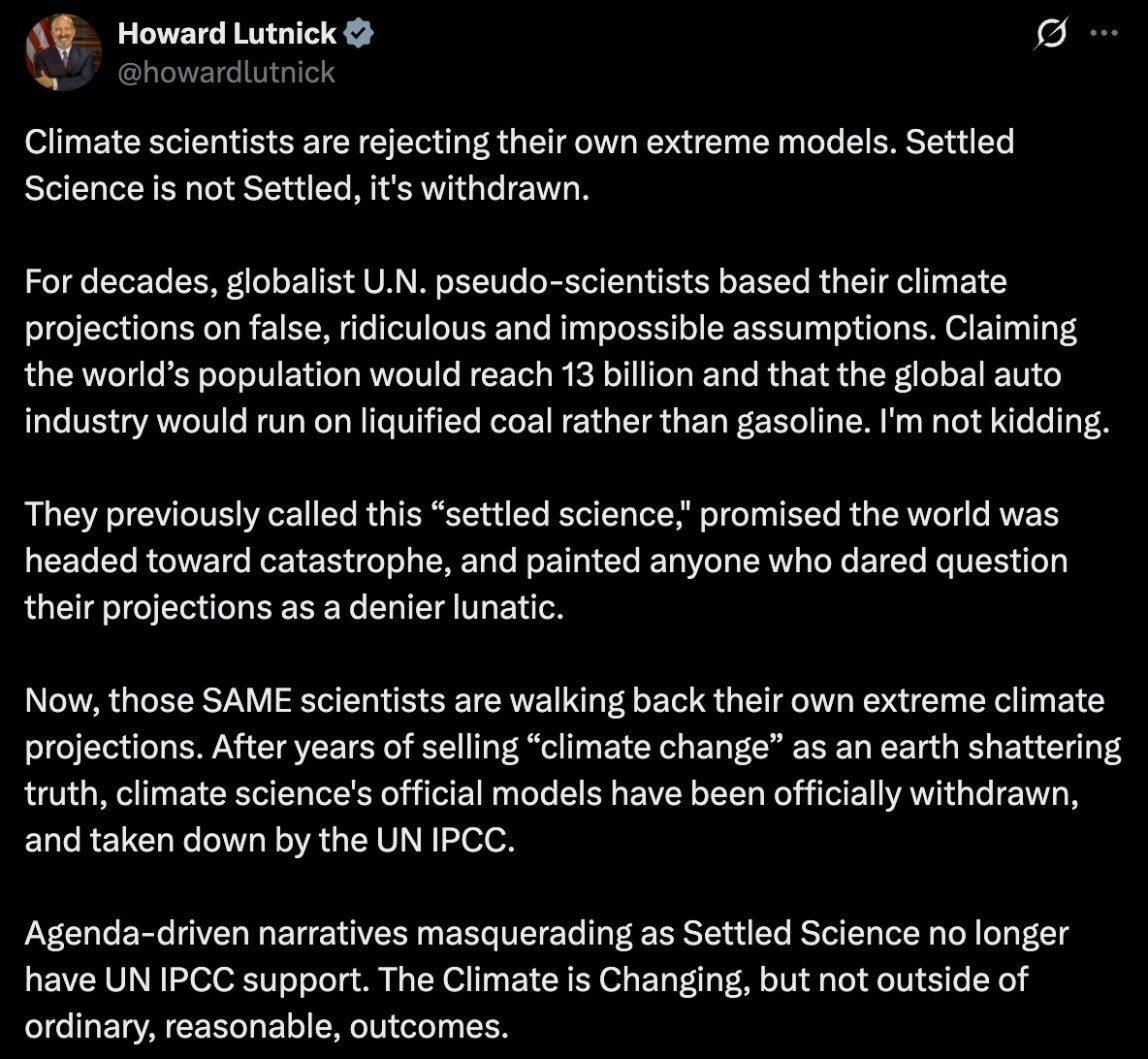
Scenario designers replaced their whole set in April and called SSP5-8.5 "implausible," citing renewable costs, climate policy and recent emission trends1. Their new High case, which assumes a policy rollback, still warms about 3.3°C by 21006.
In the paper's words, "the CMIP6 high emission levels (quantified by SSP5-8.5) have become implausible, based on trends in the costs of renewables, the emergence of climate policy and recent emission trends." At the other end, "many CMIP6 emission trajectories have become inconsistent with observed trends during the 2020–2030 period"1. The paper calls only SSP5-8.5 implausible. But SSP3-7.0, which Lutnick also lists7, has no equal in the new set either. "The entire CMIP6 'high' tier" now sits above anything in the new set6.
Co-author Chris Smith told Carbon Brief that RCP8.5 became implausible because "we've actually bent the curve"5. Fossil CO2 emissions were 38.6 billion tonnes in 2024, before subtracting a small cement carbonation sink. That is about 15% below the 45.6 billion on the RCP8.5 path, by our conversion of the published data8,9.
The 3.3°C is the median of Carbon Brief's runs of the FaIR climate emulator, measured from 1850–1900, with a range of 2.6°C to 4.4°C6. Van Vuuren also called the "business as usual" label some papers gave RCP8.5 "incorrect"5.