Read the post as text
So let me get this straight. Paying 20% of your paycheck for health insurance is good, but paying 5% of your paycheck for universal healthcare would be bad? Do I have that right?
Family premium deductions take about 12% of median full-time pay. The 5% figure leaves out the payroll tax that comes with it.
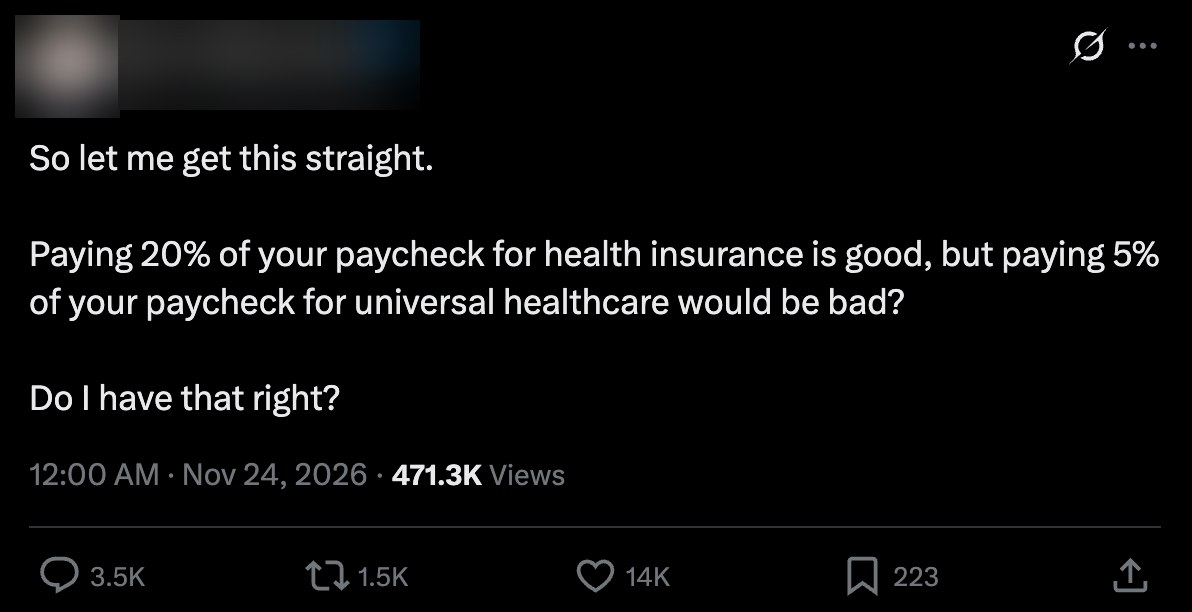
So let me get this straight. Paying 20% of your paycheck for health insurance is good, but paying 5% of your paycheck for universal healthcare would be bad? Do I have that right?
Family premium deductions take about 12% of median full-time pay, a third of total compensation counting the employer's share. Neither is 20%1,2. The 5% is a 2020 plan's household tax, beside a 10% employer payroll tax3. If that tax applies and comes out of pay, a one-earner median family would pay 71% less. The average household saves 41%.
What the post says or clearly implies, checked one by one. How verdicts work
It depends what you count, and 20% matches neither count. Family premium deductions average about 12% of median full-time pay, single about 3%. Counting the employer's share as pay, family coverage is about a third of total compensation1,2.
KFF's 2026 employer survey puts the average family premium at $28,303. Covered workers pay $7,471 of it, and employers pay the rest1. Median full-time earnings, for all full-time workers, were $1,232 a week in the third quarter, about $64,064 a year2. By our calculation, the family deduction is 11.7% of that. Single coverage, $1,672 of a $9,804 premium, is 2.6%.
Some workers do pay close to 20%. Thirteen percent of covered workers face family contributions of $12,000 or more1, about 19% of median pay. Cost sharing adds more. People with job-based coverage spend 2.4% of family income on premiums and 1.4% on cost sharing, KFF finds, and 9.6% combined at or below 199% of the poverty line4. That 2.4% divides by family income.
The bigger number counts the employer's share as pay. A 2005 study found a 10% premium rise cut covered workers' wages 2.3%5. On that view, the family premium is 33% of median earnings counting the employer's $20,832 as pay, by our math. Single coverage is 14%.
5% is the household income tax in a 2020 Lancet plan, charged on income above $29,000 for a family of four. The plan also needed a 10% employer payroll tax, above each employer's first $2 million of payroll3.
Yale researchers in The Lancet estimated Medicare for All would cut national health spending 13%, over $450 billion a year. They replaced premiums with a 10% employer payroll tax and a 5% tax on household income above $29,0003. Sanders' 2019 options paired a 4% employee premium above $29,000 for a family of four with a 7.5% employer premium, exempting the first $2 million of payroll6.
For a family of four with one median earner and no other income, 5% above the unindexed $29,000 is about $1,753, or 2.7% of earnings, by our calculation. Nationally the employer tax raises more, $436 billion a year against $375 billion3. That it comes out of pay, as premiums appear to, is an assumption5.
Other federal cost estimates are larger. CBO's 2020 options raised federal health spending $1.5 trillion to $3.0 trillion in 20307. CRFB, a deficit-focused group, put a $30 trillion decade at the equivalent of a 32% payroll tax on all wages, split with employers. Most of that replaces private spending, but it still needs financing8.
For one median earner with family coverage, the Lancet plan's two taxes would cost about 71% less than today's premiums, by our math. The study's own averages are smaller: households save 41%, employers 19%3,1.
On one basis, a family of four at median pay: today's average family premium is $28,303, worker and employer shares together1,2. Under the Lancet plan, 5% of earnings above $29,000 is $1,753, and the 10% employer tax is $6,4063. That's $8,159, about 71% less, by our calculation. It assumes one earner with no other income, an employer above the $2 million exemption, and that the employer tax comes out of pay.
That family is one case. Across everyone, the study's household premiums and out-of-pocket costs fall from $5,847 to $3,478, about 41%, and employer spending from $536 billion to $436 billion, about 19%3.
It all rests on the study's cost estimate, which its two taxes cover3. CBO found the biggest savings come from lower provider payments and administrative costs, and its options ranged from a $0.7 trillion drop in national health spending in 2030 to a $0.3 trillion rise7. Mercatus's 2018 estimate of Sanders' bill found federal costs rising $32.6 trillion over ten years9.
Facts can't settle this part, so we don't rule on it.
Should health care be paid for mainly through taxes, or mainly through jobs and private plans?
Workers pay for job-based coverage out of their pay, through deductions or lower wages5, and a public plan would be paid for with taxes. The fight is over which route costs less and who pays more of it. U.S. spending per person is about twice that of peer countries, as we found earlier, but whether a single public plan would capture that gap is disputed10.
Premiums are a private tax on work. One public plan would cover everyone and give the greatest relief to lower-income households.
Workers already hand over thousands a year for coverage, and the employer's share is pay they never see. A Jacobin writer called premiums "a tax, just one paid to a private insurer rather than the federal government"11. The burden falls hardest on those with the least: 9.6% of income in premiums and cost sharing combined for lower-income families with job coverage4, and family contributions of $12,000 or more for 31% of covered workers at smaller firms1.
Yale researchers estimated single-payer would cut national spending 13% and save more than 68,500 lives a year compared to the ACA, and that it "could be funded with less financial outlay than is currently incurred by employers and households"3. Sanders says that under every option he lists, "the average American family will save thousands of dollars a year"6.
The 5% leaves out the employer tax and the federal cost. Financing would take much higher tax rates and bring longer waits.
CBO found its single-payer options would raise federal health subsidies $1.5 trillion to $3.0 trillion in 2030 alone, and that demand for care would outrun supply, bringing more delays and forgone care7. Scoring Sanders' Medicare for All Act in 2018, Mercatus's Charles Blahous found that "a doubling of all currently projected federal individual and corporate income tax collections would be insufficient" to cover the added federal cost, even with provider payments more than 40% below private rates9.
CRFB found that taxes on high earners and corporations alone could not pay for it, and cited Penn Wharton's estimate that payroll-tax financing would cut GDP 7.3% in 20308. Job-based plans covered about 165.6 million people under 65 as of March 2025, and KFF, a nonpartisan research group, calls the workplace "an efficient way of offering coverage options to working families"4.
Every source was opened and read. Advocacy groups are labeled as such.
Think we got something wrong? Email editor@viewfromthegallery.com with a source. Corrections are made openly and logged on the page.
New breakdowns in your inbox: what was true, what wasn't, and what the argument is really about. No ads, no spin.