Economy · Inequality · Taxes

Sanders' bottom-53% claim is wrong. We couldn't verify "16 times"

The Fed puts the bottom half at $4.28 trillion. Forbes puts Musk at $812 billion. We found 11 uses of Sanders' line, likely not all.

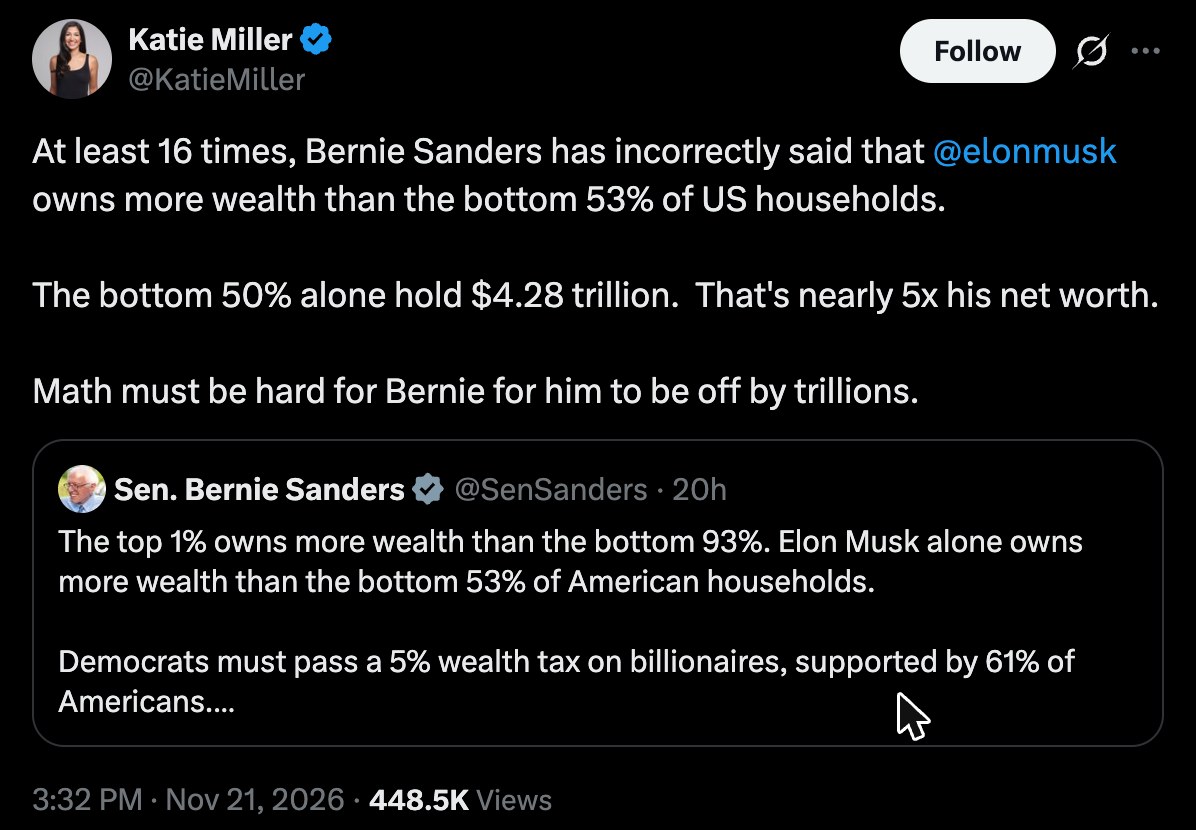
· @KatieMiller · on XThe post we're checking
At least 16 times, Bernie Sanders has incorrectly said that @elonmusk owns more wealth than the bottom 53% of US households.

The bottom 50% alone hold $4.28 trillion.  That's nearly 5x his net worth. 

Math must be hard for Bernie for him to be off by trillions.
Screenshot of the post on X, taken Nov. 22. Shown for commentary.
Read the post as text
At least 16 times, Bernie Sanders has incorrectly said that @elonmusk owns more wealth than the bottom 53% of US households. The bottom 50% alone hold $4.28 trillion. That's nearly 5x his net worth. Math must be hard for Bernie for him to be off by trillions.
Posted Nov 21, 2026About 450K views and 15.9K likes on X by Nov. 22. It quotes a Sanders post with 1.3 million views.See the original

The bottom line

Miller's $4.28 trillion is the Fed's latest figure for the bottom half1, and Forbes put Musk at $811.7 billion on Nov. 222, so the gap runs above 5 to 1. Sanders has used the line since at least April 20253, and it has never been close1,2. We found 11 uses, so 16 is plausible but unconfirmed.

The claims

What the post says or clearly implies, checked one by one. How verdicts work

1

Bernie Sanders has said at least 16 times that Elon Musk owns more wealth than the bottom 53% of US households.

Unsupported

We found 11 uses, in X posts back to at least April 2025, an op-ed, a CBS interview and his bill summary. So 16 is plausible. Miller named no source, and we found no tally to check it against.

The claim is easy to find. A search of Sanders' two X accounts for the phrase returns eight posts, from April 18, 2025 to the Nov. 21 post Miller was answering3,4. The earliest reads, "Elon Musk now owns more wealth than the bottom 53% of households"3.

It appears off X too. Sanders wrote in the Guardian on April 1, 2026 that "One man, Elon Musk, worth $805bn, owns more wealth than the bottom 53% of American households"5. He said it on CBS's "Face the Nation" on Nov. 16, and the undated summary of his Make Billionaires Pay Their Fair Share Act repeats it, with Musk "worth over $830 billion"7.

That is eleven we can document, and our search is plainly incomplete. It returns nothing between April 2025 and this October, though the op-ed and the bill summary both fall in that gap3. Speeches and interviews would add more, so 16 is plausible. But Miller cited nothing8, and we found no tracker publishing a count.
2

The bottom 50% of US households hold $4.28 trillion, nearly five times Elon Musk's net worth.

Checks out

The Fed's latest estimate, for the second quarter of 2026, is $4.278 trillion. Forbes put Musk at $811.7 billion on Nov. 22, the day we checked. That is 5.3 times his fortune, so "nearly 5x" is a conservative round.

The figure comes from the Federal Reserve's Distributional Financial Accounts, which split the household balance sheet into five wealth groups every quarter. For 2026:Q2, the most recent quarter published, the bottom 50% show net worth of $4,278,038 million1. That is Miller's $4.28 trillion, exactly as the Fed gives it.

Musk's side of the ratio moves daily, but not on a weekend. Forbes's real-time tracker had him at $811,673,765,000 on Nov. 22 and says it "reflects change since 5 pm ET of prior trading day"2. Nov. 21 and 22 were a Saturday and a Sunday, so that is Friday's close, the same figure Miller had. Sanders used $805 billion in his April 2026 op-ed5. At either number the ratio is above 5 to 1.

The accounts get revised. They are built by pushing the triennial Survey of Consumer Finances through the quarterly Financial Accounts, and the Fed updates its history as new data arrive9. Next quarter's estimate will move the number.

3

Sanders is wrong to say Musk owns more wealth than the bottom 53% of American households.

Checks out

On the Fed's measure he is off by about five times, and the bottom 53% is larger than the bottom 50%. The gap is at least $3.4 trillion, so "off by trillions" holds. A narrower measure still leaves Musk short.

The Fed doesn't publish a bottom 53%. It has to be bigger than the bottom 50%, because the three percentile points above add wealth rather than subtract it1. The floor for Sanders' comparison is $4.278 trillion.

It has never been close. Forbes's annual lists put Musk at $342 billion in April 2025 and $839 billion in March 20262. He passed $1 trillion on June 12, after SpaceX listed, and Forbes put him at $1.1 trillion10. The bottom half held $3.875 trillion in early 20251.

A narrower measure is Sanders' best ground, and still falls short. The Fed's $4.278 trillion counts $2.17 trillion of consumer durables, mostly household goods, plus $488 billion of defined-benefit pensions1. The Fed's methodology paper says the World Inequality Database omits durables and unfunded defined-benefit pensions9. We strip all defined-benefit pensions, so our cut is deeper, and we leave every dollar of debt in. That leaves about $1.6 trillion, roughly double Musk's $811.7 billion on Nov. 222. Dropping only durables leaves $2.1 trillion, so a WID-style figure sits between.

Musk's fortune has never caught the bottom half's, in trillions

$0$1$2$3$4$52017201820192020202120222023202420252026

Federal Reserve Distributional Financial Accounts, net worth level for the bottom 50%, first quarter of each year, converted from $ millions to $ trillions. The latest quarter published, 2026:Q2, is $4.278 trillion.

Net worth in trillions of dollars. Musk's points are Forbes's annual billionaires list, published each March or April2. The households line is the Fed's first-quarter estimate for the bottom 50%1.
Show the numbers
Musk's fortune has never caught the bottom half's, in trillions: the numbers
YearBottom 50% of householdsElon Musk
2017$1.22$0.01
2018$1.49$0.02
2019$1.62$0.02
2020$1.93$0.02
2021$2.96$0.15
2022$3.64$0.22
2023$3.59$0.18
2024$3.80$0.20
2025$3.88$0.34
2026$4.15$0.84

The real disagreement

Facts can't settle this part, so we don't rule on it.

Is one man's fortune set against the wealth of half the country a fair way to measure inequality, and should Washington tax that fortune every year?

The Fed's own numbers show the shape both sides are arguing about. The top 0.1% of households hold 15.0% of American household wealth. The bottom half hold 2.3%11. That bottom half's $4.28 trillion is $10.27 trillion of assets, $4.82 trillion of it in homes, set against $5.99 trillion of debt1. Sanders pairs the Musk line with a second one, that the top 1% owns more wealth than the bottom 93%5. Bridge Michigan called that "roughly accurate," judging the Fed's groups too coarse to test12. We think they settle it, and against him. Adding the groups, the top 1% hold $60.31 trillion and the bottom 90% hold $57.70 trillion. Wealth rises with percentile, so percentiles 90 through 93 must each hold at least the $1.34 trillion average of the band below, putting the bottom 93% above $61.7 trillion1. That is a floor and not an estimate, and it is enough. The right figure is the bottom 90%. California voters turned down a 5% billionaire tax this month, 52.6% to 47.4% in the state's unofficial count13. Sanders' figures on billionaire wealth held up when we checked them earlier this month14.

Tax the fortunes, because the gap is the story

Fixing the percentage changes nothing about what the Fed shows: one man holds a fifth of what half the country holds.

Musk's $811.7 billion on Nov. 22 is about a fifth of the net worth of the whole bottom half, and more than twice all the corporate stock those households own, $374 billion2,1. Adding the Fed's groups, the top 1% hold 32.5% of household wealth and the bottom 90% hold 31.1%, so one percent of households now out-own ninety11. The bottom half's share is 2.3%11.

And the $4.28 trillion is mostly not spendable. It is $10.27 trillion of assets, about two-thirds of it homes and durable goods, against $5.99 trillion of liabilities, $5.80 trillion of that mortgages and consumer credit1. Leave out consumer durables and defined-benefit pension claims, which a household can't cash out, and the figure falls to about $1.6 trillion, by our calculation1,9. Sanders' bill would take 5% a year from 938 billionaires worth $8.2 trillion7.

Get the number right before writing the law

A figure wrong by trillions, and still in use after a fact-check and a reader correction, is a poor basis for a tax, and a paper fortune is not household wealth.

The claim was wrong when Sanders first posted it in April 2025, and it is wrong now, by about five times15,1. Bridge Michigan checked it in May and found it "appears to be exaggerated"12. X readers attached the same correction to his Nov. 19 post16. He used it again on CBS and in his own bill summary6,7.

The two sides aren't the same thing. Musk's fortune is a share price: Forbes had him at $982 billion on a Thursday in June and $1.1 trillion the next day10. The bottom half's assets are about two-thirds homes and durable goods1. Pricing the rest is the hard part of any wealth tax, because "privately held business assets, artwork collections, and farm assets would create significant valuation challenges," and the Tax Foundation, citing an IRS study, reports estate-tax valuations averaging half the Forbes 400 figure17.

Where they agree

  • The Federal Reserve's quarterly accounts are the best public measure of how household wealth is split1. Musk's own figure comes from Forbes, which revalues it daily2.
  • Wealth is heavily concentrated. The top 0.1% of households hold 15.0% of it and the bottom half hold 2.3%11.

What would change minds

  • A Fed release breaking the bottom half into finer percentile bands, which would show where a single fortune actually sits in the distribution.
  • An auditable count of Sanders' uses of the figure, with dates and sources, which would settle whether 16 is right.

Sources

Every source was opened and read. Advocacy groups are labeled as such.

Show all 17 sources
  1. 1
    Distributional Financial Accounts: net worth levels, by wealth percentile
    Board of Governors of the Federal Reserve SystemDataQuarterly, 1989:Q3 through 2026:Q2, in $ millions. Sums and subtractions from its component columns are our calculation.
  2. 2
    Elon Musk, real-time net worth
    Forbes2026-11-22Data$811.7 billion "as of 11/22/26". The page's machine-readable value is $811,673,765,000. Its wealth-history chart carries Forbes's annual list figures back to 2017.
  3. 3
    X search: "bottom 53" from Sanders' two accounts
    X2026-11-22Primary documentRun Nov. 22, 2026. Eight posts carry the phrase, each opened and read in full: Nov. 21, 2026 https://x.com/SenSanders/status/2124170715985543222; Nov. 19, 2026 https://x.com/SenSanders/status/2123537021402771819; Nov. 14, 2026 https://x.com/SenSanders/status/2121594996436451742; Nov. 8, 2026 https://x.com/BernieSanders/status/2119567391667716304; Oct. 14, 2026 https://x.com/BernieSanders/status/2110437732812210293; Oct. 3, 2026 https://x.com/BernieSanders/status/2106492989904420943; April 19, 2025 https://x.com/BernieSanders/status/1913626904483033196; April 18, 2025 https://x.com/BernieSanders/status/1913249038004109664. The Nov. 14 post is a long statement; we confirmed the phrase in its full text, not the collapsed preview. X search is not exhaustive and its results can change, so this is a floor, not a count.
  4. 4
  5. 5
    Yes, the rich must start paying their fair share of taxes
    Sen. Bernie Sanders' office (originally The Guardian)2026-04-01Primary document
  6. 6
  7. 7
    The Make Billionaires Pay Their Fair Share Act (bill summary)
    Sen. Bernie Sanders' officePrimary documentSanders and Rep. Ro Khanna's summary of their 5% wealth tax bill. The document carries no date, so we don't use its "over $830 billion" as an as-of figure.
  8. 8
    Katie Miller on X
    X2026-11-21Primary document
  9. 9
    Introducing the Distributional Financial Accounts of the United States
    Federal Reserve Board, Finance and Economics Discussion Series 2019-0172019ResearchThe Fed's own methodology paper. It notes that consumer durables and unfunded defined benefit pensions are omitted from the World Inequality Database's wealth measure.
  10. 10
    SpaceX's IPO just made Elon Musk the world's first trillionaire
    Forbes Australia2026-06-13JournalismBy Matt Durot, Forbes staff.
  11. 11
    Distributional Financial Accounts: net worth shares, by wealth percentile
    Board of Governors of the Federal Reserve SystemDataEach group's share of total household net worth. 2026:Q2: top 0.1% 15.0%, next 0.9% 17.5%, next 9% 36.4%, next 40% 28.8%, bottom 50% 2.3%.
  12. 12
    Fact check: Bernie Sanders, Abdul El-Sayed make case for wealth tax
    Bridge Michigan2026-05-03JournalismBy Lauren Gibbons. The fact-check the Community Note on Sanders' Nov. 19 post cites. It gives the bottom 50% as "$4.3 trillion" as of 2025:Q3, where the Fed's own file shows $4,079,083 million, about $4.08 trillion. We use the Fed's figures, not Bridge's.
  13. 13
    Sanders' 250-to-1 ad gap is real. The $425 million isn't sourced.
    View from the GalleryJournalismOur breakdown of California's Proposition 40 and the money around it.
  14. 14
    Sanders' wage and billionaire numbers hold up, with context
    View from the GalleryJournalismOur breakdown of Sanders' figures on the minimum wage and billionaire wealth.
  15. 15
  16. 16
    Sen. Bernie Sanders on X: "Oligarchy is a global phenomenon"
    X2026-11-19Primary documentCarries a reader-written Community Note citing the Bridge Michigan fact-check.
  17. 17
    Analysis of Sen. Warren and Sen. Sanders' Wealth Tax Plans
    Tax Foundation2020-01-28Advocacy / think tankFree-market-leaning tax policy group. By Huaqun Li and Karl Smith. Updated Feb. 12, 2024.

Think we got something wrong? Email editor@viewfromthegallery.com with a source. Corrections are made openly and logged on the page.