Taxes · Elections · Campaign finance · Inequality

Sanders' 250-to-1 ad gap is real. The $425 million isn't sourced.

Prop 40 lost 52.6% to 47.4%. The ad gap was about 259 to 1, but all money raised ran nearer 11 to 1.

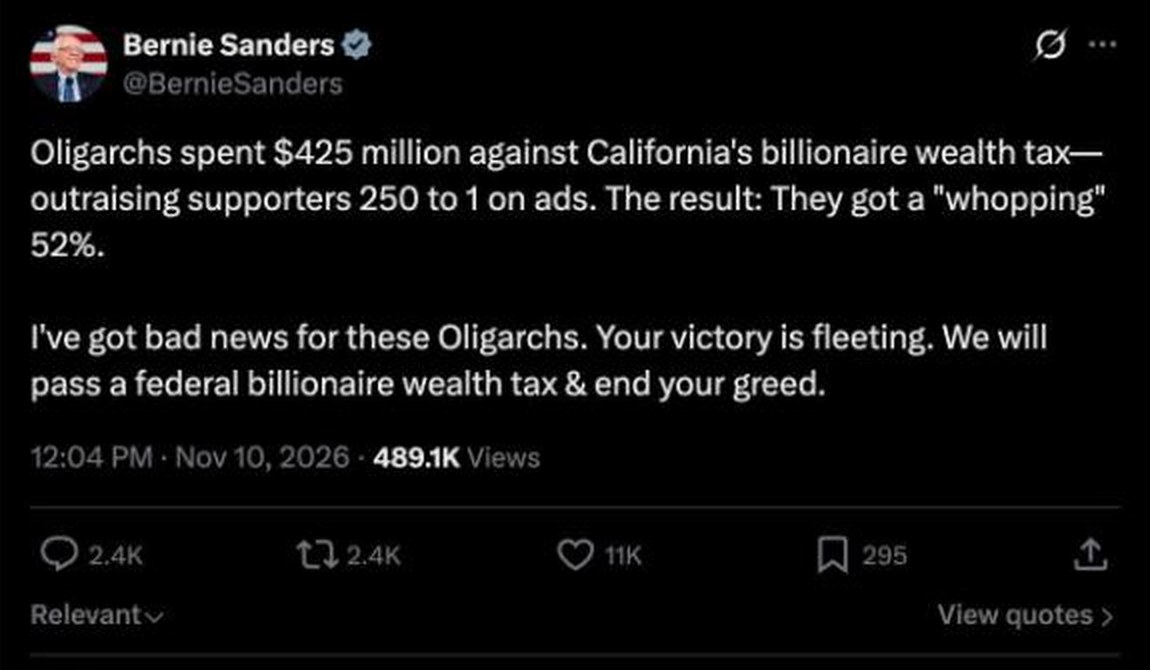
· @BernieSanders · on XThe post we're checking
Oligarchs spent $425 million against California's billionaire wealth tax—outraising supporters 250 to 1 on ads. The result: They got a "whopping" 52%.

I've got bad news for these Oligarchs. Your victory is fleeting. We will pass a federal billionaire wealth tax & end your greed.
Screenshot of the post on X. Shown for commentary.
Read the post as text
Oligarchs spent $425 million against California's billionaire wealth tax—outraising supporters 250 to 1 on ads. The result: They got a "whopping" 52%. I've got bad news for these Oligarchs. Your victory is fleeting. We will pass a federal billionaire wealth tax & end your greed.
Posted Nov 10, 2026About 491K views and 12K likes on X as of Nov. 11See the original

The bottom line

Prop 40 lost with 52.6% voting no, so Sanders' 52% is about right. Opponents did outspend supporters on ads roughly 250 to 1. But that ratio covers ads only. All money ran about 11 to 1 by CalMatters' count, and no source we found reaches $425 million.

The claims

What the post says or clearly implies, checked one by one. How verdicts work

1

Oligarchs spent $425 million against California's billionaire wealth tax.

Unsupported

We found no source for $425 million. Reported totals run from $378 million to almost $400 million, and the higher ones count two competing measures.

CalMatters counted $378.4 million from ultra-wealthy opponents, with Sergey Brin giving $102 million to the main committee. Supporters raised $33.5 million1. NPR's Planet Money cited "almost $400 million" from opponents, "including spending on competing ballot measures"2. The Washington Post counted more than $379 million raised as of Nov. 23.

These are mostly money raised, not spent, and they mix opposition to Prop 40 with support for Props 41 and 42, two measures built to override it4. Late filings could have lifted a total past $400 million. We couldn't pull committee filings from the Secretary of State's site, so we can't rule out a figure we haven't seen.

2

Opponents outraised supporters 250 to 1 on ads.

Missing context

The Washington Post, using AdImpact data, found ad spending above 250 to 1. But supporters chose not to compete on TV, and money overall ran about 11 to 1. "Outraising" blurs the two.

AdImpact data through Oct. 30 showed opponents spending more than $148 million on ads to supporters' $572,000, "more than 250-1"3. That works out to about 259 to 1, by our calculation. A person in the pro-Prop. 40 campaign told the Post supporters' ad spending would reach about $2 million by Election Day, and that opponents' total would likely rise too. NBC News also cited AdImpact for the 250-to-1 ad gap5.

The post says "outraising," which is about fundraising. On that measure, opponents raised more than $379 million against $35 million, about 11 to 13. NPR said "at least five times as much" went against the measure as for it6. Supporters chose their mix. In August, the union's president said it was "not going to try to compete at all with the billionaires on broadcast television," planning texts, social media, door-knocking and mailers instead7.
3

Opponents got a "whopping" 52% of the vote.

Checks out

Prop 40 lost 52.6% to 47.4% in the state's unofficial count, a margin of about 612,000 votes. The AP's call was 52.8%. Results are to be certified by Dec. 11.

The Secretary of State's count as of Nov. 10, 5:31 p.m. showed 6,205,615 No votes (52.6%) and 5,593,408 Yes (47.4%)8. The margin is 612,207 votes, by our calculation. The AP's earlier call was 52.8% to 47.2%1.

"52%" most likely means the No share on Prop 40. Prop 42, the measure that would ban the tax, is at 51.5% yes. It also got more yes votes than Prop 40 did, so it would have overridden Prop 40 even if Prop 40 had passed8,4. Counting continues until certification8.

The real disagreement

Facts can't settle this part, so we don't rule on it.

Did the money decide Prop 40, and should ballot-measure spending be limited?

Economists Gabriel Zucman and Joshua Rauh, both interviewed by NPR after the vote, read the result opposite ways2. Prop 40 was a one-time 5% tax on billionaires' net worth, aimed at health care4. Gov. Gavin Newsom and the California Teachers Association opposed it2.

Unequal money distorts ballot measures

When one side can buy every ad, voters never hear the other, and spending caps or disclosure rules should follow.

UC Berkeley economist Gabriel Zucman, a leading champion of wealth taxes, says "the money spent by the billionaires was critical." He points to the one-sidedness: "The billionaires spent more than $300 million on ads versus negligible sums on the other side." Voters, he says, "were exposed only to the anti-tax arguments," unlike candidate races where both sides spent2.

Ballot measures are where this hurts most, the argument goes, because voters have no party label to lean on, and the details are complicated. A vote that closed at 52.6% to 47.4%8 is the kind a lopsided ad gap could move. A measure that wealthy donors can fund without limit, they say, is one the rest of the state may never get to vote on fairly.

Voters rejected the tax on its merits

Heavy spending doesn't buy votes by itself, and a state wealth tax asked a lot of voters.

Stanford economist Joshua Rauh, a prominent critic of Prop 40, says "popular opinion on wealth taxes is clearly not as strong as proponents thought." He notes Prop 40 ran furthest behind Kamala Harris's 2024 vote in Bay Area counties, where residents are most likely to know a billionaire or work for one. "The electorate even in progressive California has shown that it isn't ready for a wealth tax," he says2.

Democrats split on the measure, and a UC Berkeley Citrin-POLITICO poll found just 46% favored Prop. 40, even as more voters (45% to 35%) backed taxing billionaires more in general1. Newsom argued that "wealth is movable," and that the fight belongs at the federal level2. On this view, spending caps wouldn't have changed the vote.

Where they agree

  • Both economists expect wealth-tax proposals to return in the next Congress2.

What would change minds

  • Post-election survey data on how much voters recalled each side's ads, and whether it moved their vote, would test the money story.
  • A later vote on a similar tax with more even spending would show how much support is there once the gap closes.

Sources

Every source was opened and read. Advocacy groups are labeled as such.

Show all 8 sources
  1. 1
  2. 2
    Why did California's billionaire tax fail to surf the blue wave?
    NPR Planet Money2026-11-10JournalismInterviews with Gabriel Zucman (UC Berkeley, wealth-tax advocate) and Joshua Rauh (Stanford, critic of Prop 40).
  3. 3
    California's mega-rich have outspent foes 250-1 to sink billionaire tax
    Washington Post (republished by DNYUZ)2026-11-02JournalismWe read the DNYUZ republication, not the Post's own page, which we couldn't open. It cites AdImpact data through the prior Friday.
  4. 4
  5. 5
  6. 6
  7. 7
    Billionaires' ads on the California wealth tax
    Common Dreams2026-08-25JournalismProgressive news outlet. Quotes the union president's comments to the New York Times.
  8. 8
    State Ballot Measures, Statewide Results, 2026 General Election (unofficial, as of Nov. 10, 5:31 p.m.)
    California Secretary of State2026-11-10Primary documentLive page that updates until certification on Dec. 11, 2026. Figures quoted are from our Nov. 11 read.

Think we got something wrong? Email editor@viewfromthegallery.com with a source. Corrections are made openly and logged on the page.