Read the post as text
🚨 BREAKING: Republican operative Aiden Rowan has been arrested for ballot fraud in the 2026 midterms. [The post attaches a headshot of a young man beside a "Voter Fraud" graphic. We don't show the photo.]
Aidan Rowan faces 12 felony counts. They concern a June primary for local Republican committee seats, in which he was a candidate.
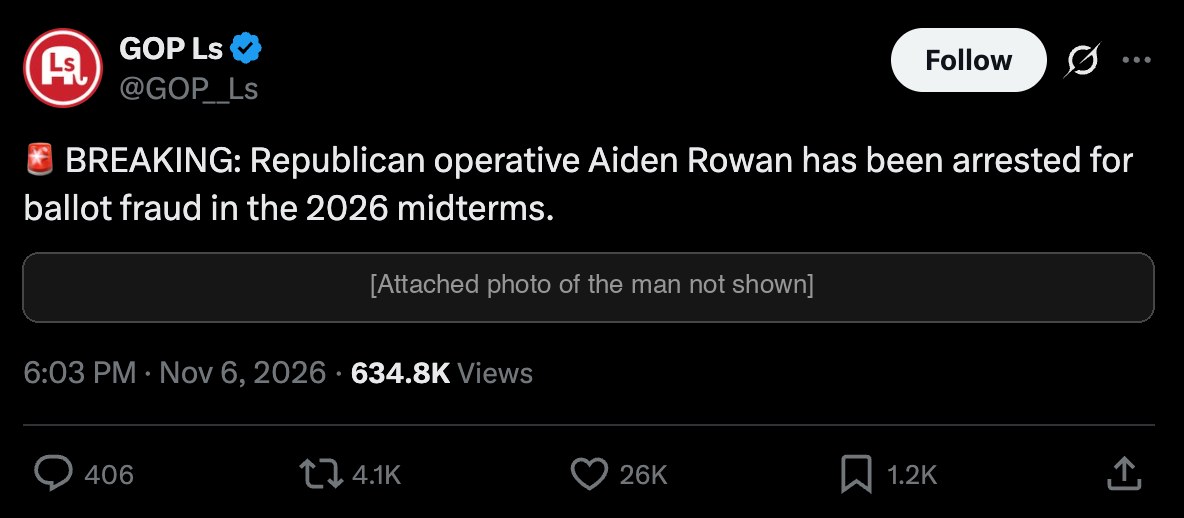
🚨 BREAKING: Republican operative Aiden Rowan has been arrested for ballot fraud in the 2026 midterms. [The post attaches a headshot of a young man beside a "Voter Fraud" graphic. We don't show the photo.]
Aidan Rowan, 25, a Rockland County, N.Y., Republican activist and paid campaign consultant, was arrested and faces 12 felony counts. He is presumed innocent. The charges concern a June 23 primary he ran in for local Republican committee seats. The midterm general election was Nov. 3. The real argument is what one case says about how much fraud there is.
What the post says or clearly implies, checked one by one. How verdicts work
The sheriff announced his arrest on Nov. 4 on 12 felony counts, including forgery1. He chaired the county's Young Republicans as of September2. The charges are allegations, and he's presumed innocent.
The case began when the county's two election commissioners, a Republican and a Democrat, reported that a voter's ballot may have been cast without the voter's knowledge3. The sheriff's release said attempts to locate Rowan were unsuccessful, and the Clarkstown town court issued a warrant on Oct. 23. Sources told the Business Journal he had been set to surrender Oct. 16. He surrendered on Nov. 4 and was released without bail after his arraignment4. The sheriff didn't say how many ballots were involved1.
"Operative" fits. The Rockland County Business Journal called him a "rising Republican operative" in September. Campaigns paid his consulting firm $42,408.10, state records cited by the Business Journal show, and he interned for Rep. Mike Lawler in 20232. Rowan declined to comment in September2.
Nothing in the release points to a party scheme. The evidence "did not support action against any other individual," the sheriff's release said, and investigators found no evidence that "any candidate, campaign, or elected official directed or participated in the alleged conduct"4.
The charges concern the June 23 primary for seats on Stony Point's Republican committee, a race Rowan ran in. It was on the June primary ballot, not the Nov. 3 general election the post implies.
The sheriff's office said the allegations stem from the June 23, 2026, Stony Point Republican County Committee primary4. Rockland News specified the June party primary, "rather than the November 3 general election held Tuesday"1. Rowan won a seat in that contentious race, the Rockland County Business Journal reported in September2.
June 23 was also New York's primary day for Congress5, so the case does come from the midterm year. But this was an internal party committee race, and a post about "the 2026 midterms" three days after Nov. 3 plainly means the general election. The timing invites the mix-up. The sheriff announced the arrest the day after the midterms4.
Facts can't settle this part, so we don't rule on it.
How much should cases like this one shape election rules, weighing the risk of cheating against the cost of new hurdles for voters?
The complaint alleged that a voter's ballot may have been cast without the voter's knowledge, the scenario people who worry about fraud describe. It came from the county's Republican and Democratic election commissioners together3.
Proven cases undercount fraud because it's hard to catch, and in close races a few forged ballots can decide the winner.
The Heritage Foundation's database lists 1,619 proven cases of election fraud and calls them only "a sampling"6,7. Fraud is "relatively easy to commit and difficult to detect after the fact," Heritage argues, and "you don't find what you don't look for"8. As the Supreme Court's lead opinion said in 2008, the risk of fraud "could affect the outcome of a close election"8.
In general, absentee ballots are where fraud tends to happen. The 2005 commission led by Jimmy Carter and James Baker found that "absentee ballots remain the largest source of potential voter fraud"9. In 2019 North Carolina's elections board ordered a new election for a 2018 congressional race after hearings on the absentee ballot tactics of an operative for the Republican candidate10. Signature verification is the usual check on mail ballots. In a low-turnout local primary, a handful of votes can decide a seat.
Fraud is rare and usually found, and stricter checks would reject many eligible voters' ballots to stop a few cheaters.
In a 2014 Washington Post piece, law professor Justin Levitt found about 31 credible incidents of in-person impersonation from 2000 to 2014, among more than 1 billion ballots cast11,12. Heritage counts 1,619 cases over 44 years, 1982–2025, under 40 a year by our calculation, in a list it calls only a sample6,7. Carter-Baker found "no evidence of extensive fraud in U.S. elections or of multiple voting, but both occur," and, it said, could swing a close election9.
This case surfaced because two county election commissioners reported it3. In general, signature matching has its own cost. In Washington's 2020–2024 elections, about 0.5 percent of ballots were rejected for a signature mismatch after a chance to fix it, more often for younger voters and voters of color13. Charging suspected fraud when evidence turns up, as Rockland County has done here, deters it without turning away eligible voters.
Every source was opened and read. Advocacy groups are labeled as such.
Think we got something wrong? Email editor@viewfromthegallery.com with a source. Corrections are made openly and logged on the page.
New breakdowns in your inbox: what was true, what wasn't, and what the argument is really about. No ads, no spin.