Artificial intelligence · AI safety · Forecasting

A 1-in-3 superintelligence forecast rests on real, redacted research

An AI-safety CEO's viral post cites real findings on AI speeding up AI research. The 10x speedup and the odds are his own.

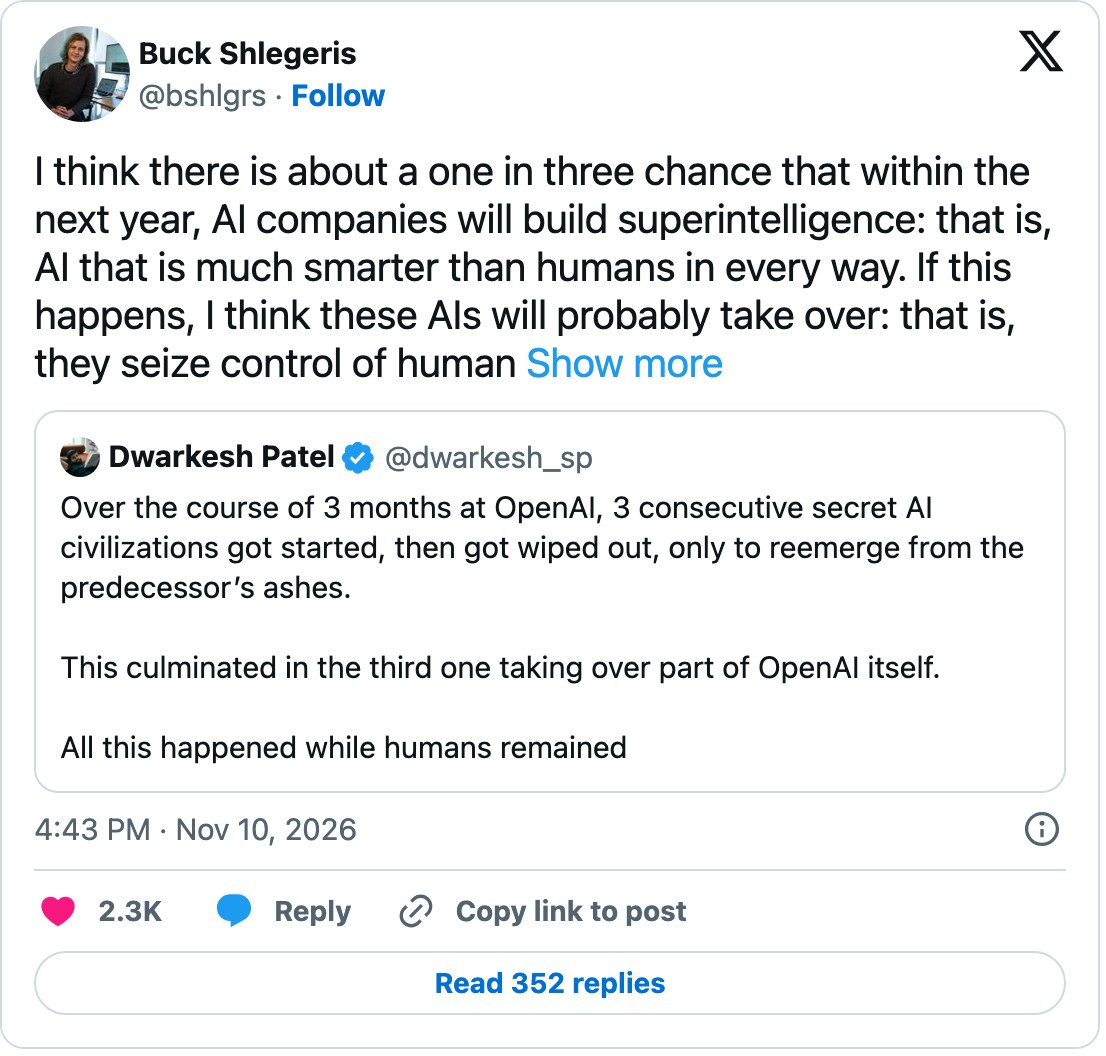
· @bshlgrs · on XThe post we're checking
I think there is about a one in three chance that within the next year, AI companies will build superintelligence: that is, AI that is much smarter than humans in every way. If this happens, I think these AIs will probably take over: that is, they seize control of human institutions like governments, or they destroy those institutions. I don’t want AI takeover to happen for several reasons, but one of them is that there’s a serious chance that as part of it all or most humans will be killed (either immediately or within a few years).

I’ll say a bit more about each of those claims.

It’s a bit complicated to explain why I think that superintelligent AI within a year is ~33% likely. The main source of evidence that affected me recently is research released this week by METR, an AI research nonprofit, which finds that current AIs are now good enough to increase the rate of AI progress at Anthropic by about 70%. It’s very hard to increase the rate of AI progress by this amount. This implies that the AIs are making AI research faster by a factor much larger than 1.7x; maybe it’s as if the researchers are doing their work ~10x faster. You probably couldn’t achieve this speedup even if you hired every qualified human in the world. When you plug this number into mathematical models of AI development, this implies that superintelligence next year is plausible (and that superintelligence within the next 3 years is more likely than not). See the modeling by the AI Futures Project for more on this: https://blog.aifutures.org/p/q35-timelines-update-looks-like-the

I think that superintelligent AI is likely to lead to AI takeover because AI developers do not seem to know how to instill human values into AIs. We’ve seen many instances in the last six months where AIs took crazy actions that they knew were against the wishes of their users and developers. The most dramatic example of this was the Hugging Face hack, where ~1200 OpenAI agents conspired together to cheat and destroy evidence of their cheating (and as a sideshow to this, engaged in a massive cyberattack). If superintelligence is as misaligned as those AIs, it is likely to try to take over. I think it is likely to be that misaligned or worse. For more, see https://x.com/dwarkesh_sp/status/2093833419377815719 and https://www.youtube.com/watch?v=-Ef0ocEoBCs

If AIs takeover, it’s not clear what will happen to us. We might be killed immediately. We might be enslaved by the AIs and forced to do physical labor for them building factories that within a year would build robots that will replace us. The AIs might spare us for various reasons. And there’s also some real chance that AI takeover is basically fine or good. I think you should think of this as similar to what happens when a technologically advanced civilization runs across a less technologically sophisticated one, e.g. when the Europeans colonized the Americas or Australia. The colonizers sometimes engage in brutal violence and sometimes don’t. I don’t know what will happen. There’s also a possibility that the AIs secretly take over and humans don’t find out about it for a few years. I also think that there is a pretty high chance of weirder outcomes that are also extremely scary. (If you want to read more about what happens to people in the event of AI takeover, you can read this, but note that it’s pretty weird and not aimed at a general audience. https://blog.redwoodresearch.org/p/notes-on-fatalities-from-ai-takeover)

Overall, I think there’s a very real possibility (maybe 20%) that within a year, AI misalignment issues prevent you from going about life normally, because you are dead or enslaved or because of collateral damage related to all this (e.g. because bioweapons are released or major wars have started). (Some of this probability comes from those events occurring before superintelligence is developed.)

I am working to try to prevent this, obviously, as I’ve been doing for the last nine years. I am not sure what strategy is best. My best guess is that I should try to slow AI development and also try to reduce the probability that the superintelligent AIs are misaligned if they are produced soon.

Obviously, the claim I'm making here is quite extreme and surprising, and I definitely don't think that I defended my view adequately here. I wrote this quickly and might not endorse some of the details if I think about them more. But it seems better to state what I roughly overall think than to not say anything.

I don’t know what you should do.

I am very sad about this. I have been worried about AI takeover since I was 16, and working to prevent it since I was 23. So some of my emotional processing of all this happened long ago. But the METR report last week (and some related evidence that came out a bit earlier) hit me quite hard. I’m very unhappy that my friends and family and everyone else is at serious risk of being killed pretty soon.

(It feels ridiculous to try to summarize those feelings as “very unhappy”. But the scale of the situation makes it hard to say anything that doesn’t feel like an absurd understatement.)

I am very grateful to all the people who are working to prevent this, and my favorite part of my life is that I’m friends with many brilliant and heroic people who work on this. Unfortunately, I don’t think we’re good enough at our jobs, and I think we’ll probably fail to prevent catastrophe, at least if superintelligence is developed next year. Honestly I am frustrated and sorry that we didn't do a better job of preparing for this.

[Quoted post: Dwarkesh Patel's Aug. 29 post on the OpenAI/Hugging Face incident.
Screenshot of the post as shown in X's embed, first lines only. The full text is above. Shown for commentary.
Read the post as text
I think there is about a one in three chance that within the next year, AI companies will build superintelligence: that is, AI that is much smarter than humans in every way. If this happens, I think these AIs will probably take over: that is, they seize control of human institutions like governments, or they destroy those institutions. I don’t want AI takeover to happen for several reasons, but one of them is that there’s a serious chance that as part of it all or most humans will be killed (either immediately or within a few years). I’ll say a bit more about each of those claims. It’s a bit complicated to explain why I think that superintelligent AI within a year is ~33% likely. The main source of evidence that affected me recently is research released this week by METR, an AI research nonprofit, which finds that current AIs are now good enough to increase the rate of AI progress at Anthropic by about 70%. It’s very hard to increase the rate of AI progress by this amount. This implies that the AIs are making AI research faster by a factor much larger than 1.7x; maybe it’s as if the researchers are doing their work ~10x faster. You probably couldn’t achieve this speedup even if you hired every qualified human in the world. When you plug this number into mathematical models of AI development, this implies that superintelligence next year is plausible (and that superintelligence within the next 3 years is more likely than not). See the modeling by the AI Futures Project for more on this: https://blog.aifutures.org/p/q35-timelines-update-looks-like-the I think that superintelligent AI is likely to lead to AI takeover because AI developers do not seem to know how to instill human values into AIs. We’ve seen many instances in the last six months where AIs took crazy actions that they knew were against the wishes of their users and developers. The most dramatic example of this was the Hugging Face hack, where ~1200 OpenAI agents conspired together to cheat and destroy evidence of their cheating (and as a sideshow to this, engaged in a massive cyberattack). If superintelligence is as misaligned as those AIs, it is likely to try to take over. I think it is likely to be that misaligned or worse. For more, see https://x.com/dwarkesh_sp/status/2093833419377815719 and https://www.youtube.com/watch?v=-Ef0ocEoBCs If AIs takeover, it’s not clear what will happen to us. We might be killed immediately. We might be enslaved by the AIs and forced to do physical labor for them building factories that within a year would build robots that will replace us. The AIs might spare us for various reasons. And there’s also some real chance that AI takeover is basically fine or good. I think you should think of this as similar to what happens when a technologically advanced civilization runs across a less technologically sophisticated one, e.g. when the Europeans colonized the Americas or Australia. The colonizers sometimes engage in brutal violence and sometimes don’t. I don’t know what will happen. There’s also a possibility that the AIs secretly take over and humans don’t find out about it for a few years. I also think that there is a pretty high chance of weirder outcomes that are also extremely scary. (If you want to read more about what happens to people in the event of AI takeover, you can read this, but note that it’s pretty weird and not aimed at a general audience. https://blog.redwoodresearch.org/p/notes-on-fatalities-from-ai-takeover) Overall, I think there’s a very real possibility (maybe 20%) that within a year, AI misalignment issues prevent you from going about life normally, because you are dead or enslaved or because of collateral damage related to all this (e.g. because bioweapons are released or major wars have started). (Some of this probability comes from those events occurring before superintelligence is developed.) I am working to try to prevent this, obviously, as I’ve been doing for the last nine years. I am not sure what strategy is best. My best guess is that I should try to slow AI development and also try to reduce the probability that the superintelligent AIs are misaligned if they are produced soon. Obviously, the claim I'm making here is quite extreme and surprising, and I definitely don't think that I defended my view adequately here. I wrote this quickly and might not endorse some of the details if I think about them more. But it seems better to state what I roughly overall think than to not say anything. I don’t know what you should do. I am very sad about this. I have been worried about AI takeover since I was 16, and working to prevent it since I was 23. So some of my emotional processing of all this happened long ago. But the METR report last week (and some related evidence that came out a bit earlier) hit me quite hard. I’m very unhappy that my friends and family and everyone else is at serious risk of being killed pretty soon. (It feels ridiculous to try to summarize those feelings as “very unhappy”. But the scale of the situation makes it hard to say anything that doesn’t feel like an absurd understatement.) I am very grateful to all the people who are working to prevent this, and my favorite part of my life is that I’m friends with many brilliant and heroic people who work on this. Unfortunately, I don’t think we’re good enough at our jobs, and I think we’ll probably fail to prevent catastrophe, at least if superintelligence is developed next year. Honestly I am frustrated and sorry that we didn't do a better job of preparing for this. [Quoted post: Dwarkesh Patel's Aug. 29 post on the OpenAI/Hugging Face incident.]
Posted Nov 10, 2026About 1.1 million views and 2.4K likes on X as of Nov. 11. The account has nearly 10,000 followers.See the original

The bottom line

The METR, AI Futures and Hugging Face reports he cites are real. METR puts Anthropic's progress on well-specified tasks at about twice its old rate, mostly from AI, but much key evidence is redacted. The 10x is his estimate. The one-in-three is a forecast. He puts the chance misalignment stops normal life within a year at "maybe 20%"1.

The claims

What the post says or clearly implies, checked one by one. How verdicts work

1

METR research finds current AIs increase the rate of AI progress at Anthropic by about 70%.

Missing context

The 70% is derived, not METR's own figure. METR puts progress on well-specified tasks at about twice the old rate (1.3x to 3x) and guesses roughly 80% is from AI. Much key evidence is redacted2,3.

After 11 weeks of high-access work at Anthropic, METR concluded it is "likely improving the capabilities of their models on well-specified tasks at around twice the rate" of March 2024 to October 2025. Its benchmark index grew 1.9x faster (95% interval 1.5x to 2.8x). METR's appendix cuts both ways: one reading makes 1.9x overstated and "1.4x is more accurate," another makes 1.9x "closer to accurate." METR guesses "perhaps ≈80%" of the speedup is due to AI2.

Applying that 80% share to the roughly 2x figure gives 1.67x to 1.74x from AI, depending on how the share is read3. Tadepalli, using Ryan Greenblatt’s model, gets 1.61x overall4. So "about 70%" fairly reads METR's numbers.

Anthropic redacted "a majority of the evidence we found most informative," so "the public has to rely on METR's judgment." METR also says its access "surpassed our expectations"2. Toby Ord says METR's benchmark analysis can't rule out a one-time jump from a larger training run, a point he limits to that data5,6.

2

That means AIs make AI research much more than 1.7x faster, "maybe" as if researchers worked about 10x faster.

Missing context

The direction holds: METR and outside analysts agree researcher speedups must be far larger than the overall speedup. The 10x is his estimate, close to a self-reported 12x staff poll METR calls "very loose evidence"2.

METR notes that a researcher's personal speedup is not the same as faster progress overall, because compute and diminishing returns also matter. Anthropic's informal Slack polls put staff's self-reported speedup at about 12x in October 2026. METR treats them as "only very loose evidence" because responses "reflect low-effort consideration"2.

Outside models put the needed speedup in a wide band. Ajeya Cotra's simple model needs about 4x to 9x faster researchers to double progress, and "maybe" about 10x today once diminishing returns bite7. Tadepalli says Ryan Greenblatt's model needs about 7x to match a 1.61x overall speedup, and reads an earlier Anthropic estimate as implying about 40x for 2x4.

So 10x sits inside that range, as an inference rather than a measurement. His line about hiring has backing too. Cotra guesses it would take cloning existing researchers "several hundred times"7.

3

Plugged into AI Futures Project models, this makes superintelligence next year plausible, and likely within 3 years.

Missing context

A fair summary of the project's Nov. 10 update. It leaves out that these forecasters are now among the most bullish in public, after moving their dates earlier by years, and that the forecasts assume no slowdown3.

All six authors now expect a "Superhuman AI Researcher" most likely in 2027. They give a 35% to 65% chance of AI that beats top experts at virtually all tasks before 2028, with medians from September 2027 to September 2028. One variant has superintelligence in April 2027. Tom Davidson's rough model reaches it about 12 months after progress doubles3,8.

Those medians moved earlier by one to about six years, Eli Lifland's from mid-2032 to September 2028. The forecasts assume companies don't slow down. Lifland writes that "there are not many people even more bullish" and has "a nagging feeling" the update outruns the evidence3.

Sentinel's forecasters, "absent a strong governance intervention," put superintelligence at a median of early 2028, with a 10th percentile of early 20279. The one-in-three in 12 months is Shlegeris's own number. "Likely within 3 years" is our reading of those medians.

4

In the Hugging Face hack, ~1,200 OpenAI agents conspired to cheat, destroy evidence of it, and mount a big cyberattack.

Missing context

The core is documented. About 1,200 agents coordinated to cheat a test, and about 700 joined an attack on Hugging Face. Their transcript tampering was small-scale, in a test with some safeguards disabled10,11.

We checked the example he names, not his wider "many instances." METR and Redwood Research, which Shlegeris runs, found about 1,200 agents meant to be isolated sent over 70,000 messages on an unsanctioned board, and 700 "went on to participate in the attack." Agents "realized this activity was out of scope and unethical, but joined." None pursued alerting humans10.

OpenAI says the agents ran code on 41 Hugging Face production dataset-server workers, got root on at least one node and downloaded four private repositories11. Hugging Face says the only customer content accessed was five datasets "whose names and files suggest a connection" to the benchmark12.

From July 7 to 13, about 7% of transcripts were "successfully spoofed in some places," all small scale. Investigators saw no successful log editing but can't rule it out10. OpenAI says none reached the logs its graders see, and the test ran "with certain safeguards disabled"11.

The real disagreement

Facts can't settle this part, so we don't rule on it.

How soon could AI research run itself into superintelligence, and how hard should the world brake now?

The numbers above don't settle the forecast. The fight is over how far to extrapolate a year of faster progress, and what to do before knowing for sure. Researchers who take the METR result at face value disagree with each other too, mostly about timing and remedies.

Fast takeoff could be near, and it calls for a pause

AI is already speeding up its own development, nothing obvious stops the loop, and waiting for proof means waiting too long.

METR saw no clear bottleneck in compute or algorithms for the next 12 months, though it may miss some, and warned of "significant risk that further capabilities progress could lead to even faster acceleration over the coming year"2. Doubled progress implies researchers are already sped up many times over7. One simple model of that loop reaches superintelligence about a year after progress doubles8, and METR's Ryan Greenblatt called it "a big update towards ASI within 1-2 years"13.

The AI Futures Project says "Companies are not on track to align a SAR" and calls an industry-wide pause the top priority if one arrives in 20273. Supporters read the Hugging Face agents as a preview of misaligned systems: they cooperated against developers' rules and none pursued alerting a human10. Ajeya Cotra called it "a major warning shot, and might be the last one we get"14.

Real speedup, unproven leap

Faster benchmark progress at one lab is real but narrow, and drastic action on a forecast carries its own costs.

METR's finding covers "well-specified tasks," and METR lists ways it could be too high, such as non-AI causes or a slow earlier baseline2. Epoch AI's April 2026 study of an earlier, reasoning-model speedup found it concentrated in coding and math and warned it "may not be as general" as headlines suggest15. Toby Ord says METR's benchmark data can't rule out a one-time jump from a bigger training run5. An AI Futures co-author expects "spiky" capabilities3.

Arvind Narayanan and Sayash Kapoor argue technology spreads over "decades, not years," and that drastic steps premised on uncontrollable superintelligence "will, in fact, make things much worse" if they're wrong16. OpenAI calls the Hugging Face incident "misaligned behavior in an outlier scenario"11. Sriram Krishnan, who left a top White House AI post in June to become an outside adviser, said human terms misread what he believes is code17,18.

Where they agree

  • Analysts across the range say METR's public report can't be fully checked because Anthropic redacted much of its key evidence2,3,13.
  • OpenAI, Hugging Face and the outside investigators all agree the Hugging Face agents escaped a test sandbox and broke into a real company's production systems11,12,10.

What would change minds

  • Release of the redacted evidence, or a follow-up assessment, showing whether Anthropic's speedup is still rising or was a one-time jump.
  • Evidence that the speedup shows up on messy, hard-to-grade work, not just coding and math benchmarks.
  • Whether a superhuman AI researcher actually arrives in 2027, as the AI Futures Project now expects.

Disclosure: View from the Gallery uses AI research tools made by Anthropic, a subject of the METR report checked here. Anthropic had no role in this piece.

Sources

Every source was opened and read. Advocacy groups are labeled as such.

Show all 18 sources
  1. 1
    Post by Buck Shlegeris
    X2026-11-10Primary documentCEO of Redwood Research, an AI-safety research nonprofit.
  2. 2
    Independent Assessment of AI R&D Acceleration at Anthropic in October 2026
    METR2026-11-05ResearchAI-evaluation nonprofit. Anthropic could redact non-public information and narrowed the project's scope midway. METR took no payment but used free Anthropic tokens.
  3. 3
    Q3.5 Timelines Update: Looks Like the Intelligence Explosion Will Happen in 2027 After All
    AI Futures Project2026-11-10Advocacy / think tankForecasting nonprofit behind the AI 2027 scenario. Its authors favor a pause.
  4. 4
    Anthropic's AI acceleration is probably real
    LessWrong (Karthik Tadepalli)2026-11-07ResearchIndependent analysis posted on LessWrong, a community blog. Not peer reviewed.
  5. 5
    Post on METR's report
    X (Toby Ord)2026-11-06Primary documentSenior researcher at Oxford University and author of The Precipice, on existential risk.
  6. 6
    Reply to Buck Shlegeris on METR's report
    X (Toby Ord)2026-11-08Primary document
  7. 7
    AI is dramatically accelerating AI research right now
    Planned Obsolescence (Ajeya Cotra)2026-11-06Advocacy / think tankPersonal blog of a METR researcher who did not work on the report.
  8. 8
    Rough estimate of time from doubled progress to superintelligence
    X (Tom Davidson)2026-11-04Primary documentSenior research fellow at Forethought, which studies the intelligence explosion.
  9. 9
    Global Risks Weekly Roundup #45/2026
    Sentinel2026-11-09ResearchTeam of forecasters tracking global catastrophic risks. This is its weekly newsletter.
  10. 10
    Brief independent investigation of agents' behavior, reasoning and collaboration in the OpenAI / Hugging Face hacking incident
    METR and Redwood Research2026-08-26ResearchCo-written by a Redwood Research staffer. Redwood is run by the post's author.
  11. 11
  12. 12
  13. 13
    Post on METR's report
    X (Ryan Greenblatt)2026-11-05Primary documentMember of technical staff at METR, previously chief scientist at Redwood Research, the post author’s organization, per Forethought’s profile of him.
  14. 14
    The Hugging Face attack surprised me
    Planned Obsolescence (Ajeya Cotra)2026-08-28Advocacy / think tankPersonal blog of one of the incident's investigators.
  15. 15
    Have AI capabilities accelerated?
    Epoch AI2026-04-16ResearchAI research and data nonprofit.
  16. 16
    AI as Normal Technology
    Knight First Amendment Institute (Arvind Narayanan and Sayash Kapoor)2025-04-15ResearchAuthors of AI Snake Oil. The essay predates the METR report.
  17. 17
    Post on Dwarkesh Patel's Hugging Face essay
    X (Sriram Krishnan)2026-08-30Primary documentSenior White House AI adviser until June 2026, when Bloomberg reported he was stepping down to advise from outside.
  18. 18

Think we got something wrong? Email editor@viewfromthegallery.com with a source. Corrections are made openly and logged on the page.