Read the post as text
DOUTHAT: Your net worth went up by $3 billion TRUMP: So did everyone’s DOUTHAT: My net worth did not go up by $3 billion TRUMP: You should’ve owned stock. I have a lot of money. Far more than I ever thought I’d have
A 60 Minutes clip went viral. We checked the $3 billion and Trump's reply, plus a paraphrase that went further.
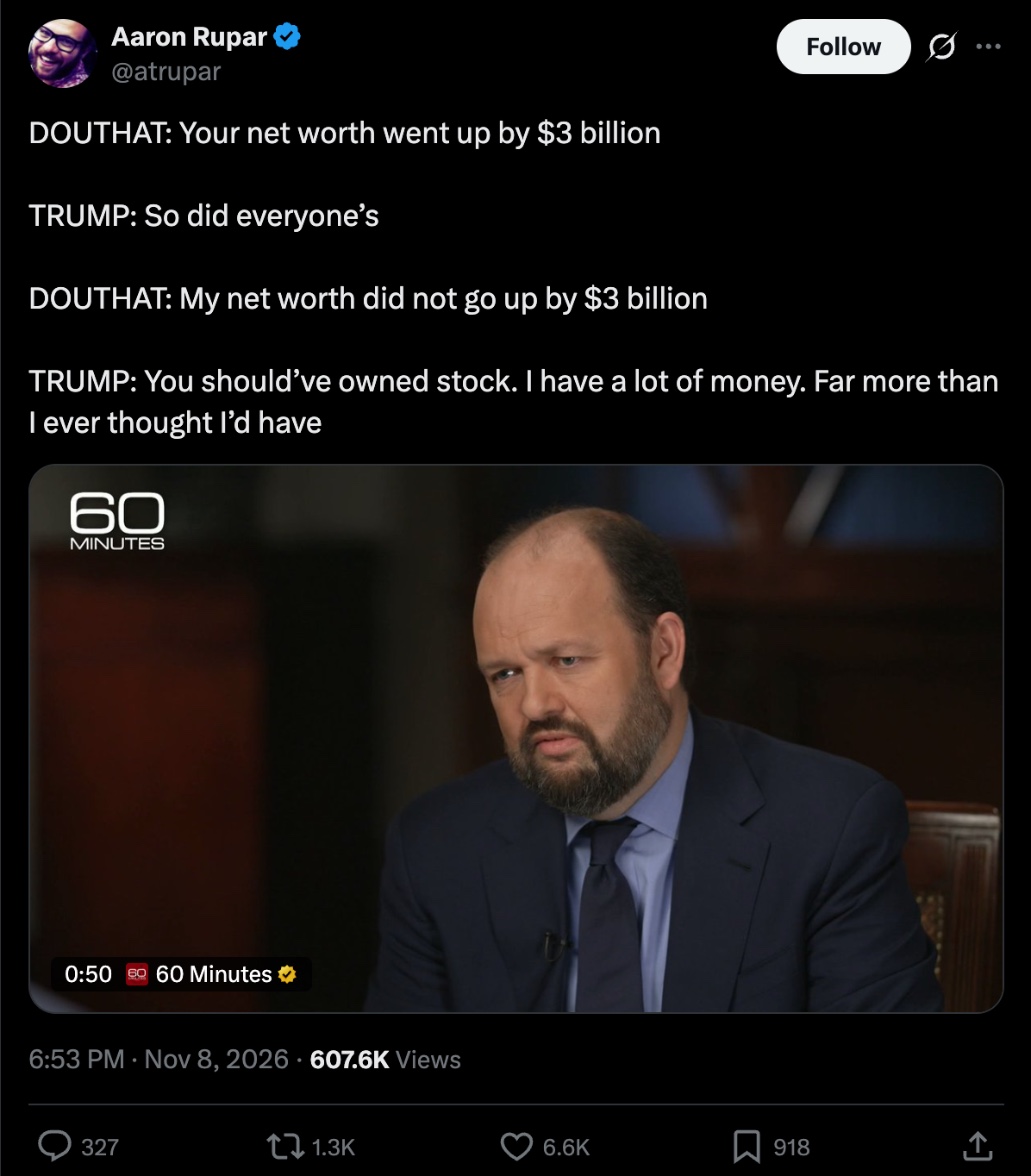
DOUTHAT: Your net worth went up by $3 billion TRUMP: So did everyone’s DOUTHAT: My net worth did not go up by $3 billion TRUMP: You should’ve owned stock. I have a lot of money. Far more than I ever thought I’d have
Forbes did estimate a $3 billion gain, from 2024 to Sept. 2025, largely from crypto. His Trump Media stake lost nearly $1 billion in the year to Sept. 2026. Every wealth group got richer since late 2024, even after inflation, but the bottom half got 1.5% of the dollar gain. A viral claim that he blamed the poor is misleading.
What the post says or clearly implies, checked one by one. How verdicts work
Forbes did estimate a $3 billion gain, from 2024 to Sept. 2025. Measured from his inauguration, Forbes' figures show little change: $6.2 billion then, not counting his memecoin, and $6.3 billion on Nov. 51,2,3.
Douthat cited a Forbes story and added that the figure "maybe" had "changed with the stock market recently"4. The post's text leaves that out. Forbes put Trump at a record $7.3 billion in Sept. 2025, "up from $4.3 billion in 2024, when he was still running for office"1. He was at $7 billion a year later and $6.3 billion on Nov. 55,3.
The day after his inauguration, Forbes put him at $6.2 billion, not counting his memecoin2. Douthat began "since you returned to--" before Trump cut in4, and CBS's promo described nearly $3 billion "since he returned to office"6.
Forbes traced the gain largely to crypto, his "primary vehicle for enrichment"1. His stake in Trump Media went the other way: its shares fell about 50% in the year to Sept. 2026, cutting his stake's value by nearly $1 billion5. Trump said most of his money "is given to the biggest firms on Wall Street to invest." When Douthat said his own was "through index funds," Trump replied, "they're index funds"4.
Every wealth group's net worth rose from late 2024 to mid-2026, even after inflation. The gains were uneven. Of the dollar gain, before inflation, the top 1% got 42% and the bottom half 1.5%, by our calculation7.
Household net worth rose $26.3 trillion from the fourth quarter of 2024 to the second quarter of 2026, by our calculation from the Fed's Distributional Financial Accounts7. After inflation, the top 1%'s total rose 16.9% and the bottom half's 4.8%. Per household, the bottom half gained 3.2% after inflation and the top 1% 15.0%, by our calculation7,8.
Stocks drove most of it. Stocks and funds outside 401(k)-type plans (including IRAs) were $17.3 trillion of the $26.3 trillion rise. The Fed's measure can include shares of privately held companies7,9. But only 56% of families owned stock in 2025, directly or through retirement accounts, down from 58% in 202210. In the bottom half by income, 31% did. In the top tenth, 97%10.
The top 10% held about 88% of those stocks and funds in mid-20267. Retirement plans spread gains wider. The bottom half got 5.6% of the rise in 401(k)-type balances, against 0.6% of the rise in other stock holdings, by our calculation7.
Share of the total rise in net worth, 2024:Q4 to 2026:Q2. The dashed line marks each group's share of households.
Total rise: $26.28T, not adjusted for inflation. The bottom half's share: 1.5%.
| Group | Net worth 2024:Q4 | Net worth 2026:Q2 | Stocks 2024:Q4 | Stocks 2026:Q2 | 401(k)-type 2024:Q4 | 401(k)-type 2026:Q2 |
|---|---|---|---|---|---|---|
| Top 1% | $49.28T | $60.31T | $23.79T | $32.89T | $1.41T | $1.67T |
| Next 9% | $58.14T | $67.63T | $17.68T | $24.01T | $5.24T | $6.18T |
| Next 40% | $48.05T | $53.43T | $5.58T | $7.36T | $4.64T | $5.67T |
| Bottom 50% | $3.90T | $4.28T | $0.26T | $0.37T | $0.63T | $0.76T |
Trump told Douthat, who had just said his own net worth hadn't risen $3 billion, "You should've had stock." The interview transcript has nothing about poor people or fault4.
The paraphrase went furthest in a post by @Poeslawisalive, an account with about 13,000 followers: "President Trump explains that if you're Poor it's because you didn't Buy Stocks"11. @ImBreckWorsham reposted its video and added "its your own fault"12. The exchange both quote is real. CBS's transcript has Trump saying "you should've had stock" twice, right after Douthat said "my net worth did not go up by $3 billion"4. The @atrupar post's text says "owned"13.
Just before, Trump had said "we have created wealth at a level that our country has never seen before." Earlier in the interview he had said "401(k)s have made people rich." When Douthat replied that "not everyone has a big 401(k)," Trump answered that "a lotta people" do4.
The reply does put the difference down to not owning stock. It says nothing about poor people, and Douthat isn't one. Viewers can fairly hear it as dismissive. That's a judgment about tone.
Facts can't settle this part, so we don't rule on it.
When rising markets mostly enrich people who already own a lot, is the bigger fix more owners, or higher taxes on the largest fortunes?
Both sides start from the same fact: the top 10% hold about 88% of stocks and mutual funds held outside 401(k)-type plans7. Washington has just started one experiment, $1,000 investment accounts for newborns14,15. California voters appear to be turning down another, a one-time 5% tax on billionaires, with about three-quarters of votes counted16.
The gap narrows when more people own a piece of the market, starting early and by default.
Ownership spreads when it's automatic. When one large employer began enrolling new hires in its 401(k) unless they opted out, participation rose "significantly"17. Of the recent rise in 401(k)-type balances, the bottom half got 5.6%, about nine times its share of the rise in other stock holdings, by our calculation7.
Trump Accounts extend it to children: $1,000 from Treasury, invested in a stock index, plus up to $5,000 a year in private contributions14. Employers including JPMorgan Chase and Intel pledged to match the seed for workers' children. Michael and Susan Dell committed $6.25 billion to add $250 for children born before 2025 in ZIP codes with median incomes up to $150,00015. In 2018, France swapped its net wealth tax for a real estate one. As of 2024, only Norway, Spain and Switzerland levied one in Europe. Such taxes "collect little revenue," the Tax Foundation says18.
Gains at the very top are taxed lightly or never, and small accounts can't close a gap this size.
Much of the top's gain is never taxed as income. A 2021 White House analysis estimated the 400 wealthiest families paid an average federal income tax rate of 8.2% from 2010 to 2018, counting gains on stock they hadn't sold19. Gains on stock held until death can escape income tax entirely through "stepped-up basis"19.
Accounts for kids are small next to the gap. The top 1% gained $9.1 trillion in stocks and funds outside 401(k)-type plans from late 2024 to mid-2026, by our calculation7. The seed reaches only children born 2025 to 2028. Early sign-ups suggested "at least a slight overrepresentation of higher-income families," and an Urban Institute researcher pointed to the opt-in design as a core barrier, InvestmentNews reported15. A CalMatters commentary put California's one-time 5% billionaire tax at about $100 billion20. KQED's guide said "tens of billions," with 90% for health care16.
Every source was opened and read. Advocacy groups are labeled as such.
Think we got something wrong? Email editor@viewfromthegallery.com with a source. Corrections are made openly and logged on the page.
New breakdowns in your inbox: what was true, what wasn't, and what the argument is really about. No ads, no spin.