Read the post as text
The typical pay for child care workers is $34,000 a year. That puts them in the bottom third of workers in the U.S. These are the people taking care of our babies. In the richest country in the world, we can do better.
The typical child care worker earns $34,980 a year, in the bottom quarter of U.S. wage earners. The fight is over raising it.
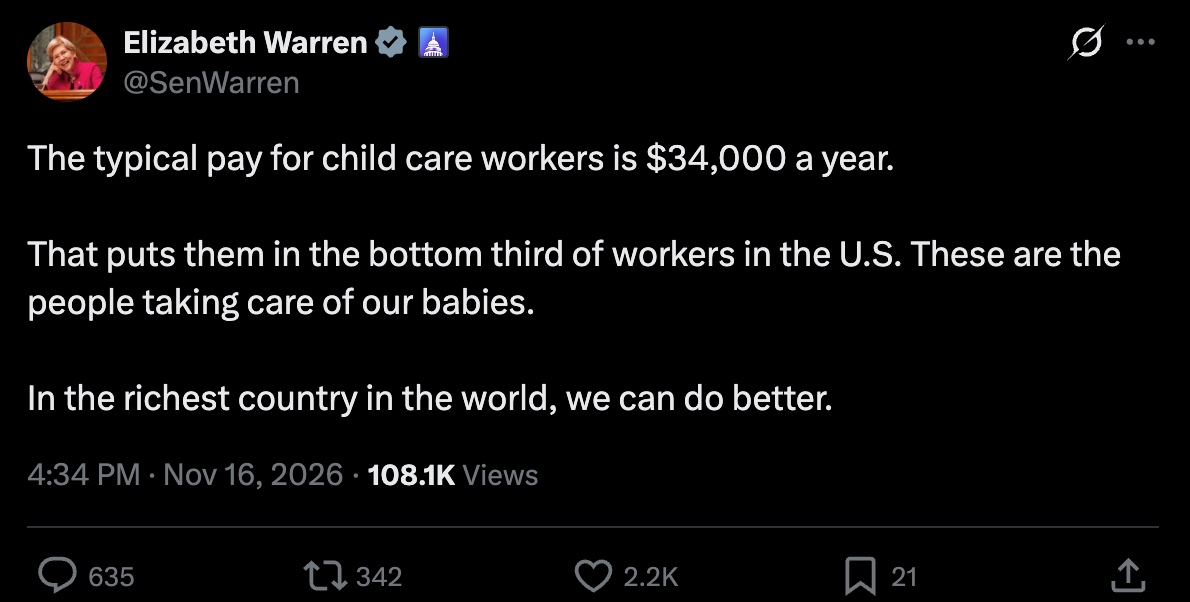
The typical pay for child care workers is $34,000 a year. That puts them in the bottom third of workers in the U.S. These are the people taking care of our babies. In the richest country in the world, we can do better.
Warren's numbers hold up. BLS puts the typical child care worker at $34,980 a year, which assumes full-time hours many don't work. That's the bottom quarter of U.S. wage and salary workers, so "bottom third" undersells it1,2. The real fight is how to raise it: public money, or looser rules that cut what care costs to provide.
What the post says or clearly implies, checked one by one. How verdicts work
BLS puts the median at $34,980 for May 2025, its newest data, and Warren rounded down. The yearly figure assumes full-time, year-round work, which many in the field don't get, so it flatters actual take-home pay.
Warren's post gives no source3. "Typical" here means the median: half earn more, half less. BLS puts the median for childcare workers at $16.82 an hour, or $34,980 a year, in May 20251. BLS's wage survey lists May 2025 as its newest year4.
BLS's yearly figures assume a full-time, year-round schedule of 2,080 hours5. BLS says part-time work is common in the job1, so many child care workers take home less than $34,980 in a year. The survey behind that median covers wage and salary workers in nonfarm establishments, not the self-employed or household workers4. It counts 518,910 childcare workers6.
UC Berkeley's Center for the Study of Child Care Employment, a research center that backs higher pay, measures "early educators": everyone who works with children from birth to age five, in centers or homes. Using a new methodology that includes self-employed providers, it found a 2022 median of $13.07 an hour7. That isn't directly comparable to BLS's $16.82.
If anything, it understates. In the same BLS survey, a quarter of U.S. wage and salary workers earned less than $37,590 in May 2025. The typical child care worker, at $34,980, falls below that line, in the bottom quarter.
In May 2025, a quarter of U.S. wage and salary workers earned less than $37,590 a year2. The child care median, $34,980, sits below that1. Both yearly figures assume 2,080 hours5, so the comparison is like for like. A child care worker at the field's 75th percentile earned $38,570, barely above the line8.
Berkeley's center, using its own methodology that includes the self-employed, says 97 percent of other occupations are paid more than early educators7. That ranks jobs, not workers, but it points the same way.
The gap hasn't widened. A different BLS survey tracks hourly pay for nonsupervisory staff in child care businesses, an average across all their jobs ($19.69 in 2025), so it runs above the $16.82 occupation median. Before inflation, it rose 81% from 2007 to 2025 by our calculation, matching the private sector's 80%9,10. After inflation, child care pay rose about 16%, by our calculation9,11.
BLS series CEU6562440008, annual average, as published.
| Year | Child care industry | All private industries |
|---|---|---|
| 2007 | $10.90 | $17.41 |
| 2008 | $11.32 | $18.06 |
| 2009 | $11.91 | $18.61 |
| 2010 | $11.99 | $19.04 |
| 2011 | $11.82 | $19.44 |
| 2012 | $11.83 | $19.73 |
| 2013 | $12.00 | $20.13 |
| 2014 | $12.44 | $20.60 |
| 2015 | $12.57 | $21.03 |
| 2016 | $12.77 | $21.53 |
| 2017 | $13.08 | $22.05 |
| 2018 | $13.50 | $22.71 |
| 2019 | $14.16 | $23.51 |
| 2020 | $14.97 | $24.68 |
| 2021 | $15.85 | $25.90 |
| 2022 | $17.50 | $27.57 |
| 2023 | $18.38 | $28.93 |
| 2024 | $19.12 | $30.13 |
| 2025 | $19.69 | $31.35 |
Facts can't settle this part, so we don't rule on it.
Should taxpayers pay to raise child care wages, or should states loosen the rules that make care costly to provide?
Both sides start from the same squeeze. Child Care Aware of America, an advocacy and research group, puts the national average annual price of child care at $13,184 in 2025, averaged across 47 states. It found prices rose 23% from 2021 to 2025, against 24% for prices overall12. Over the longer run, since 2007, day care and preschool prices rose 80%, in step with child care pay and well ahead of overall prices (55%), by our calculation from BLS data13,11,9.
Parents can't pay more, so low wages fill the gap. Public funding should pay care workers like the educators they are.
Low pay is already a hidden subsidy. Berkeley's center finds 13.1 percent of early educators earn below the poverty line, against 2.3 percent of elementary and middle school teachers. It says 43 percent of their families rely on programs like Medicaid and food stamps, costing taxpayers more than $4.7 billion a year7. The typical child care worker sits in the bottom quarter of U.S. wage earners2,1.
Supporters say public money works where it's spent. Teaching staff with a bachelor's degree in school-sponsored pre-K were paid more than $20,000 more a year than those in centers without public funding, a gap associated with public money7. Warren's Child Care for Every Community Act, reintroduced Sept. 30, 2025, would cap costs at 7% of income for higher-income families, fully cover families below 75% of state median income, and require wages and benefits comparable to similarly credentialed public school teachers14.
Rules on ratios and credentials drive up costs, and strict ratios hold down wages. Subsidies just move the bill to taxpayers.
Regulation makes care expensive. Economists Diana Thomas and Devon Gorry, for the free-market Mercatus Center in 2015, found that allowing one more infant per staff member is associated with 9 to 20 percent lower costs. Requiring lead teachers to hold a high school diploma was tied to 25 to 46 percent higher infant care costs15. Strict ratios also hold down wages, because more staff are needed for the same number of children15.
Ryan Bourne of the libertarian Cato Institute argued in 2018 that none of the proposed fixes for costly care would make it cheaper: "They would simply transfer the high costs to taxpayers." He cites research finding that tightening ratios by one child cuts the number of centers in an average area by 10 percent, with "no apparent impact on quality," and that the harm falls "almost entirely in poorer areas" and on single mothers16.
Every source was opened and read. Advocacy groups are labeled as such.
Think we got something wrong? Email editor@viewfromthegallery.com with a source. Corrections are made openly and logged on the page.
New breakdowns in your inbox: what was true, what wasn't, and what the argument is really about. No ads, no spin.