USAID · Foreign aid · Budget

The USAID totals match the record. Ukraine aid drove Biden's peak.

The totals are USAID's own obligations data [[fa-managing-agency]]. The $1.4 billion counts USAID after it stopped running aid, and some programs moved to State [[pbs-83-percent]].

· @ginamilan_ · on XThe post we're checking
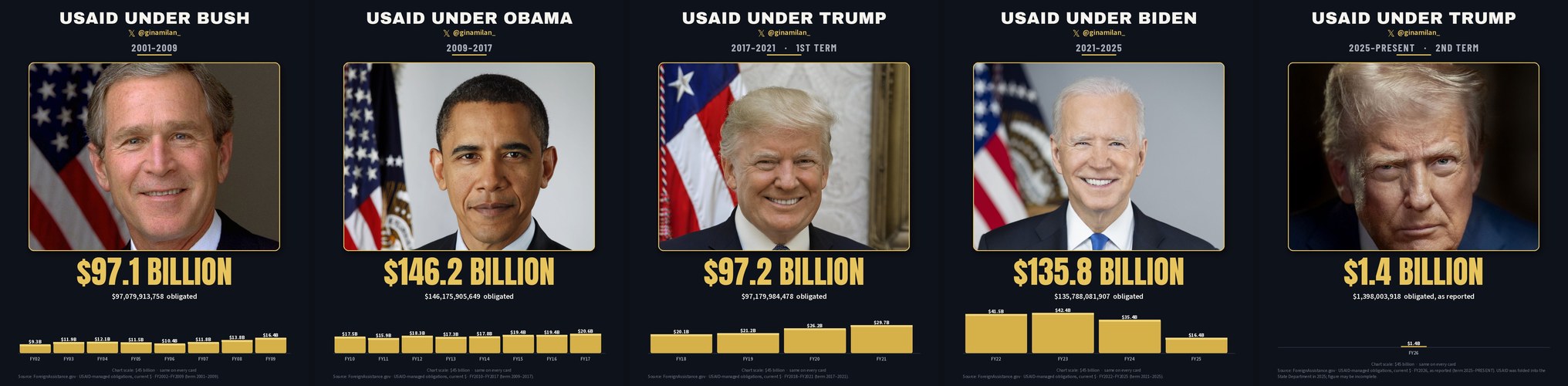
USAID spending by president:

Bush: $97.1B (8 years)
Obama: $146.2B (8 years)
Trump: $97.2B (4 years)
Biden: $135.8B (4 years)
Trump 2nd term: $1.4B

Total: $477.6 BILLION of your tax dollars.

If Trump didn't shut it down, the money would still be flowing.
The five images attached to @ginamilan_'s post on X, shown side by side. Each card cites ForeignAssistance.gov, "USAID-managed obligations, current $.". Shown for commentary.
Read the post as text
USAID spending by president: Bush: $97.1B (8 years) Obama: $146.2B (8 years) Trump: $97.2B (4 years) Biden: $135.8B (4 years) Trump 2nd term: $1.4B Total: $477.6 BILLION of your tax dollars. If Trump didn't shut it down, the money would still be flowing.
Posted Nov 27, 202699,158 views and 4,719 likes on X as of Nov. 29, 2026. Milan has about 133,000 followers.See the original

The bottom line

The four term totals match USAID's obligations on ForeignAssistance.gov to the dollar. About $37 billion of Biden's total went to Ukraine1. The $1.4 billion is USAID's fiscal 2026, after it stopped running aid, now revised to $1.7 billion1,2. USAID and State obligations halved in 20251. Congress appropriated $50 billion for State and foreign programs for 20263.

The claims

What the post says or clearly implies, checked one by one. How verdicts work

1

USAID spent $97.1B under Bush, $146.2B under Obama, $97.2B in Trump's first term and $135.8B under Biden.

Checks out

These are USAID-managed obligations from ForeignAssistance.gov, in current dollars, and they match to the dollar. The post uses a common convention: a fiscal year goes to the president in office when it starts on Oct. 11,4.

We added up the site's managing-agency file by fiscal year. Bush's fiscal 2002–2009 obligations come to $97,079,913,758, the exact figure on the post's card, and the other three terms match too, by our calculation1,4. With the second-term figure, the five add to $477.6 billion.

Obligations are money committed, not money paid out. Disbursements, the money actually paid, land within 6% of each term's obligations1.

That convention matters most for fiscal 2025, which began Oct. 1, 2024. The post gives that year's $16.4 billion to Biden, though Trump took office Jan. 20. Award records lean the same way: of USAID's net award obligations that year, $8.9 billion came before Jan. 20 and $3.7 billion after, by our USAspending query5.

2

By the post's own year counts, Biden's USAID spending per year was the highest of the four presidents.

Missing context

True: about $33.9 billion a year in current dollars, $35.8 billion in 2025 dollars. But $37.1 billion of it went to Ukraine. Without Ukraine, Biden's average matches Trump's first term in current dollars and trails it in 2025 dollars1.

USAID-managed obligations for Ukraine rose from $246 million in fiscal 2021 to $16.4 billion in 2023 and totaled $37.1 billion over fiscal 2022–2025, by our calculation1. Much was budget support for Ukraine's government. GAO counts $30.2 billion of that support disbursed from April 2022 to December 2024, a different measure from obligations6.

Our without-Ukraine figure uses USAID-managed obligations for fiscal 2022–2025, with 2025 counted as Biden's, as the post does. In current dollars that's $98.7 billion, about $24.7 billion a year, against $24.3 billion for Trump's first term. In 2025 dollars it's $26.0 billion a year against Trump's $29.6 billion. Fiscal 2025 includes Trump's freeze, which pulls Biden's average down1,7.

Trump's first-term total rose too, from $20.1 billion in fiscal 2018 to $29.7 billion in 2021. Worldwide obligations not tied to one country (code WLD) went from $4.65 billion to $11.18 billion. We didn't trace why. In 2025 dollars the term totals are Bush $150.8 billion, Obama $197.2 billion, Trump $118.4 billion and Biden $143.1 billion1.

USAID obligations peaked in fiscal 2022–2023, as Ukraine aid flowed

Bushavg $12.13Obamaavg $18.27Trumpavg $24.30Bidenavg $33.95$0$10$20$30$40$50200220042006200820102012201420162018202020222024FY2023 peak (current $): $42.45FY2025: $16.39

Sum of all USAID-managed obligations, every country and worldwide, ForeignAssistance.gov managing-agency summary, billions of current dollars. Our calculation.

USAID-managed obligations by fiscal year, in billions, from ForeignAssistance.gov. Toggle for 2025 dollars, using the site's adjustment. Shading follows the post's terms. Fiscal 2026 ($1.7 billion as reported) is left off because USAID had stopped running aid1,2.
Show the numbers
USAID obligations peaked in fiscal 2022–2023, as Ukraine aid flowed: the numbers
YearCurrent dollars2025 dollars
2002$9.27$15.77
2003$11.85$19.79
2004$12.12$19.76
2005$11.50$18.19
2006$10.36$15.87
2007$11.77$17.56
2008$13.82$20.18
2009$16.39$23.71
2010$17.51$25.10
2011$15.92$22.37
2012$18.29$25.25
2013$17.32$23.48
2014$17.82$23.73
2015$19.41$25.58
2016$19.36$25.31
2017$20.55$26.42
2018$20.07$25.23
2019$21.21$26.20
2020$26.16$31.89
2021$29.74$35.06
2022$41.51$45.71
2023$42.45$44.67
2024$35.44$36.37
2025$16.39$16.39
3

Trump's second term: $1.4 billion.

Missing context

That's USAID's reported fiscal 2026 obligations as of September, since revised to $1.7 billion. It leaves out USAID's commitments from Jan. 20 to Sept. 30, 2025, and the 18% of programs Rubio kept and moved to State1,7.

The card itself says the figure "may be incomplete"4. Fiscal 2026 ended Sept. 30, and USAID's reporting for it runs through the fourth quarter, though the site marks it partial and warns data can lag up to two years. The Oct. 30 update raised USAID's 2026 obligations to $1,703,768,0392,1.

The convention that gives fiscal 2025 to Biden also keeps Trump's first eight months out of his column. USAID's net award obligations from Jan. 20 to Sept. 30, 2025 were $3.7 billion, by our query5. The agency disbursed $23.7 billion that fiscal year1.

The small number reflects a real collapse. Rubio said in March 2025 that about 5,200 of USAID's 6,200 programs were gone and the remaining 18% would move to State. USAID stopped running foreign aid on July 1, 20257,8. State's own obligations, including that work, fell from $23.9 billion in fiscal 2024 to $13.3 billion in 20251.
4

If Trump didn't shut it down, the money would still be flowing.

Missing context

USAID's flow largely stopped, and combined USAID and State obligations halved, from $59.3 billion in fiscal 2024 to $29.7 billion in 2025. Congress then appropriated $50.07 billion for 2026, not all of it aid1,3.

Congress passed the fiscal 2026 State and foreign programs act as part of a six-bill package, 71–29 in the Senate and 217–214 in the House, and Trump signed it Feb. 39,3. It appropriates $50.07 billion in budget authority, 3.5% below 2025. That isn't all aid: $16.63 billion is for State's own operations and related agencies. Bilateral economic aid gets $23.35 billion, including $9.42 billion for global health and $5.5 billion for humanitarian aid3.

Appropriated isn't spent. State's partial fiscal 2026 data, through the first quarter, show $3.92 billion obligated and $10.89 billion disbursed1,2.

Cuts did happen. The Rescissions Act of 2025 canceled $7.67 billion in unspent fiscal 2025 foreign affairs money. The title that used to pay for USAID's own operations got $174.5 million for 2026, 90.9% less than in 20253.

The real disagreement

Facts can't settle this part, so we don't rule on it.

Is spending tens of billions a year on foreign aid worth it, and who should run it?

Foreign aid has run between 0.7% and 1.4% of federal outlays since 2001, Pew found10. The fight is over what that money buys. We've covered the death estimates tied to the cuts11 and the USAID Files12.

Aid should be targeted and serve U.S. interests

Decades of USAID money bought too little, and what's left should be targeted, time-limited and run by State.

Rubio says a review of "over $715 billion in inflation-adjusted spending over the decades" showed USAID "fell well below" the standard of advancing U.S. interests. "Development objectives have rarely been met, instability has often worsened, and anti-American sentiment has only grown," he wrote. Sub-Saharan African nations voted with the U.S. on key UN resolutions only 29% of the time in 2023, after $165 billion in outlays since 19918.

Oversight was weak where the money was biggest, this side argues. Contractors for USAID and the World Bank found weaknesses in Ukraine's controls over the project that carried U.S. budget support, and GAO found USAID never assessed which posed the highest risk6. Rubio's alternative: "trade over aid, opportunity over dependency," with help "targeted and time limited" for nations willing to help themselves8.

Aid is cheap and saves lives

Foreign aid is about 1% of the budget, and cutting it costs lives and U.S. standing.

The $71.9 billion the government disbursed in fiscal 2023 was 1.2% of federal outlays. Most of the $16 billion for health went to HIV/AIDS, tuberculosis, malaria and influenza, and the U.S. supplied more than 40% of the humanitarian aid the UN tracked in 202410. A Boston University model projected 781,343 deaths in a year from the cuts, a projection rather than a count11.

Congress largely agreed, this side notes. Senators voted 71–29 for a six-bill package that included the fiscal 2026 State and foreign programs act9. That act kept global health at $9.42 billion, 1.9% below 2025, though humanitarian accounts got 25.8% less3.

Where they agree

  • The administration's 2026 request and the final act both funded HIV/AIDS programs, at $2.91 billion and $4.63 billion, all run by State3.
  • Congress funded State and foreign programs for fiscal 2026 within 3.5% of 2025 while cutting USAID's operating title by 90.9%3.

What would change minds

  • Complete fiscal 2026 data for State and USAID, which ForeignAssistance.gov says can take up to two years, showing how much aid went out after the merger2.
  • Counts of deaths and disease where canceled programs ended, compared with the projections11.

Sources

Every source was opened and read. Advocacy groups are labeled as such.

Show all 12 sources
  1. 1
    Managing Agency Summary: obligations and disbursements by managing agency and country, 2001 to present
    ForeignAssistance.gov (U.S. Department of State)2026-10-30DataThe site blocks automated fetches; opened in a browser. Term sums, Ukraine totals and per-year averages are our calculation from the CSV. The post's figures match the Sept. 2, 2026 version; the Oct. 30 version changes only fiscal 2026.
  2. 2
    Status: Financial Data Reporting Status by Fiscal Year
    ForeignAssistance.gov (U.S. Department of State)2026-10-30DataStatus tab of the About page. Opened in a browser.
  3. 3
  4. 4
    "USAID spending by president" post and five attached cards
    X (@ginamilan_)2026-11-27Primary documentEach card cites "ForeignAssistance.gov · USAID-managed obligations, current $." The second-term card says "figure may be incomplete."
  5. 5
    Spending Over Time API (queried for USAID award obligations, fiscal 2025, split at Jan. 20, 2025)
    USAspending.gov (U.S. Treasury)2026-11-29DataOur query of api.usaspending.gov/api/v2/search/spending_over_time, awarding agency USAID. Covers awards only, net of deobligations, so it is smaller than ForeignAssistance.gov's total.
  6. 6
  7. 7
  8. 8
    Making Foreign Aid Great Again
    U.S. Department of State (Secretary Marco Rubio, State Department Substack)2025-07-01Primary document
  9. 9
    Congress Approves FY 2026 National Security, Department of State Appropriations Bill
    Senate Appropriations Committee (majority)2026-02-03Primary document
  10. 10
    What the data says about U.S. foreign aid
    Pew Research Center2025-02-06Research
  11. 11
  12. 12

Think we got something wrong? Email editor@viewfromthegallery.com with a source. Corrections are made openly and logged on the page.