Read the post as text
JUST IN: U.S. House records reveal the Trump administration approved exports of 879,000 Nvidia & AMD AI chips to China over 6 months.
Records a House chairman released show Commerce approved the Nvidia and AMD chips. The figures are a May snapshot, and none had shipped then.
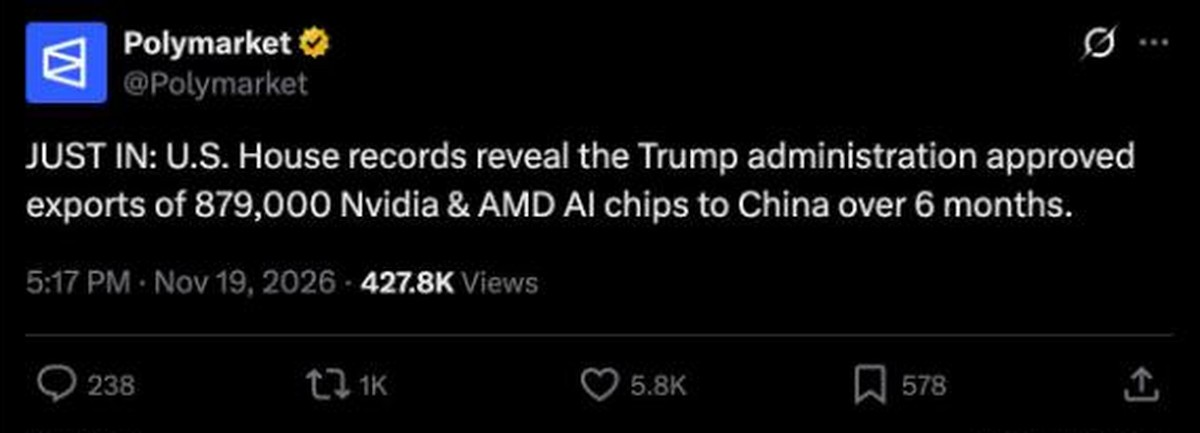
JUST IN: U.S. House records reveal the Trump administration approved exports of 879,000 Nvidia & AMD AI chips to China over 6 months.
The number is real. Commerce approved 879,868 Nvidia H200 and AMD MI325X chips for Chinese companies, a House committee's release shows1. The tally is a May 11 snapshot, and every approved license then read "not shipped"2. Some H200s reached China later3,4. Nvidia has now stopped shipping licensed Hopper chips, the H200's family5.
What the post says or clearly implies, checked one by one. How verdicts work
Commerce records show 879,868 Nvidia H200 and AMD MI325X chips approved for Chinese companies across 21 licenses, about a quarter of the 3.4 million requested. By our count, 579,868 were Nvidia's and 300,000 AMD's.
Rep. Brian Mast, the Republican who chairs the House Foreign Affairs Committee, used his power under the Export Control Reform Act to publish the records Nov. 196. The committee's summary says the Bureau of Industry and Security (BIS), Commerce's export licensing office, "approved the export, re-export, or transfer (in-country) of 879,868 covered integrated circuits to PRC companies across 21 license applications, as of May 11, 2026." The chips are Nvidia's H200 and AMD's MI325X1.
Approvals include 75,000 chips for Alibaba, 150,000 for Tencent and its subsidiaries, 43,000 for Baidu and 4,000 for BYD. The committee says all four are on the Pentagon's list of Chinese military companies1. Others went to ByteDance, JD, DiDi, Kuaishou and Tesla's Shanghai unit, in lots from 8 chips to 75,000. Seventeen licenses were Nvidia's and four AMD's2.
BIS marked other big requests "RWA," which we read as returned without action. They include Nvidia applications for 610,000 chips to Alibaba and 508,000 to a ByteDance unit in Malaysia2. "House records" fits: a House committee obtained and released these Commerce records6.
The release is new. The numbers are not. They are a snapshot from May 11, 2026, covering applications filed from Dec. 9, 2025, to April 16, 2026. Approvals after May 11 aren't counted.
The post says "over 6 months"7. Neither the committee's release nor its summary mentions six months6,1. The BIS table is titled "H200 License and Equivalent Application Status as of May 11, 2026." Its approved applications were filed between Dec. 9, 2025, and April 16, 2026, about four months, and it doesn't say when each was approved2.
The window follows the policy. Trump announced Dec. 8, 2025, that Nvidia could ship H200s to "approved customers in China"8,9. A BIS rule moving these chips from a presumption of denial to case-by-case review took effect Jan. 15, 202610. Nvidia made the first approval public Feb. 25, according to Rep. Gregory Meeks and Sen. Elizabeth Warren11.
The summary itself says the committee holds other applications "not fully reflected" in the May tally, such as a Dec. 19 Nvidia request to send 445,000 H200s to Tencent1. Whatever BIS decided after May 11 isn't public.
Approval isn't delivery. All 21 licenses read "not shipped" in May. Some H200s reached China later. There's no official count, only an anonymous estimate. Nvidia says it has stopped shipping licensed Hopper chips.
Every approved line in the BIS table reads "Approved, not shipped"2. In July, BIS chief Jeffrey Kessler told the committee that "very few shipments against licenses for H200s and equivalents have taken place"3.
Nvidia later reported selling $2.4 billion of licensed Hopper data center products, the family that includes the H200, to China in the quarter ended Oct. 25. On Nov. 17, interim CEO Colette Kress said, "we are no longer shipping licensed Hopper data centre products to China," without saying why5. Reuters reported Nov. 6 that about 600,000 H200s sat in Hong Kong as Beijing withheld approval for large-scale imports. One source said several Chinese internet companies had each obtained about 10,0004.
Beijing is part of the gap. CNAS wrote in January that Chinese customs had reportedly told agents H200s were not permitted to enter12. We found no public count of AMD MI325X shipments.
Facts can't settle this part, so we don't rule on it.
Should the U.S. sell China older but still capable AI chips for revenue and market share, or hold them back to slow China's AI and its military?
The two camps split over whether selling China the H200 helps or hurts America's position in AI13,14. Under the deal, Washington takes a 25 percent cut, collected as an import tariff on chips headed to China12,15.
Selling older chips to vetted Chinese buyers earns revenue and takes market share from Huawei.
Trump said sales would go ahead "under conditions that allow for continued strong National Security," adding, "$25% will be paid to the United States of America"16. BIS requires exporters to show China sales won't cut supply for U.S. customers, to vet buyers, and to have chips tested by an independent lab in the U.S.9. China's total is capped at 50 percent of the computing power shipped to U.S. customers for the same chip10. "Permitting the sale of the H200 to China under controlled conditions will strengthen the American technology ecosystem," Kessler said9.
White House AI adviser David Sacks called the H200 a "lagging" chip and said selling it meant "you can take market share away from Huawei"13. Nvidia called sales to vetted customers "a thoughtful balance that is great for America"8. Nvidia's newest Blackwell chips stay banned3.
Computing power is what holds China's AI back, and these sales give it to companies the Pentagon ties to China's military.
CFR's Chris McGuire writes the H200 has over six times the processing power of the H20, previously the best allowed, and Huawei's roadmap plans no chip beating it before the Ascend 960 in Q4 2027. In his hypothetical, three million H200s exported in 2026, over three times the 879,868 approved, would give China more AI computing power than it could make until 2028 or 202914. Mast's release stresses approvals for "Department of War-designated Chinese Military Companies"6.
CNAS analysts call the safeguards "almost entirely unenforceable," since chips can be redirected inside China and military-civil fusion blurs company and army12. Every application stated the diversion risk was "low," the committee's summary says. Most Nvidia applications named Maginfra and Beijing New Matrix as installers, two of three firms public reports had questioned1. Mast wants every company the Pentagon lists as a Chinese military company on the entity list3.
Every source was opened and read. Advocacy groups are labeled as such.
Think we got something wrong? Email editor@viewfromthegallery.com with a source. Corrections are made openly and logged on the page.
New breakdowns in your inbox: what was true, what wasn't, and what the argument is really about. No ads, no spin.