Economy · Trade

Thailand would end tariffs on about 99% of U.S. goods. Not signed yet

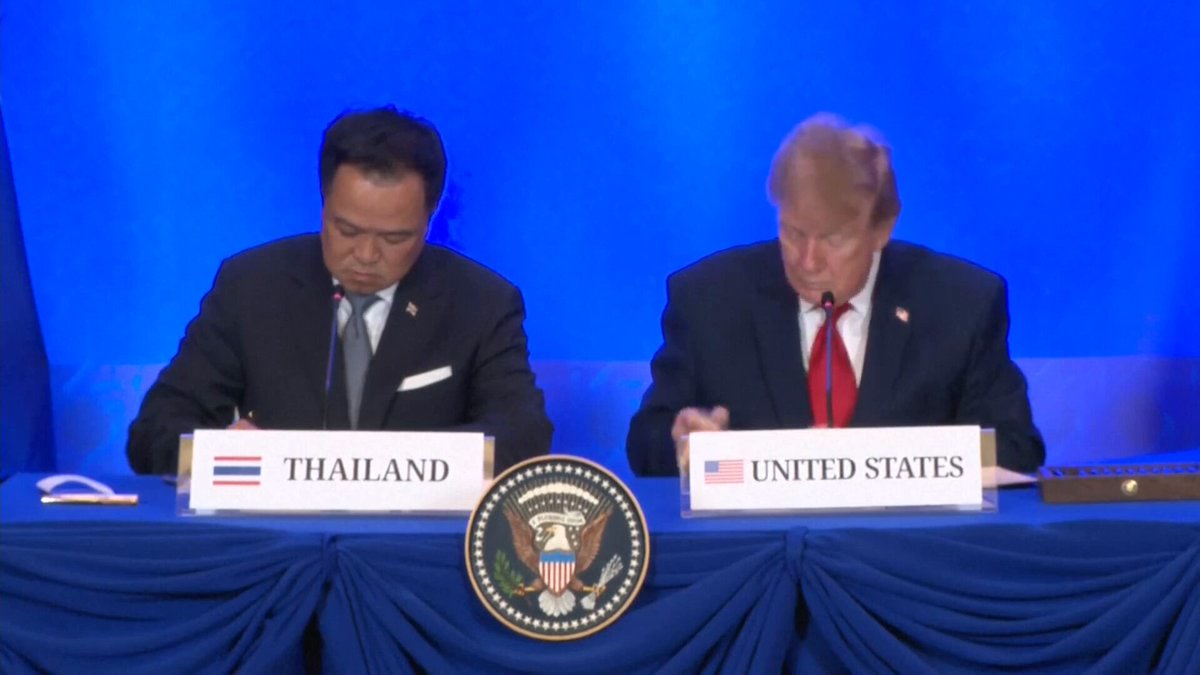
Trump and Thailand's prime minister signed a statement that talks are nearly done. The terms date to 2025, and Thai officials plan farm-goods limits.

· @EricLDaugh · on XThe post we're checking
🚨 BREAKING: By stroke of pen, President Trump signs a trade framework with Thailand where the nation will ELIMINATE ALL tariffs on US exports, remove substantial non-tariff barriers on American vehicles, medical devices, pharmaceuticals, ethanol and poultry...and BUY an estimated $2.6 billion in additional U.S. agricultural products 🇺🇸

47 is securing more economic wins while overseas!

He ALWAYS uses these overseas trips to help business back home.
Still from the video in the post on X. Shown for commentary.
Read the post as text
🚨 BREAKING: By stroke of pen, President Trump signs a trade framework with Thailand where the nation will ELIMINATE ALL tariffs on US exports, remove substantial non-tariff barriers on American vehicles, medical devices, pharmaceuticals, ethanol and poultry...and BUY an estimated $2.6 billion in additional U.S. agricultural products 🇺🇸 47 is securing more economic wins while overseas! He ALWAYS uses these overseas trips to help business back home.
Posted Nov 17, 2026About 717K views on X as of Nov. 18. A @TrumpWarRoom post with video of Trump's remarks had about 141K.See the original

The bottom line

Trump signed a joint statement in Manila, not the trade agreement. It says talks reached "substantial conclusion," but the text is unsigned and needs Thai cabinet and parliament approval. Under the 2025 framework, Thailand will eliminate tariffs on about 99% of U.S. goods. Thai officials describe pork and corn limits. The $2.6 billion is an estimate of yearly company deals.

The claims

What the post says or clearly implies, checked one by one. How verdicts work

1

President Trump signed a trade framework with Thailand.

Missing context

Trump signed a joint statement on Nov. 17 saying talks reached "substantial conclusion." The framework dates to October 2025. The final agreement is unsigned and needs Thai cabinet approval, then parliament.

The statement, signed in Manila at the ASEAN summit1,2, says the two countries "have reached substantial conclusion"3. It names no terms3,4. The terms in the post5 come from Trump's remarks6 and track the Oct. 26, 2025 framework7.

Commerce Minister Suphajee Suthumpun expects a signing in about two months and said one before the end of 2026 was unlikely. The cabinet approves before signing. Hearings and parliament follow before it takes effect4. On Nov. 16 the Thai government said existing tariff measures stay unchanged until signing8.

The 2025 framework kept a 19% U.S. tariff on Thai goods7. The Supreme Court struck down that and other emergency-powers tariffs Feb. 209, and importers are getting refunds10. A 10% surcharge followed Feb. 24. Since July 24, a 12.5% Section 301 tariff applies, over Thailand's failure to ban forced-labor imports11,12. USTR says it covers "most imports"13. Thai figures exempt $56.2 billion of $91.3 billion in 2025 exports, plus $7 billion under Section 232, leaving about a third paying it, by our calculation14.
2

Thailand will eliminate ALL tariffs on U.S. exports.

Missing context

Trump did say "all." But the only published terms say about 99% of goods, Thai officials describe limits on U.S. pork and corn, and the final product list is confidential. None of it is in force yet.

At the signing, Trump said "Thailand will eliminate all tariffs on U.S. exports"6. Both 2025 documents put it at about 99 percent of goods7,15. Nothing published since gives a different number. Suphajee says the product-by-product terms stay confidential during legal review4.

No public source lists what the excluded 1% covers. Thai officials have described limits on farm goods, to be settled in final talks16. In 2025 Thailand's finance minister said U.S. pork imports would be held under 1% of Thai consumption, with offal banned17. In August Suphajee called pork raised with beta-agonist growth promoters a red line14. For corn, Thailand announced plans to raise its zero-tariff quota to one million tons, open only February through June, with feed mills required to buy three tons of Thai corn for every imported ton18.

Suphajee also said quotas would stay available to prevent import surges that hurt Thai producers4.

3

Thailand will buy an estimated $2.6 billion in additional U.S. agricultural products.

Missing context

The figure is from the 2025 framework: an estimate of yearly deals between companies, not a government obligation. It would be new business if the deals happen. The U.S. sold Thailand $1.34 billion in farm goods in all of 2025.

The 2025 joint statement "take[s] note of the forthcoming commercial deals between U.S. and Thai companies," including feed corn, soybean meal and distillers grains, "with an estimated value of $2.6 billion per year"7. Trump repeated the number a year later6.

"Additional" fits. U.S. farm exports to Thailand were $1.34 billion in 2025 and have shrunk by 1.66% a year on average since 2016, USDA says19. Distillers grains were $59.14 million. Neither corn nor soybean meal makes USDA's top-10 table, which ends at $40.17 million, so the three products totaled under about $140 million, by our calculation19. The $2.6 billion is nearly twice all U.S. farm sales to Thailand in 2025.

We found no public tally of deals signed under the pledge. Thailand's main tool, the zero-tariff corn quota, was set to open in 202618.

The real disagreement

Facts can't settle this part, so we don't rule on it.

Should the U.S. trade its market access for near-zero tariffs abroad while keeping tariffs of its own?

Under the 2025 framework, Thailand would cut tariffs to near zero while the U.S. kept a tariff on Thai goods7. The U.S. ran a $71.7 billion goods deficit with Thailand in 2025, up from $45.0 billion in 202420.

Tariffs are leverage that pry markets open

Greer says tariff threats won openings free-traders sought for decades, and that foreign exporters paid much of the cost.

U.S. Trade Representative Jamieson Greer says 19 partners with nearly 40% of world GDP signed deals in which the U.S. set a lower tariff in exchange for the "resolution of longstanding tariff and nontariff barriers," which he calls "a prize free-trade fundamentalists have sought for decades"21. Thailand agreed to accept U.S.-standard cars and FDA approvals for drugs and devices, and to issue permits for U.S. ethanol7.

On cost, Greer cites a July paper by UC San Diego's Caroline Freund finding foreign exporters absorbed roughly 40% to 50% of the 2025 tariff increases. Greer says shoppers were spared, quoting Morningstar's Preston Caldwell that U.S. firms are "footing most of the tariff bill"21. Thai officials said the deal was important to retaining the U.S. market2. The forced-labor tariff also presses partners to ban goods made with forced labor, as the U.S. has for nearly a century13.

Trade deals should cut barriers on both sides

Americans pay U.S. tariffs, and a deal that keeps them while partners drop theirs isn't reciprocal.

"There is nothing 'reciprocal' about the agreed tariff rates," a CSIS analysis says: the U.S. used its market size to drive its own rates and partners' rates "further apart"22. The Tax Foundation estimates U.S. tariffs will raise taxes by an average of $820 per household in 2026, after $1,000 in 202523. A tariff Thailand drops lowers costs for Thai buyers. The U.S. tariff that stays is a tax collected at home.

Boston University's Global Development Policy Center says these agreements "grant disproportionate rights to the United States," such as purchase commitments with no U.S. equivalent24. PIIE researchers say partners are caught between U.S. demands and possible Chinese retaliation25. The CSIS author warns the pressure could make China a more attractive place to invest22.

Where they agree

  • Neither government has published the final text or the product list, so both sides are arguing over terms no one outside the talks has seen3,4.
  • U.S. farm sales to Thailand were lower in 2025 than in 2016, so new purchases would be a real change19.

What would change minds

  • The signed agreement, with Thailand's full tariff schedule and the U.S. rate on Thai goods.
  • USDA export data for 2026 and 2027 showing whether U.S. corn, soybean meal and distillers grain sales to Thailand approach $2.6 billion a year.
  • Studies of who paid the 2026 Section 301 tariffs: foreign exporters, U.S. importers or U.S. consumers.

Sources

Every source was opened and read. Advocacy groups are labeled as such.

Show all 25 sources
  1. 1
    Trump: Thailand to drop all tariffs on U.S. goods as deal nears
    One America News Network2026-11-17Journalism
  2. 2
    Thailand and US sign joint reciprocal trade statement ahead of full trade agreement
    Asia News Network2026-11-18JournalismSyndication network. The page doesn't name the original outlet. Reports the Thai government spokesman's announcement.
  3. 3
  4. 4
  5. 5
    Eric Daugherty (@EricLDaugh), post on X, Nov. 17, 2026
    X2026-11-17Primary documentRead via the fxtwitter API on Nov. 18: 717,165 views.
  6. 6
    Trump War Room (@TrumpWarRoom), post on X with video of Trump's remarks at the signing
    X2026-11-17Primary documentWhite House video feed. Quotes are from our transcript of the 52-second clip.
  7. 7
  8. 8
  9. 9
    Supreme Court Rules Against Tariffs Imposed Under the International Emergency Economic Powers Act (IEEPA)
    Congressional Research Service (EveryCRSReport copy)2026-02-23Research
  10. 10
    Our breakdown of companies' tariff refunds
    View from the Gallery2026-11-17Journalism
  11. 11
    Business Impact of New US Section 301 Tariffs on Thailand
    Tilleke & Gibbins2026-10-02JournalismClient alert from a Southeast Asian law firm.
  12. 12
  13. 13
  14. 14
  15. 15
  16. 16
    Thailand's Zero Tariff Vow to Trump Still Limits US Imports
    Bloomberg LawJournalismPaywalled. We read the opening paragraphs.
  17. 17
  18. 18
    Thailand opens door to U.S. corn under its zero-tariff pledge
    Bloomberg, via Farm Futures/Barchart2025-11-11Journalism
  19. 19
    Thailand: U.S. Trade with Thailand in 2025
    USDA Foreign Agricultural ServiceDataBlocks automated requests. We read it in a browser on Nov. 18.
  20. 20
    Trade in Goods with Thailand
    U.S. Census BureauDataNominal dollars, not seasonally adjusted.
  21. 21
  22. 22
    The Deal of the ART: Assessing the "America First" Trade Policy in Asia
    Center for Strategic and International Studies2026-05Advocacy / think tankForeign-policy think tank. Commentary by a nonresident senior associate.
  23. 23
    Trump Tariffs Tracker: Rates, Revenue, and Impact
    Tax FoundationAdvocacy / think tankTax policy think tank.
  24. 24
    US "Reciprocal" Trade Agreements and the Seven Sovereignties Constrained for Developing Countries
    Boston University Global Development Policy Center2026-09-24ResearchUniversity research center focused on development policy.
  25. 25
    US reciprocal trade deals are built to push America's trade partners away from China
    Peterson Institute for International Economics2026Advocacy / think tankEconomics think tank that generally favors open trade.

Think we got something wrong? Email editor@viewfromthegallery.com with a source. Corrections are made openly and logged on the page.