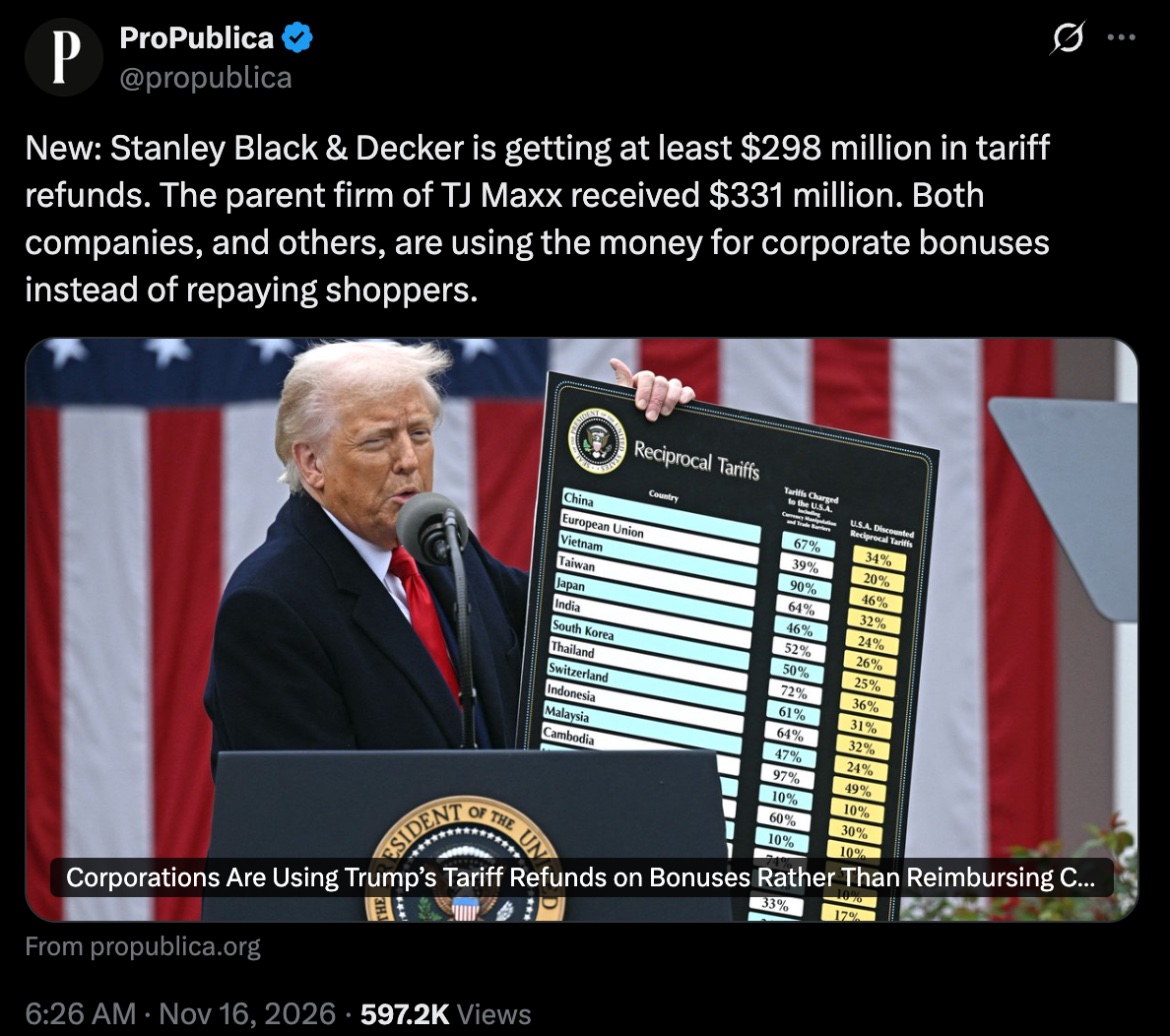
Both companies tie bonus spending to the refunds in their own reports. But TJX accrued $112 million of its $331 million for bonuses, for employees globally. Stanley hasn't said how much of its related costs went to bonuses.
TJX was explicit: "Due to these tariff refunds, the Company accrued incremental expenses of $112 million for year-end incentive compensation and discretionary bonuses for eligible Associates globally"8. That is about 34% of the refund, by our calculation, and it is an accrual, not yet paid. TJX hasn't said how far down the ranks the bonuses go, and said the rest "will be used to support our future growth"9.
Stanley says its refund gains were partially offset by "directly attributable variable incentive compensation costs, growth investments, and taxes (for EPS only)"10,11. Those pretax costs were $83.4 million and $48.2 million in the last two quarters, at least $131.6 million through Q3 by our calculation, with no split between bonuses and investments6. More offsets land in the fourth quarter, its finance chief said7. He cited $70 million to $80 million of growth spending pulled forward from 20276.
"And others" holds up. ProPublica counted at least nine companies using refunds for bonuses. One is Titleist's parent Acushnet, which disclosed about $12.0 million in incentive compensation expense9.