Elections · Presidency

The 272 math works, but none of those states has joined the compact

A viral post says Democrats now control enough states to let the national vote pick the president. The math holds. Passing the laws is harder.

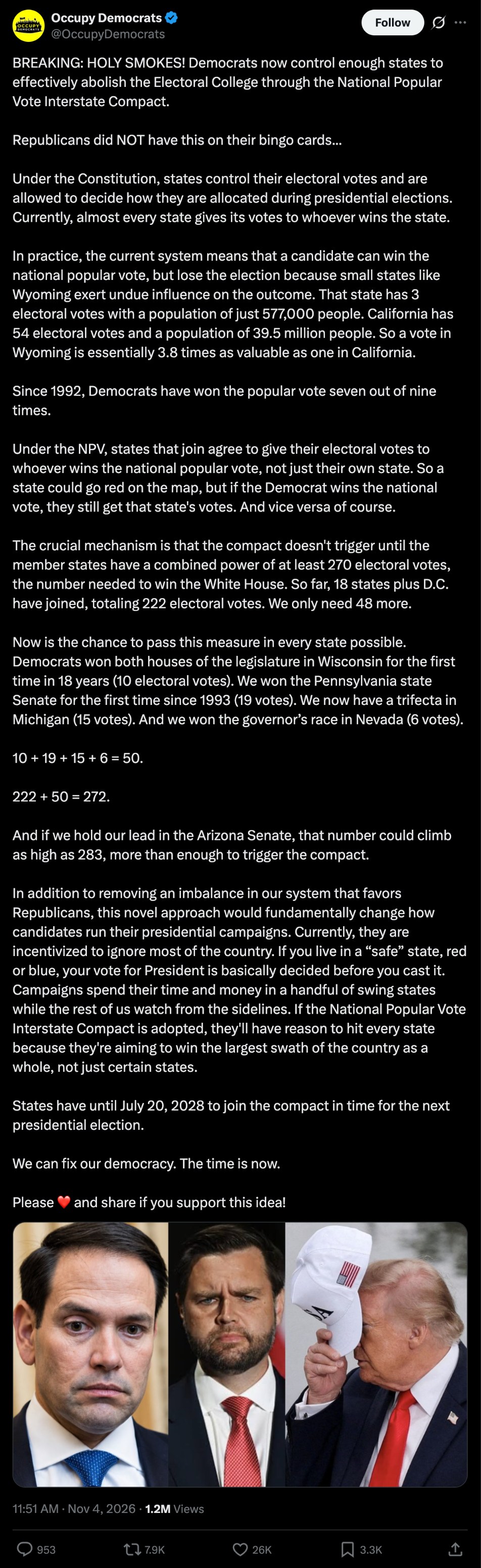
· @OccupyDemocrats · on XThe post we're checking
BREAKING: HOLY SMOKES! Democrats now control enough states to effectively abolish the Electoral College through the National Popular Vote Interstate Compact.

Republicans did NOT have this on their bingo cards...

Under the Constitution, states control their electoral votes and are allowed to decide how they are allocated during presidential elections. Currently, almost every state gives its votes to whoever wins the state.

In practice, the current system means that a candidate can win the national popular vote, but lose the election because small states like Wyoming exert undue influence on the outcome. That state has 3 electoral votes with a population of just 577,000 people. California has 54 electoral votes and a population of 39.5 million people. So a vote in Wyoming is essentially 3.8 times as valuable as one in California.

Since 1992, Democrats have won the popular vote seven out of nine times.

Under the NPV, states that join agree to give their electoral votes to whoever wins the national popular vote, not just their own state. So a state could go red on the map, but if the Democrat wins the national vote, they still get that state's votes. And vice versa of course.

The crucial mechanism is that the compact doesn't trigger until the member states have a combined power of at least 270 electoral votes, the number needed to win the White House. So far, 18 states plus D.C. have joined, totaling 222 electoral votes. We only need 48 more.

Now is the chance to pass this measure in every state possible. Democrats won both houses of the legislature in Wisconsin for the first time in 18 years (10 electoral votes). We won the Pennsylvania state Senate for the first time since 1993 (19 votes). We now have a trifecta in Michigan (15 votes). And we won the governor’s race in Nevada (6 votes).

10 + 19 + 15 + 6 = 50. 

222 + 50 = 272.

And if we hold our lead in the Arizona Senate, that number could climb as high as 283, more than enough to trigger the compact.

In addition to removing an imbalance in our system that favors Republicans, this novel approach would fundamentally change how candidates run their presidential campaigns. Currently, they are incentivized to ignore most of the country. If you live in a “safe” state, red or blue, your vote for President is basically decided before you cast it. Campaigns spend their time and money in a handful of swing states while the rest of us watch from the sidelines. If the National Popular Vote Interstate Compact is adopted, they'll have reason to hit every state because they're aiming to win the largest swath of the country as a whole, not just certain states.

States have until July 20, 2028 to join the compact in time for the next presidential election.

We can fix our democracy. The time is now.

Please ❤️ and share if you support this idea!
Screenshot of the post on X, with its attached photo collage. Shown for commentary.
Read the post as text
BREAKING: HOLY SMOKES! Democrats now control enough states to effectively abolish the Electoral College through the National Popular Vote Interstate Compact. Republicans did NOT have this on their bingo cards... Under the Constitution, states control their electoral votes and are allowed to decide how they are allocated during presidential elections. Currently, almost every state gives its votes to whoever wins the state. In practice, the current system means that a candidate can win the national popular vote, but lose the election because small states like Wyoming exert undue influence on the outcome. That state has 3 electoral votes with a population of just 577,000 people. California has 54 electoral votes and a population of 39.5 million people. So a vote in Wyoming is essentially 3.8 times as valuable as one in California. Since 1992, Democrats have won the popular vote seven out of nine times. Under the NPV, states that join agree to give their electoral votes to whoever wins the national popular vote, not just their own state. So a state could go red on the map, but if the Democrat wins the national vote, they still get that state's votes. And vice versa of course. The crucial mechanism is that the compact doesn't trigger until the member states have a combined power of at least 270 electoral votes, the number needed to win the White House. So far, 18 states plus D.C. have joined, totaling 222 electoral votes. We only need 48 more. Now is the chance to pass this measure in every state possible. Democrats won both houses of the legislature in Wisconsin for the first time in 18 years (10 electoral votes). We won the Pennsylvania state Senate for the first time since 1993 (19 votes). We now have a trifecta in Michigan (15 votes). And we won the governor’s race in Nevada (6 votes). 10 + 19 + 15 + 6 = 50. 222 + 50 = 272. And if we hold our lead in the Arizona Senate, that number could climb as high as 283, more than enough to trigger the compact. In addition to removing an imbalance in our system that favors Republicans, this novel approach would fundamentally change how candidates run their presidential campaigns. Currently, they are incentivized to ignore most of the country. If you live in a “safe” state, red or blue, your vote for President is basically decided before you cast it. Campaigns spend their time and money in a handful of swing states while the rest of us watch from the sidelines. If the National Popular Vote Interstate Compact is adopted, they'll have reason to hit every state because they're aiming to win the largest swath of the country as a whole, not just certain states. States have until July 20, 2028 to join the compact in time for the next presidential election. We can fix our democracy. The time is now. Please ❤️ and share if you support this idea!
Posted Nov 4, 20261.32M views and 27K likes on X by about 8 a.m. ET Nov. 5. A headline making the same claim was among r/politics' top posts that day.See the original

The bottom line

Democrats will control Wisconsin, Pennsylvania, Michigan and Nevada in January, and their 50 electoral votes plus the compact's 222 make 272. But none of those states has passed it, and Nevada's previous Democratic governor vetoed it. A lawsuit is all but certain. The Electoral College has tilted toward each party this century.

The claims

What the post says or clearly implies, checked one by one. How verdicts work

1

Democrats now control enough states to bring the compact to 272 electoral votes, maybe 283.

Missing context

Democrats will hold full control of Wisconsin, Pennsylvania, Michigan and Nevada in January, and 222 plus their 50 votes is 272. But none of the four has ever enacted the compact, and Arizona's legislature is uncalled.

The compact has 222 electoral votes from 18 states and D.C., after Virginia joined in April1,2. Next year Democrats will hold the governorship and both legislative chambers in Wisconsin, Pennsylvania, Michigan and Nevada3,4,5. Their 50 electoral votes would make 2726. Arizona's 11 would make 283, but its legislature is still being counted7.

Control isn't passage. None of the five has enacted the compact. Michigan Democrats held full control in 2023 and 2024, and the bill got no further than a House committee1. Nevada's legislature passed it in 2019, and Democratic Gov. Steve Sisolak vetoed it8. A 2023 version written as a state constitutional amendment needed a second passage and never got one9. Without Arizona, the margin is two votes.

The compact governs an election only if it's in effect, in states with 270 votes, on July 20 of that year10. In Michigan and Arizona, a referendum petition can hold a new law until voters decide at the next general election11,12.

2

The compact would "effectively abolish the Electoral College" in time for the 2028 election.

Missing context

If it took effect, the national popular vote would decide the winner, as backers and critics agree. But electors would still meet, and states could leave. No court has ruled on whether it needs Congress's consent.

Member states pledge their electors to "the national popular vote winner." That starts once members hold a majority of electoral votes10. The Congressional Research Service says that "would effectively establish direct popular election" of the president "while retaining the structure of the electoral college system"13. Heritage, a critic, agrees: it "would effectively abolish the Electoral College"14.

The open question is whether it needs Congress's approval under the Compact Clause. CRS calls a central part of that question "simply unresolved by the relevant case law" and expects "considerable litigation"13. A 2019 suit against Washington's law was dismissed for lack of standing and ripeness, and an appeals court affirmed in 2020 without reaching the merits15. Backers expect a suit too, noting that "no court has ever invalidated an interstate agreement for lack of congressional consent"16.

Projected 2030 reapportionment would cost today's members 9 to 11 votes and Pennsylvania and Wisconsin one each, leaving a 272-vote coalition near 260 for 2032. Adding Arizona, projected to gain one, keeps it above 270, by our calculation17.

3

The Electoral College favors Republicans, because a vote in Wyoming counts 3.8 times as much as one in California.

Missing context

The 3.8-times figure checks out, and the system has tilted Republican lately. But it tilted Democratic from 2004 to 2012, and small states' extra electors explain only a small part of the recent tilt.

By the 2020 census, Wyoming has 192,573 people per electoral vote and California 732,903, or 3.81 times as many, by our calculation18. Democrats did win the popular vote in seven of the last nine elections19.

The tilt moves. Comparing the state that decided each election with the national vote, it favored Republicans by 2.9 points in 2016 and 3.8 in 2020, and Democrats by 1.7 in 2008 and 1.5 in 2012. In 2024 it was 0.2 toward Republicans, by our calculation from FEC results19. Sabato's Crystal Ball found the same Democratic edge from 2004 to 201220.

Take away every state's two Senate-based electors and the tilt shrinks only a little, from 3.8 to 3.3 points in 2020, by our calculation19. In 2000, with D.C. at one elector, Gore wins 225 to 211. Economists find small states' extra electors have favored modern Republicans, with a "moderate" effect, and that modern Democrats "win large states by large margins and lose them by small margins"21.

The Electoral College tilt has flipped between the parties

-4-20242000200220042006200820102012201420162018202020222024Gore wins vote, loses: 0.52Clinton wins vote, loses: 2.86

Our calculation from FEC official results. States are ordered by margin, as a share of all votes cast, and the deciding state is the one that takes the winner to at least 270 pledged electors. Each Maine and Nebraska district elector is ordered by its own district margin. Positive numbers favor Republicans.

Points by which the state that decided each election was more Republican (above zero) or more Democratic (below zero) than the national vote, by our calculation from FEC results19. Sabato's Crystal Ball reports the same pattern20.
Show the numbers
The Electoral College tilt has flipped between the parties: the numbers
YearTilt toward Republicans, in points
20000.52
2004-0.36
2008-1.68
2012-1.51
20162.86
20203.83
20240.23

The real disagreement

Facts can't settle this part, so we don't rule on it.

Should the president be chosen by the national popular vote, and is an interstate compact a fair way to get there?

Changing the Electoral College itself takes a constitutional amendment, ratified by 38 states. The compact instead uses each state's power over how its electors are chosen, which the Supreme Court called "far-reaching" in 202022. A national popular vote has polled well for years: 63% favored it in Pew's 2024 survey, including 46% of Republicans23. Gallup found 58% in favor, and 32% of Republicans24. Neither asked about the compact itself.

Elect the president by national popular vote

Every American's vote for president should count equally, and states may use their own power over electors to make that happen.

The president serves every American, so every vote should count the same wherever it's cast. Today it doesn't. FairVote tracked 261 campaign events in the 2024 general election, and 94% were in seven swing states. Thirty-two states got no visit at all25. Twice since 2000 the candidate with fewer votes won, though Gore led by 543,895 and Clinton by 2,868,68619.

The compact is a lawful path. Article II lets each state appoint electors "in such Manner as the Legislature thereof may direct," and the Supreme Court called that "far-reaching authority"22. Winner-take-all isn't in the Constitution. States adopted it one law at a time, and the compact changes it the same way26. Akhil and Vikram Amar, the law professors who sketched the idea in 2001, wrote that cooperating states use "no more power than they are entitled to wield individually"27.

Keep choosing presidents state by state

Choose presidents state by state, and if the country wants a national popular vote, amend the Constitution rather than route around it.

The Electoral College was built for a union of states, and it still works. Each state counts under its own rules, so a close race means recounts in a few states28. The compact would bind member states to cast their electors for the national winner even when their own voters chose someone else14. Professor William G. Ross doubts states would keep that pledge for a candidate their voters strongly opposed28.

A national vote would reward campaigns that chase "the highest concentrations of voters most likely to support its candidate," Heritage's Thomas Jipping argues14. Changing how presidents are chosen belongs to Article V, which needs 38 states. The compact needs only states with 270 electoral votes, which Paul Godek, in Cato's Regulation, calls "an agreement among a minority of states"29. Even the Supreme Court's "far-reaching authority" for states holds only "absent some other constitutional constraint"22.

Where they agree

  • Both sides expect a court to decide whether the compact can take effect16,28.

What would change minds

  • A Supreme Court ruling on whether the compact needs Congress's consent would settle the legal question.
  • Evidence on where candidates would campaign under a national vote, across the country or mainly in big metro areas, would test the practical case on both sides.

Sources

Every source was opened and read. Advocacy groups are labeled as such.

Show all 29 sources
  1. 1
    One Plausible Path to Getting the Additional 48 Electoral Votes Needed to Activate the National Popular Vote Compact (state status)
    National Popular VoteAdvocacy / think tankThe group behind the compact. Checked Nov. 5, 2026.
  2. 2
  3. 3
    2026 State Legislative Elections: The Results and What They Mean
    National Conference of State Legislatures2026-11-04ResearchBipartisan association of state legislatures.
  4. 4
  5. 5
  6. 6
    Distribution of Electoral Votes
    National ArchivesData
  7. 7
  8. 8
  9. 9
    Nevada National Popular Vote Compact Amendment (2026)
    BallotpediaResearchNonpartisan encyclopedia of American politics.
  10. 10
    Agreement Among the States to Elect the President by National Popular Vote (bill text)
    National Popular VotePrimary documentThe compact's text, as enacted by member states, posted by its sponsor.
  11. 11
  12. 12
  13. 13
    The National Popular Vote (NPV) Initiative: Direct Election of the President by Interstate Compact (R43823)
    Congressional Research Service2019-10-28ResearchCongress's nonpartisan research arm.
  14. 14
    The National Popular Vote: Misusing an Interstate Compact to Bypass the Constitution
    Heritage Foundation2020-10-08Advocacy / think tankConservative think tank. By Thomas Jipping.
  15. 15
    Miller v. Washington, No. 19-35542 (memorandum)
    U.S. Court of Appeals for the Ninth Circuit2020-09-17Primary document
  16. 16
  17. 17
    The red baby boom could give GOP the political edge for the next decade
    Deseret News2026-01-29JournalismReports projections by the American Redistricting Project and Jonathan Cervas.
  18. 18
    2020 Census Apportionment Results, Table 1
    U.S. Census Bureau2021-04-26Data
  19. 19
  20. 20
    A Brief History of Electoral College Bias
    Sabato's Crystal Ball, University of Virginia Center for Politics2023-07ResearchWritten before the 2024 election.
  21. 21
    Inversions in US Presidential Elections: 1836–2016 (NBER Working Paper 26247)
    National Bureau of Economic Research2020-10ResearchBy Michael Geruso, Dean Spears and Ishaana Talesara. Published in American Economic Journal: Applied Economics, 2022.
  22. 22
    Chiafalo v. Washington, No. 19-465
    U.S. Supreme Court2020-07-06Primary document
  23. 23
    Majority of Americans continue to favor moving away from Electoral College
    Pew Research Center2024-09-25ResearchNonpartisan research organization.
  24. 24
  25. 25
    Presidential campaign events in 2024
    FairVote2024-11-06Advocacy / think tankNonpartisan group that backs electoral reforms, including a national popular vote.
  26. 26
    9.1 Myths about the Constitution
    National Popular VoteAdvocacy / think tankThe group behind the compact.
  27. 27
    How to Achieve Direct National Election of the President Without Amending the Constitution
    FindLaw's Writ2001-12-28Advocacy / think tankBy law professors Akhil Reed Amar and Vikram David Amar.
  28. 28
    Testimony of William G. Ross opposing LD 1330 and LD 1384
    Maine Legislature2021-05-11Advocacy / think tankLaw professor at Samford University's Cumberland School of Law.
  29. 29
    The Unconstitutional Compact to Nullify the Electoral College
    Regulation (Cato Institute)2026-09Advocacy / think tankLibertarian think tank's journal. By Paul E. Godek, an economist at Analysis Group.

Think we got something wrong? Email editor@viewfromthegallery.com with a source. Corrections are made openly and logged on the page.