Elections · Money in politics

Sanders' $2 billion is close, but not every top donor is a billionaire

The Times counts roughly $2 billion from the 20 biggest midterm donors, including Democrats, nonprofits and companies. Undoing Citizens United takes more than Congress.

· @SenSanders · on XThe post we're checking
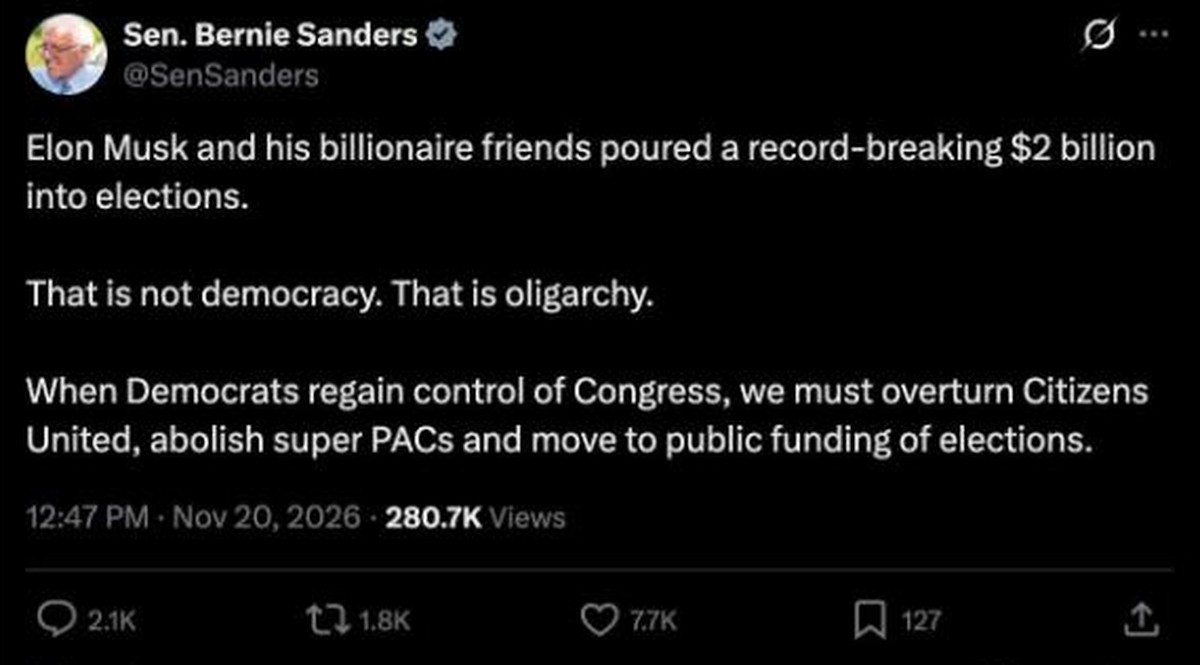
Elon Musk and his billionaire friends poured a record-breaking $2 billion into elections. 

That is not democracy. That is oligarchy.

When Democrats regain control of Congress, we must overturn Citizens United, abolish super PACs and move to public funding of elections.
Read the post as text
Elon Musk and his billionaire friends poured a record-breaking $2 billion into elections. That is not democracy. That is oligarchy. When Democrats regain control of Congress, we must overturn Citizens United, abolish super PACs and move to public funding of elections.

The bottom line

The Times's 20 biggest midterm donors gave "roughly $2 billion" through Oct. 14, $1.95 billion by our sum. Six are nonprofits and at least two more are companies. Donors labeled Democratic gave 24%. Top-donor giving set a record for this point in a midterm since 2010. Undoing Citizens United takes an amendment or the Supreme Court.

The claims

What the post says or clearly implies, checked one by one. How verdicts work

1

Elon Musk and his billionaire friends poured $2 billion into the 2026 elections.

Missing context

The Times's top 20 donors gave $1.95 billion through Oct. 14, by our sum, which it calls roughly $2 billion. Donors it labels Republican gave 69%, those labeled Democratic 24%. Six of the 20 are nonprofits.

Sanders didn't name a source for the figure1. The closest match is a New York Times ranking from Nov. 1, which found the 20 biggest donors had put "roughly $2 billion" into federal races2. Musk led with $445.6 million, nearly three times the next donor2.

Adding up the list, donors the Times labels Republican gave $1.34 billion, or 69%. Donors it labels Democratic, including three party-aligned nonprofits, gave $473 million, or 24%. Counting only individuals and companies, the split is about 56% to 12%. Soros, Bloomberg and Hoffman gave $230 million of it. Ripple (with Chris Larsen) and Coinbase, labeled special interests, gave $128 million, by our calculation2.

Not all 20 are billionaires. Six are nonprofits that don't disclose their own donors, together $493 million split almost evenly between the parties, by our calculation. At least two more are companies, Koch Inc. and Coinbase2.

2

The $2 billion that billionaires poured into the elections was record-breaking.

Missing context

Partly. The Brennan Center calls top-donor giving a record for this point in a midterm since 2010. But one advocacy group's partial 2026 count of billionaire families, $1.7 billion, trails its $2.6 billion for all of 2024.

The counts cover different windows. The Times tallies contributions from Nov. 5, 2024, through Oct. 14, 20262. The Brennan Center, a law and policy institute at NYU, found the 40 biggest donors gave $2.4 billion through mid-October, "a record high for this point in the midterms" since Citizens United in 20103.

Americans for Tax Fairness counted $881 million from 465 individual billionaires by October 20224. This cycle it counts about 170 families, including companies they control, at $1.7 billion from Jan. 1, 2025, through Aug. 28, 2026, 69% of it backing Republicans5. Its 2024 total, a full presidential cycle, was $2.6 billion from 100 families6. The 2026 total isn't final.

Musk's totals vary by what's counted. The Times top-20 list has $445.6 million in FEC filings2. Brennan's $483 million adds one of his companies, more than any donor has given in any cycle, it found3. A separate Times count, cited in our earlier piece, put him at $474 million7.
3

Once Democrats control Congress, they can overturn Citizens United and abolish super PACs.

Missing context

Not by passing a law. That takes a constitutional amendment, ratified by 38 states, or a new Supreme Court ruling. Congress can create a public financing program, within limits the Court has set.

Citizens United held that independent spending, including by corporations, does "not give rise to corruption or the appearance of corruption," so the First Amendment protects it8. Two months later, a federal appeals court relied on that ruling to strike down limits on gifts to groups that only spend independently9. The FEC calls these independent expenditure-only committees, or "Super PACs"10.

A law can't override those rulings. An amendment must be proposed by two-thirds of both chambers, or by a convention called by two-thirds of state legislatures, then ratified by three-fourths of the states11. Democrats will hold 56 Senate seats in January, 11 short of two-thirds12. In 2014 the Senate rejected a motion to advance such an amendment, 54 to 42, with 60 needed. All 54 yeas came from Democrats and independents, Sanders among them13.

Public funding is different, but design matters. In 1976 the Court upheld presidential public financing as an effort "to facilitate and enlarge public discussion," while striking down limits on overall campaign spending14.

The real disagreement

Facts can't settle this part, so we don't rule on it.

Should individuals and groups be free to spend without limit on independent election ads, or should the country change the Constitution and fund campaigns publicly to curb big donors' sway?

Since 2010, court rulings have let individuals and groups spend unlimited sums on elections, as long as they don't coordinate with candidates8,9. Both parties' biggest outside groups now lean on a handful of donors and on nonprofits that don't name theirs2. Montana voters approved a ban on election spending by corporations and other groups on Nov. 3, about 65% to 35%. It takes effect Jan. 1 and is being challenged in court15.

Limit big money, fund campaigns publicly

When 20 donors supply $2 billion, a few people set the terms of elections, and the fix is an amendment plus public funding.

Top-donor giving in midterms is eight times what it was in 2014, adjusted for inflation, and the cutoff to make the top 40 is now $25 million3. Dark money groups that hide their funders supplied 29% of top-donor giving this year3. "In a democracy, it's supposed to be one person, one vote," said Ian Vandewalker of the Brennan Center, "and the more one person can influence, the less egalitarian our system becomes"16.

Billionaire families spent $1.7 billion by August, equal to 0.04% of their combined wealth, by Americans for Tax Fairness's count5. The courts have ruled out limits on independent spending, so the remedy has to be constitutional. In a 2023 Pew survey, 72% said there should be limits on what individuals and organizations can spend on campaigns17.

Spending is speech, and voters decide

Independent spending is political speech, and voters can weigh it for themselves.

Limits hurt challengers most. "Challengers need to be able to raise and spend money to overcome the many advantages that incumbent legislators enjoy," says University of Missouri economist Jeff Milyo. His study with Jordan Butcher of nearly 66,000 state legislative races found most reforms did little, and Citizens United, if anything, increased competition18. Disclosure, not limits, lets voters "give proper weight to different speakers and messages"8. An amendment would let lawmakers decide what could "influence elections," the ACLU warned19.

Money rarely buys the outcome. A 1994 study of repeat House challengers found spending has "an extremely small impact on election outcomes"20. Musk outgave every donor in any cycle3, and Ken Paxton, his Texas Senate pick, lost21. Jeff Yass, No. 5 on the Times list2, was Vivek Ramaswamy's top backer for Ohio governor21. Amy Acton beat Ramaswamy 52% to 45%21.

Where they agree

  • Whatever the rules are, they should bind big donors on both sides the same way.
  • Public matching funds for small donors have backers even among opponents of an amendment, including the ACLU19.

What would change minds

  • Evidence from places with small-donor matching on whether it changed who runs, who gives and who wins.
  • A record of how past limits on election spending were enforced, and whether they fell harder on unpopular or small groups.

Sources

Every source was opened and read. Advocacy groups are labeled as such.

Show all 21 sources
  1. 1
    Sen. Bernie Sanders on X
    X2026-11-20Primary document
  2. 2
    Meet the Megadonors Pumping $2 Billion Into the 2026 Midterms
    The New York Times2026-11-01JournalismFEC contributions from Nov. 5, 2024, through Oct. 14, 2026. Sums by party label and donor type are our calculation from the Times list.
  3. 3
    Big Changes in the Makeup of the Biggest Midterm Donors
    Brennan Center for Justice2026-10-27Advocacy / think tankLaw and policy institute at NYU School of Law. Its totals come from FEC data.
  4. 4
    Billionaire Money in the 2022 Election
    Americans for Tax Fairness (Substack)2022-10Advocacy / think tankAdvocacy group that campaigns for higher taxes on billionaires. Counts individual billionaires, not families.
  5. 5
    Billionaires Buying Elections: Midterm Edition
    Americans for Tax Fairness Action Fund2026-10-07Advocacy / think tankAdvocacy group that campaigns for higher taxes on billionaires. Counts FEC contributions from Jan. 1, 2025, through Aug. 28, 2026.
  6. 6
    Billionaires Buying Elections: They've Come to Collect
    Americans for Tax Fairness2025-04-02Advocacy / think tankAdvocacy group that campaigns for higher taxes on billionaires. Its final count for the 2024 cycle.
  7. 7
    Musk's "nearly half a billion" checks out. So does "no return."
    View from the GalleryJournalismOur breakdown of Musk's 2026 giving and how his candidates fared
  8. 8
    Citizens United v. Federal Election Commission (opinion of the Court)
    Legal Information Institute, Cornell Law School2010-01-21Primary document
  9. 9
    SpeechNow.org v. FEC
    Federal Election CommissionPrimary documentThe FEC's case summary of the 2010 D.C. Circuit ruling.
  10. 10
    Types of nonconnected PACs
    Federal Election CommissionPrimary document
  11. 11
    U.S. Constitution, Article V
    Legal Information Institute, Cornell Law SchoolPrimary document
  12. 12
  13. 13
    Roll Call Vote 261: cloture on S.J.Res. 19
    U.S. Senate2014-09-11Primary document
  14. 14
    Buckley v. Valeo, 424 U.S. 1
    Legal Information Institute, Cornell Law School1976-01-30Primary document
  15. 15
    Montana voters passed a corporate spending ban. It isn't in force yet.
    View from the GalleryJournalismOur breakdown of Montana's I-194 and its legal challenge
  16. 16
    'Oligarchy Is on the Ballot': Reports Uncover Unprecedented Sums Ultrarich Spent to Buy 2026 Midterms
    Common Dreams2026-11-02JournalismProgressive news site. Cited for the Vandewalker quote, which it attributes to an interview with The Guardian.
  17. 17
  18. 18
    Do campaign finance reforms truly help make elections more competitive?
    University of Missouri2020-07-15ResearchUniversity summary of a study by Jeff Milyo and Jordan Butcher in PS: Political Science and Politics.
  19. 19
    The ACLU Supports Campaign Finance Reform and Free Speech
    American Civil Liberties Union2014-09-12Advocacy / think tankCivil liberties group. Written by Laura W. Murphy.
  20. 20
  21. 21

Think we got something wrong? Email editor@viewfromthegallery.com with a source. Corrections are made openly and logged on the page.