$2 million Trump pardons? Unproven. Paying for access? Documented.
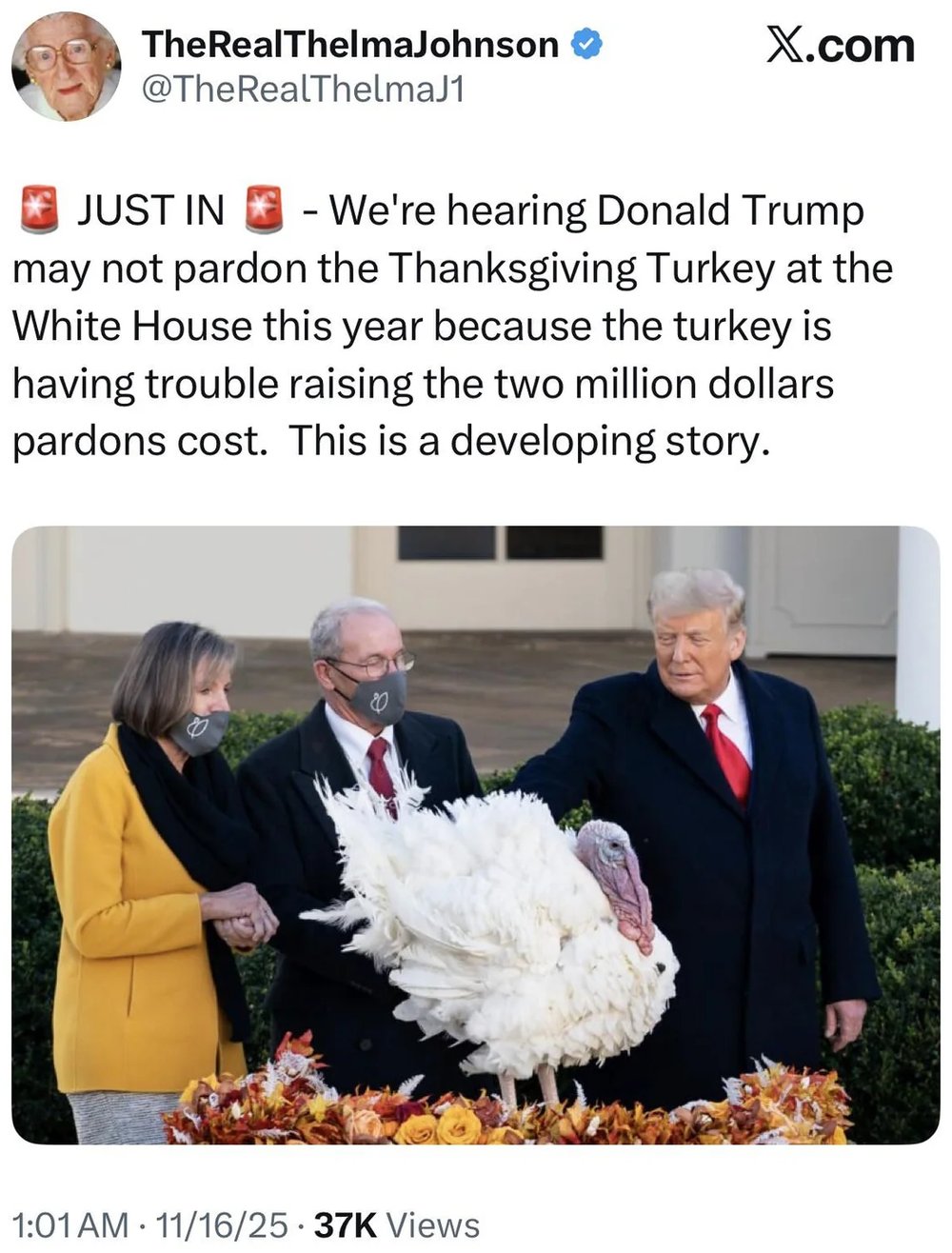
A parody post says the turkey can't afford its pardon. The $2 million figure has a real history, but no proven price tag.
The bottom line
- UnsupportedTrump sells pardons for $2M
- Missing contextPeople pay ~$2M for one
- Checks outBig donors got pardons
The post is a joke, and its premise isn't proven: no one has shown that a payment to Trump, of $2 million or any amount, bought a pardon. What is documented is a fast-growing, legal market in paid pardon advocacy, with fees reported as high as $3 million, and several pardons for big donors or their relatives1,2.
The claims
What the post says or clearly implies, checked one by one. How verdicts work
Trump sells pardons, for about $2 million each.
UnsupportedNo one has shown that a payment or donation to Trump bought a pardon. The $2 million figure traces back to two allegations involving Rudy Giuliani, neither of them proven.
The post is satire (Trump pardoned two turkeys on Nov. 25, 2025)3, but its premise is a real claim. Sen. Chuck Schumer said Trump "is selling pardons in a scheme that amounts to bribery." The White House counsel called claims of unethical conduct "either ill-informed or malicious"4.
Ex-CIA officer John Kiriakou said a Giuliani associate told him in 2020 Giuliani would want $2 million for pardon help. Giuliani rejected the claim, and Kiriakou didn't pay it5,6. A 2023 lawsuit by a former Giuliani aide alleged he was selling pardons for $2 million, to split with Trump. Giuliani didn't immediately respond to The Independent. No evidence has emerged that Trump or Giuliani was paid for a pardon7.
Proof would take records minority Democrats can't subpoena2, and Trump's ex-pardon attorney Ed Martin says he never saw a quid pro quo1. Marc Rich's ex-wife gave $450,000 to Clinton's library fund before his 2001 pardon. Clinton aides denied money mattered, and the FBI probe closed in 2005 without charges8,9. "Clinton sold that pardon" gets the same verdict.
People pay around $2 million to get a Trump pardon.
Missing contextFees that high have been reported, but they go to lawyers and lobbyists, not the president. Paying advocates is legal, happened under Clinton too, and doesn't guarantee a pardon.
Paid pardon advocacy has boomed in Trump's second term. CBS reported over two dozen pardon-related lobbying registrations10, and sources told CBS that brokers' fees can reach $3 million1. A lobbyist allied with Trump told NBC, "You can basically charge whatever you want"11. A House Judiciary Democrats' staff report, citing Reuters, says intermediaries with access to Trump's circle charge as much as $2 million per engagement12.
Hiring advocates is legal: as the Times put it in 2021, "there is nothing illegal about Trump associates being paid to lobby for clemency"6. Paying doesn't guarantee results. Only a "tiny fraction" of those registrations preceded clemency10. Rapper Torence Hatch says he paid two brokers $600,000 up front and, as of September 2026, hadn't been pardoned. The brokers say they owe him nothing1.
It isn't new. In 2001 it emerged that Hillary Clinton's brother Hugh Rodham had collected $400,000 from two men after helping them get clemency from Bill Clinton. She promised the money would be returned13.
Big Trump donors and their families have received pardons.
Checks outSeveral recipients or their relatives gave large sums to Trump-aligned groups, or had business ties to his family. The White House denies money played a role, and no exchange has been proven.
Nikola founder Trevor Milton and his wife gave at least $3 million, CBS reported, to Trump's 2024 campaign and allied groups before his 2025 pardon. A White House official said the donations "played absolutely no role"2. Tax offender Paul Walczak was pardoned less than three weeks after his mother, who had hosted three Trump fundraisers, was invited to a $1 million-per-person MAGA Inc. dinner. As of May 2025 it was unclear whether she gave. The White House said Walczak was targeted over his family's politics14.
Bank owner Julio Herrera Velutini was pardoned in January 2026 after his daughter gave $3.5 million to MAGA Inc. The Campaign Legal Center alleges in an FEC complaint that she was a straw donor for him15. Binance founder Changpeng Zhao was pardoned in October 2025. Binance has close ties to World Liberty Financial, the Trump family's crypto venture, which says it had "no role in the clemency process"16.
Same standard, other side: "a big Clinton donor's ex-husband got a pardon" also checks out8.
The real disagreement
Facts can't settle this part, so we don't rule on it.
Should the pardon power stay broad and personal, or be bound by rules that keep money and access from shaping who gets mercy?
The facts leave a gap: plenty of money around pardons, no proven purchase. How much that gap matters depends on what you think the pardon power is for. The Constitution gives it to the president alone, and the Supreme Court has said Congress can't trim it17.
Mercy should stay in the president's hands
The pardon is a deliberate check on prosecutors, and the remedy for bad pardons is voters, not new limits.
Hamilton argued "the benign prerogative of pardoning should be as little as possible fettered or embarrassed," since one accountable person judges mercy best18. The Supreme Court agrees the power "cannot be modified, abridged, or diminished by the Congress"17. Petitioning the department that prosecuted you is, as broker and ex-U.S. attorney Brett Tolman put it, "the fox watching the hen house"1. The White House called Zhao's "an overly prosecuted case by the Biden administration"16.
Hiring a lawyer to petition is normal and legal6. Trump's ex-pardon attorney, speaking of the Jan. 6 grants, said mercy reached people "whether they're wealthy or poor," and the White House says anyone paying to lobby for pardons "is foolishly wasting their money"1. Both parties' presidents pardon people close to them. Biden pardoned his son and siblings19. Without proof of a bribe, the check is the ballot box.
Clemency should follow rules money can't shortcut
Mercy that flows through access and donors gives the connected a separate justice system, even without a provable bribe.
Equal justice means similar cases get similar treatment. CBS found about 70% of Trump's second-term clemency actions, not counting Jan. 6 cases, skipped the Justice Department's process1. Elizabeth Oyer, pardon attorney under Biden, said the pay-for-access market "entrenches a two-tier system of justice in which wealth really can be a get-out-of-jail-free card"11. When the side door runs through advisers who charge six or seven figures, people who can pay get heard while thousands of others wait in line12.
Harm doesn't require a proven crime. Pardons of fraud and tax offenders have erased restitution owed to victims, including Walczak's $4.4 million14,12. House Judiciary Democrats put restitution and fines wiped out at nearly $1.7 billion12. Requiring disclosure of who paid whom, and of applicants' donations, would let voters judge without touching the power to show mercy.
Where they agree
What would change minds
- Records showing whether any pardon was promised for a payment or donation, which a Congress with subpoena power could produce2, and the FEC's ruling on the Herrera complaint, which could show who really paid15.
- A comparison of grant rates for applicants with and without paid advocates or donations, across administrations, would show whether money buys outcomes or just attention.
Sources
Every source was opened and read. Advocacy groups are labeled as such.
Show all 19 sources
- 1
- 2
- 3
- 4
- 5
- 6
- 7
- 8
- 9
- 10
- 11
- 12
- 13
- 14
- 15
- 16
- 17
- 18
- 19
Think we got something wrong? Email editor@viewfromthegallery.com with a source. Corrections are made openly and logged on the page.
Get new breakdowns by email
New breakdowns in your inbox: what was true, what wasn't, and what the argument is really about. No ads, no spin.