Elections · Voting rules

Democrats swept the no-ID states. They won plenty of ID states too.

The post's midterm tally holds for Congress. Under the same rules in 2024, Republicans won Pennsylvania outright.

· @TrumpDailyPosts · on XThe post we're checking
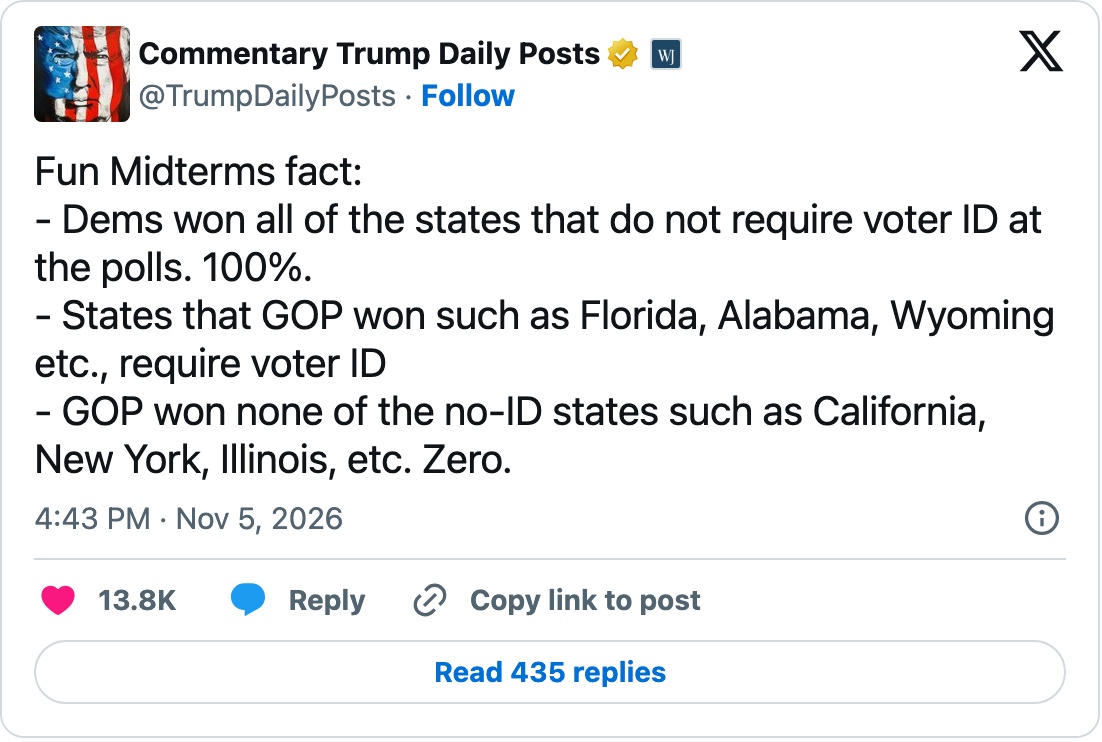
Fun Midterms fact:
- Dems won all of the states that do not require voter ID at the polls. 100%.
- States that GOP won such as Florida, Alabama, Wyoming etc., require voter ID 
- GOP won none of the no-ID states such as California, New York, Illinois, etc. Zero.
Screenshot of the post on X. The account says it is unofficial and not affiliated with Donald Trump. Shown for commentary.
Read the post as text
Fun Midterms fact: - Dems won all of the states that do not require voter ID at the polls. 100%. - States that GOP won such as Florida, Alabama, Wyoming etc., require voter ID - GOP won none of the no-ID states such as California, New York, Illinois, etc. Zero.
Posted Nov 5, 2026About 578K views and 13.9K likes on X as of Nov. 10. The account has about 3 million followers.See the original

The bottom line

Democrats did win every no-ID state in congressional races, and Republicans won none. The exception is Vermont, which re-elected a Republican governor. Democrats also won 13 Senate races in states that ask for ID. The no-ID rules were the same in 2024, when Trump carried Pennsylvania and Nevada, and Pennsylvania elected a Republican senator and a Republican House majority.

The claims

What the post says or clearly implies, checked one by one. How verdicts work

1

Democrats won all of the states that don't require voter ID at the polls, and Republicans won none.

Missing context

True for Congress. Democrats won a Senate race or most House seats in all 14, and Republicans won neither in any. Vermont is the exception, giving Republican Gov. Phil Scott a sixth term.

NCSL lists 14 states and D.C. that "do not require any documentation to vote at the polls": California, Hawaii, Illinois, Maine, Maryland, Massachusetts, Minnesota, Nevada, New Jersey, New Mexico, New York, Oregon, Pennsylvania and Vermont1. The post doesn't define "won." Snopes counted a Senate seat or most House seats, and rated the claim True2.

By NBC News's projections as of Nov. 10, Democrats won all seven Senate races there and most House seats in 12 of the states3,4. In Maine and Minnesota, one uncalled seat decides the majority. Republicans won 24 House seats in eight of the 14, including six each in New York and Pennsylvania. Snopes, using AP, counted nine states2. Democrats won the statewide House vote in all 14, by our calculation from NBC's district results4.

Democrats won 12 of the 13 governor's races, including Nevada, where Aaron Ford unseated Gov. Joe Lombardo5,6. Scott beat Democrat/Progressive Amanda Janoo by about 7 points7. New Jersey had no governor's race.
2

The states Republicans won, such as Florida, Alabama and Wyoming, require voter ID.

Missing context

They ask for it, as does every state where Republicans won a Senate race, though most let some voters without ID cast a ballot that counts. Democrats won 13 Senate races in those states too, and lead two uncalled ones.

Florida and Alabama ask for photo ID, and Wyoming for ID that may lack a photo1. All 13 Senate races Republicans won were in states that ask for ID, as were 11 of their 12 governor's races. Vermont's was the other3,5.

"Require" overstates it for most. NCSL counts 36 states that "request or require" ID. In 22, including Florida and Alabama, some voters without ID can still cast a ballot that counts. In most of the 14 strict states they "must vote on a provisional ballot" and take more steps. New Hampshire has a lead poll worker verify them instead1.

By Snopes's measure, Democrats won 16 ID states by AP's count2, as NBC's projections also show. Republicans won 22 by our NBC tally3,4. Fourteen of the 22 are non-strict. Four, Georgia, Kansas, South Carolina and Texas, count for both. Democrats won 7 of the 14 strict states: Arizona, Georgia, Iowa, Kansas, New Hampshire, North Carolina and Ohio. Texas, a photo ID state, elected Democrats James Talarico to the Senate and Gina Hinojosa as governor3,5.

Democrats swept the no-ID states and won many that ask for ID

D wonR wonUncalled or tiedNo race

No ID document asked (14)

Signatures or other details are checked against the voter's record. D 7 · R 0 · no race 7

  • CACalifornia: no race
  • HIHawaii: no race
  • ILIllinois: Democrat won
  • MEMaine: Democrat won
  • MDMaryland: no race
  • MAMassachusetts: Democrat won
  • MNMinnesota: Democrat won
  • NVNevada: no race
  • NJNew Jersey: Democrat won
  • NMNew Mexico: Democrat won
  • NYNew York: no race
  • OROregon: Democrat won
  • PAPennsylvania: no race
  • VTVermont: no race

ID asked, non-strict (22)

Some voters without ID can still cast a ballot that counts, for example by signing an affidavit. D 7 · R 10 · uncalled or tied 1 · no race 4

  • ALAlabama: Republican won
  • AKAlaska: uncalled, Democrat leads
  • COColorado: Democrat won
  • CTConnecticut: no race
  • DEDelaware: Democrat won
  • FLFlorida: Republican won
  • IDIdaho: Republican won
  • KYKentucky: Republican won
  • LALouisiana: Republican won
  • MIMichigan: Democrat won
  • MOMissouri: no race
  • MTMontana: Republican won
  • NENebraska: Republican won
  • OKOklahoma: Republican won
  • RIRhode Island: Democrat won
  • SCSouth Carolina: Democrat won
  • SDSouth Dakota: Republican won
  • TXTexas: Democrat won
  • UTUtah: no race
  • VAVirginia: Democrat won
  • WAWashington: no race
  • WVWest Virginia: Republican won

Strict ID (14)

In most strict states, voters without ID cast a provisional ballot and must take further steps for it to count. New Hampshire has a lead poll worker verify them instead. D 6 · R 3 · uncalled or tied 1 · no race 4

  • AZArizona: no race
  • ARArkansas: Republican won
  • GAGeorgia: Democrat won
  • INIndiana: no race
  • IAIowa: Democrat won
  • KSKansas: Democrat won
  • MSMississippi: uncalled, Democrat leads
  • NHNew Hampshire: Democrat won
  • NCNorth Carolina: Democrat won
  • NDNorth Dakota: no race
  • OHOhio: Democrat won
  • TNTennessee: Republican won
  • WIWisconsin: no race
  • WYWyoming: Republican won

2026 results: NBC News projections, 6:02 a.m. ET Nov. 10. A ? marks an uncalled race (with its leader) or, for the House, an uncalled majority. House: the party with more than half the state's seats. An = marks a tie.

Show the numbers
Voter ID law and results by state
StateID law (NCSL)SenateGovernorHouse D–R (uncalled)2024
AlabamaPhoto, non-strictRR2–5Trump
AlaskaNon-photo, non-strictD?D?0–0 (1)Trump
ArizonaNon-photo, strict–D5–4Trump
ArkansasPhoto, strictRR0–4Trump
CaliforniaNo document–D46–3 (3)Harris
ColoradoNon-photo, non-strictDD6–1 (1)Harris
ConnecticutNon-photo, non-strict–D5–0Harris
DelawareNon-photo, non-strictD–1–0Harris
FloridaPhoto, non-strictRR7–18 (3)Trump
GeorgiaPhoto, strictDD5–9Trump
HawaiiNo document–D2–0Harris
IdahoPhoto, non-strictRR0–2Trump
IllinoisNo documentDD14–3Harris
IndianaPhoto, strict––3–6Trump
IowaNon-photo, strictDD3–1Trump
KansasPhoto, strictDD?1–3Trump
KentuckyPhoto, non-strictR–2–4Trump
LouisianaPhoto, non-strictR–1–3 (2, 2 in runoffs)Trump
MaineNo documentDD1–0 (1)Harris
MarylandNo document–D7–1Harris
MassachusettsNo documentDD9–0Harris
MichiganPhoto, non-strictDD9–4Trump
MinnesotaNo documentDD4–3 (1)Harris
MississippiPhoto, strictD?–1–3Trump
MissouriPhoto, non-strict––3–5Trump
MontanaPhoto, non-strictR–1–1Trump
NebraskaPhoto, non-strictRR1–2Trump
NevadaNo document–D4–0Trump
New HampshirePhoto, strictDR2–0Harris
New JerseyNo documentD–11–1Harris
New MexicoNo documentDD3–0Harris
New YorkNo document–D20–6Harris
North CarolinaPhoto, strictD–9–2 (3)Trump
North DakotaNon-photo, strict––0–1Trump
OhioPhoto, strictDD8–7Trump
OklahomaNon-photo, non-strictRR0–5Trump
OregonNo documentDD5–1Harris
PennsylvaniaNo document–D11–6Trump
Rhode IslandPhoto, non-strictDD2–0Harris
South CarolinaPhoto, non-strictDR2–4 (1)Trump
South DakotaPhoto, non-strictRR0–1Trump
TennesseePhoto, strictRR0–8 (1)Trump
TexasPhoto, non-strictDD14–24Trump
UtahNon-photo, non-strict––1–3Trump
VermontNo document–R1–0Harris
VirginiaNon-photo, non-strictD–8–3Harris
WashingtonNon-photo, non-strict––8–2Harris
West VirginiaPhoto, non-strictR–0–2Trump
WisconsinPhoto, strict–D4–4Trump
WyomingNon-photo, strictRR0–1Trump
States grouped by NCSL's 2026 voter ID categories1. 2026 results are NBC News projections as of 6:02 a.m. ET Nov. 10, unofficial and uncertified3,5,4. 2024 results: FEC8. House majorities are our tally.
3

Implied: Democrats win these states because voters there don't need to show ID.

Misleading

The pattern predates this election. Trump won two of these states in 2024 under the same rules, and a nationwide study of a decade of voter records found no drop in turnout by party under strict ID laws.

Most of the 14 voted Democratic before. Harris carried 12 of them in 2024, but only 7 of the 36 states that ask for ID8. NCSL's list was the same then9. So the cause may run the other way, with ID laws rarer in states that already leaned Democratic.

The same rules didn't stop Republicans two years ago. Trump won Pennsylvania and Nevada8. Pennsylvania also elected Republican Dave McCormick to the Senate and sent 10 Republicans and 7 Democrats to the House10. In 2026, Democrats won half the strict-ID states, and Senate races in Kansas, South Carolina and Texas, which Trump carried by 14 to 18 points, by our calculation3,8.

A study of 1.6 billion observations of voter records found strict ID laws had no negative effect on turnout, "overall or for any group defined by race, gender, age, or party affiliation," and "no effect on fraud – actual or perceived"11. Of 10 that GAO reviewed in 2014, five found no significant effect on turnout, four found decreases and one an increase12.

The real disagreement

Facts can't settle this part, so we don't rule on it.

Should voters have to show an ID to cast a ballot at the polls, or are signature checks and registration records enough?

Every state checks identity somehow. Thirty-six ask for a document at the polls. The other 14 and D.C. usually check a signature or other details against the voter's record1.

Ask every voter for ID

An ID check is a simple safeguard most voters want, and the best research finds it doesn't keep people from voting.

The bipartisan Carter-Baker commission made the case in 2005: "Photo identification cards currently are needed to board a plane, enter federal buildings, and cash a check. Voting is equally important." Upholding Indiana's photo ID law, the Supreme Court's lead opinion noted that "flagrant examples of such fraud in other parts of the country have been documented throughout this Nation's history," and that public confidence "has independent significance"13. In 2025, 83% of adults favored photo ID, including 71% of Democrats14.

The feared cost hasn't shown up. Across a nationwide panel of voter records, strict ID laws had no negative effect on turnout for any racial group or party11. Low fraud counts measure what gets caught. Heritage says its database is "not comprehensive" but "demonstrates vulnerabilities"15. Precincts have grown, the lead opinion noted, so poll workers are less likely to know the voters in front of them13.

Verify voters without an ID requirement

Impersonation at the polls is rare, and an ID rule turns away eligible citizens who lack the right card.

ID rules guard against the rarest fraud. The Carter-Baker report said, "There is no evidence of extensive fraud in U. S. elections or of multiple voting, but both occur, and it could affect the outcome of a close election." The Court's lead opinion found Indiana's record had "no evidence" of in-person impersonation "actually occurring in Indiana at any time in its history"13. Heritage lists 34 such cases over two decades, against more than 155 million presidential votes in 202415,8.

About 2.6 million people lack any government-issued photo ID, and 34.5 million adult citizens lack a license or state ID with their current name or address, a Maryland survey estimates16. After Kansas and Tennessee changed their laws, GAO found turnout fell 1.9 to 3.2 points more than in comparison states, and "was reduced by larger amounts" among registrants aged 18 to 23, new registrants and African-American registrants12.

Where they agree

  • Polls should confirm voters are who they say they are, and every state does, by document or by signature and record checks1.
  • Over 80% of Democrats and Republicans in the Maryland survey backed having high schools give state ID cards to students without a driver's license16.

What would change minds

  • Audits in no-ID states counting how many ballots, if any, were cast in another voter's name.
  • Turnout studies of New Hampshire and Iowa, which became strict-ID states between the 2024 and 2026 elections, against similar states9,1.

Sources

Every source was opened and read. Advocacy groups are labeled as such.

Show all 16 sources
  1. 1
    Voter ID Laws
    National Conference of State Legislatures, via the Internet ArchiveUpdated 2026-09-03; archived 2026-11-01DataBipartisan organization serving state legislatures. Table 1, laws in force in 2026. NCSL's paragraph on non-strict states also names Vermont, which contradicts Table 1. We follow Table 1.
  2. 2
    Did Democrats win every state that doesn't require voter ID at polls in 2026 midterms?
    Snopes2026-11-09JournalismRated True, counting a state as won with a Senate seat or more than half its House seats, using AP projections.
  3. 3
    Senate Elections 2026 Live Results
    NBC NewsRead 2026-11-10, last updated 6:02 a.m. ETJournalismNBC News Decision Desk projections. Unofficial. Alaska and Mississippi uncalled.
  4. 4
    House Elections 2026 Live Results
    NBC NewsRead 2026-11-10, last updated 6:02 a.m. ETJournalismDistrict-level projections and counts: 252 Democrats, 166 Republicans, 17 uncalled. State majorities and statewide House vote are our tally from these counts.
  5. 5
    Governor Elections 2026 Live Results
    NBC NewsRead 2026-11-10, last updated 6:02 a.m. ETJournalismNBC News Decision Desk projections. Unofficial. Alaska and Kansas uncalled.
  6. 6
  7. 7
  8. 8
    Official 2024 Presidential General Election Results
    Federal Election CommissionDataSpreadsheet. Trump won Pennsylvania 3,543,308 to 3,423,042 and Nevada 751,205 to 705,197.
  9. 9
    Voter ID Laws
    National Conference of State Legislatures, via the Internet ArchiveUpdated 2024-02-02; archived 2024-11-01DataTable 1, laws in force in 2024. Same 14 states and D.C. with no document required.
  10. 10
    Statistics of the Presidential and Congressional Election of November 5, 2024
    Office of the Clerk, U.S. House of Representatives2025-03-10DataPennsylvania, pages 59–60: McCormick 3,399,295, Casey 3,384,180. Republicans won districts 1, 7, 8, 9, 10, 11 and 13–16.
  11. 11
    Strict ID Laws Don't Stop Voters: Evidence from a U.S. Nationwide Panel, 2008–2018
    National Bureau of Economic Research2019; published in the Quarterly Journal of Economics, 2021ResearchBy Enrico Cantoni and Vincent Pons. Quarterly Journal of Economics 136(4): 2615–2660.
  12. 12
    Elections: Issues Related to State Voter Identification Laws
    U.S. Government Accountability Office2014-09-19; reissued 2015-02-27ResearchCompares 2008 and 2012 turnout in Kansas and Tennessee with Alabama, Arkansas, Delaware and Maine. Also reviews 10 earlier studies of ID laws and turnout.
  13. 13
    Crawford v. Marion County Election Board, 553 U.S. 181 (2008), opinion of Justice Stevens
    Legal Information Institute, Cornell Law School2008-04-28Primary documentLead opinion by Justice Stevens, joined by Chief Justice Roberts and Justice Kennedy. Quotes the 2005 Commission on Federal Election Reform (Carter-Baker) report.
  14. 14
    Majority of Americans Continue to Back Expanded Early Voting, Voting by Mail, Voter ID
    Pew Research Center2025-08-22ResearchNonpartisan research organization. Survey of 3,554 adults, Aug. 4–10, 2025.
  15. 15
    Election Fraud Map: Explore the Data
    The Heritage FoundationRead 2026-11-10; database last updated 2025-12-12Advocacy / think tankConservative think tank. 1,619 cases in all; 34 in the category "Impersonation Fraud at the Polls," dated 2004–2024. The home page of its map, electionfraud.heritage.org, calls it "a sampling" and says: "While not comprehensive, this map demonstrates vulnerabilities in the election process."
  16. 16
    New CDCE Survey Shows Millions Lack ID as Voter ID Laws Spread to More States
    Center for Democracy and Civic Engagement, University of Maryland2024-03-13ResearchBy Sam Novey and Jillian Andres Rothschild, on CDCE's newsletter. Survey with VoteRiders, a voter-ID assistance group.

Think we got something wrong? Email editor@viewfromthegallery.com with a source. Corrections are made openly and logged on the page.