Read the post as text
Watch. This is being reported in multiple states. [A 15-second video of a touchscreen voting machine. The voter touches the box for Tobi Beck, Democratic, and the mark lands on Jim Baird, Republican, the name above.]
A viral post says machines in four states flip Democratic votes to Republican. Some voters saw it happen. Officials blame touch errors. Check the paper.
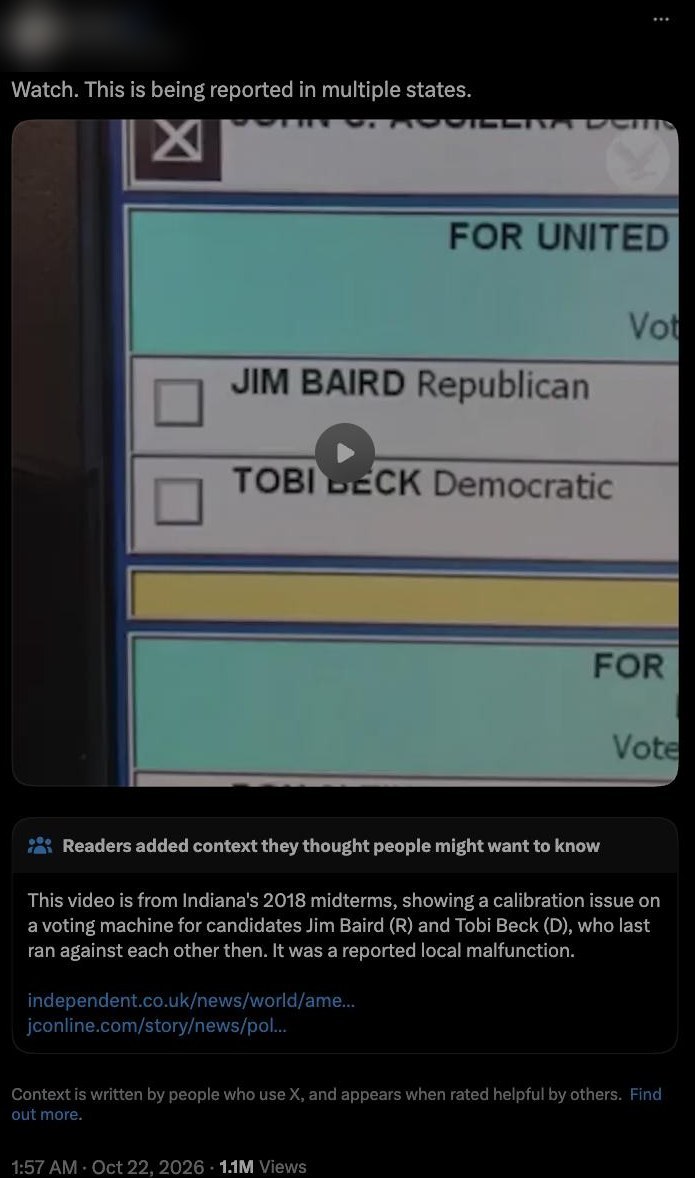
Watch. This is being reported in multiple states. [A 15-second video of a touchscreen voting machine. The voter touches the box for Tobi Beck, Democratic, and the mark lands on Jim Baird, Republican, the name above.]
The video is from Indiana's 2018 midterms, on machines Tippecanoe County has since retired. This fall, voters in Tennessee, Texas and Florida did report Democratic picks jumping to Republicans on screen. Officials blame mis-touches and screen calibration. We found no reports from Ohio. The machines print a paper ballot voters can check before it's counted.
What the post says or clearly implies, checked one by one. How verdicts work
The clip is from Indiana in 2018. It shows Republican Jim Baird and Democrat Tobi Beck, who ran for the U.S. House that year, on machines Tippecanoe County has since replaced.
The Independent published the footage on Nov. 6, 2018, from "inside an Indiana polling booth"1. The voter pressed Beck, and the screen selected Baird. The man who filmed it said he wasn't assuming fraud, but asked, "how likely is it there are other errors we can't even see?" The clip in the viral post still carries The Independent's logo. PolitiFact dated it to 2018, citing a Journal & Courier report on a West Lafayette poll2.
That fall, eight Tippecanoe County voters reported Democratic picks showing up as Republican. Two election board members tried and couldn't reproduce it3. The county's machines had no paper backup and had "malfunctioned several times in recent elections"4. The county replaced them in 20215.
Voters in Tennessee, Texas and Florida did see Democratic picks jump to Republicans on screen. Officials blame mis-touches and screen calibration, and the printed ballot lets voters catch it. We found no reports from Ohio.
The four-state wording also ran on a Facebook post by the liberal group The Other 98%6,2. Dozens of Tennessee voters said the screen showed a different candidate. One kept pressing Democrat Jerri Green and "it kept punching back to Marsha Blackburn." Tennessee elections coordinator Mark Goins called it "an unintended touch"7. The state logged one complaint among about 400,000 voters2. A Palm Beach County, Florida, voter said her Democratic picks jumped to Republicans. Officials couldn't recreate it8.
Two Bexar County, Texas, voters said Democratic picks switched to Republicans, and a third said picks dropped9. A Texas officials' group says "nearly every case comes back to the screen calibration on older touchscreen machines"2. The county is checking with the manufacturer10.
These voters get a paper ballot to review, and the paper is what counts7,2. Florida defaults to pen-marked ballots11, though Palm Beach offered touchscreens to every early voter12,8. As of 2020, most Ohio counties used paper ballots, and 13 used touchscreens that print a paper record13.
Facts can't settle this part, so we don't rule on it.
Should most Americans vote on touchscreen ballot-marking machines, or mark paper ballots by hand?
Both sides want a paper ballot that can be recounted and audited. The National Academies say ballots "may be marked by hand or by machine"14, and federal law requires at least one accessible voting system at every polling place15. The fight is over who should use the machines: everyone, or mainly voters who need them.
A ballot the voter marked by hand is the best record of what they chose.
Paper protects an election only if it records what the voter chose, and a machine-printed ballot depends on the software that printed it. Computer scientists Andrew Appel, Richard DeMillo and Philip Stark conclude that "no audit can assure that the votes on paper are the ones expressed by the voter on a touchscreen"16.
The backstop is voters checking their printouts, and few do. When University of Michigan researchers modified machines in a mock polling place, "only 40% of participants reviewed their printed ballots at all, and only 6.6% told a poll worker"17. Tennessee's election chief says a voter can mis-touch without noticing7. Hand-marked ballots are still scanned and audited, and Verified Voting backs machines "for voters who need to use them"18.
One system for all voters keeps every vote private and every ballot readable.
Federal law promises voters with disabilities "the same opportunity for access and participation (including privacy and independence) as for other voters"15. If only they use the machine, their ballots can stand out. The National Disability Rights Network says "a private and independent vote is the law of the land"19. The Michigan researchers note the machines "allow voters of all abilities to vote in the same manner"17.
Machines also end guessing over stray marks. Georgia's audit of about 5.3 million 2024 ballots found 87 discrepancies. Eighty-six were on hand-marked ballots, where reviewers had to interpret what the voter meant20. And voters can learn to check. In a Rice University study, voters given a list of their choices "can be near-perfect detectors of ballot changes"21.
Every source was opened and read. Advocacy groups are labeled as such.
Think we got something wrong? Email editor@viewfromthegallery.com with a source. Corrections are made openly and logged on the page.
New breakdowns in your inbox: what was true, what wasn't, and what the argument is really about. No ads, no spin.