SNAP · Food assistance · Federal rulemaking

USDA's SNAP rule is real. Its 17.6% means 6.3 million people.

USDA proposes ending the rule and puts the figure at 17.6%. The same notice says that is 6.3 million people who would lose benefits.

· @Breaking911 · on XThe post we're checking
BREAKING: USDA is moving to close a SNAP loophole known as “broad-based categorical eligibility" (BBCE) that allows millionaires to collect food stamps. The agency says 17.6% of SNAP participants qualify only because of BBCE.

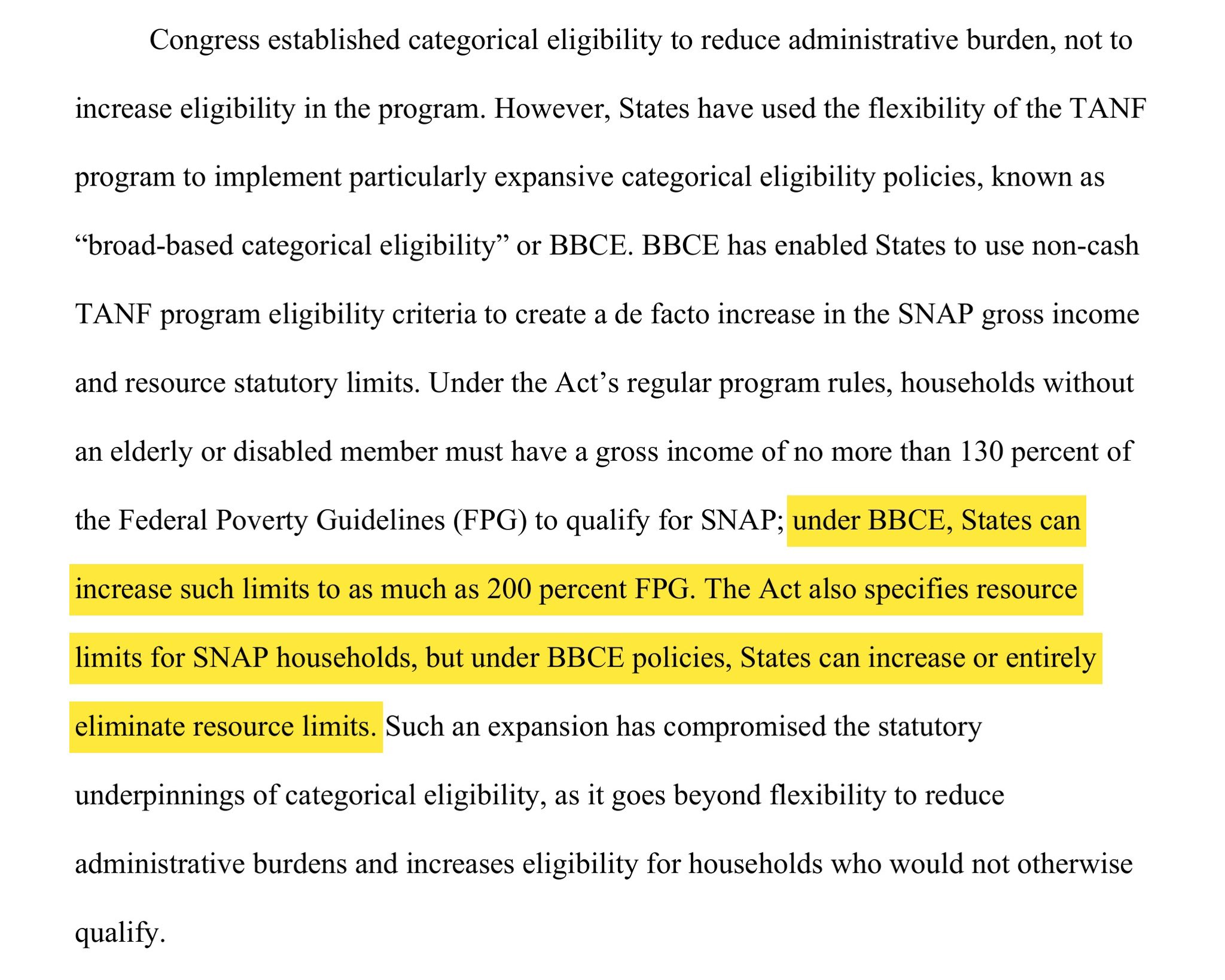
[Image: a highlighted passage from the proposed rule. The highlighted sentences say states can raise SNAP's income limits under BBCE to as much as 200 percent of the poverty guidelines, and can "increase or entirely eliminate resource limits."
Image attached to the post: a passage from the Federal Register notice, with yellow highlighting. Shown for commentary.
Read the post as text
BREAKING: USDA is moving to close a SNAP loophole known as “broad-based categorical eligibility" (BBCE) that allows millionaires to collect food stamps. The agency says 17.6% of SNAP participants qualify only because of BBCE. [Image: a highlighted passage from the proposed rule. The highlighted sentences say states can raise SNAP's income limits under BBCE to as much as 200 percent of the poverty guidelines, and can "increase or entirely eliminate resource limits."]
Posted Nov 10, 2026About 207K views and 1.5K likes on X as of Nov. 11. The account has about 2.3 million followers.See the original

The bottom line

USDA did propose ending broad-based categorical eligibility, and its notice does put 17.6% of participants over federal limits. That group is 6.3 million people who would lose SNAP, and USDA gives no count of millionaires. Its one example is a 2018 case. The rule is a proposal, open for comment until Dec. 10.

The claims

What the post says or clearly implies, checked one by one. How verdicts work

1

USDA is moving to close a SNAP loophole known as broad-based categorical eligibility (BBCE).

Checks out

USDA published a proposed rule Nov. 10 that would end BBCE. It is not final, and comments are open until Dec. 10. "Loophole" is USDA's own word for it1.

The notice would limit categorical eligibility to households receiving TANF "assistance," mostly cash, and stop states from using non-cash TANF benefits to confer it. USDA says states were encouraged to use benefits of nominal value, such as "an informational pamphlet or an 800-number to call to locate TANF-funded services"1.

Forty-six states use BBCE, and USDA's own table lists most of them as treating "all households" as eligible on the strength of a brochure or notice2. The state discretion behind it traces to a 1999 USDA memo, and BBCE spread from 18 states in FY 2008 to 43 by FY 2011. USDA under the Obama administration encouraged states to adopt it "to increase SNAP participation"1.

The post's image is a passage from the notice's paperwork section. It matches the notice: states can raise income limits to as much as 200% of poverty and "increase or entirely eliminate resource limits"3,1.

2

BBCE allows millionaires to collect food stamps.

Missing context

USDA says a household with $1 million or more in resources and no regular income could qualify in states with no asset limit. It cites one case, from 2018, and gives no count. Income limits still apply1,4.

The notice says "in States with no resource limit, a household with a million dollars or more in available resources but no regular income could apply for and be eligible." Forty-one states have no resource limit. SNAP resources leave out a home and retirement accounts1.

That describes what the rule permits, not how many people use it. USDA says it is "aware of instances" and links one: a 2018 CBS Minnesota report on Rob Undersander, who said he had $1 million in property and retirement accounts and little income. He told lawmakers he got about $300 a month for 19 months to show the loophole, and says he donated the amount4,1.

States still set gross-income limits, from 130% to 200% of the poverty guidelines2. Households of three or more must also have a low enough net income to receive a benefit1.
3

USDA says 17.6% of SNAP participants qualify only because of BBCE.

Missing context

USDA's notice says it. The group is 6.3 million people who would lose benefits, counted by being over federal income or asset limits. USDA estimates the asset figure from a model. It is not a count of millionaires1.

The notice says 16.9% of households and 17.6% of participants "would no longer receive SNAP benefits because their income or resources exceed the Federal statutory limits." That is 3.2 million households and 6.3 million people in FY 2029, the first year of full effect. It is the same 17.6% the post cites. USDA puts the federal savings at $44.649 billion over FY 2027–20311.

For FY 2024, USDA estimates 5.4 million participants had resources above the limit and 2.0 million had incomes above it. States don't verify resources for categorically eligible households, so the resource estimate comes from a model run on December 2019 Census survey data1.

The notice adds that 1.78 million children would lose automatic free school meals. USDA says about 97% would still qualify for free or reduced-price meals another way1.

The real disagreement

Facts can't settle this part, so we don't rule on it.

Should states be able to waive SNAP's income and asset tests for households that get a small TANF-funded service, or should the federal limits apply everywhere?

USDA says the change keeps benefits for "the truly needy" and saves $44.6 billion1. The Food Research & Action Center, an anti-hunger group, says ending BBCE "would increase hunger for families and children"5.

Federal limits should bind every state

Congress set SNAP's income and asset limits, and a pamphlet shouldn't let states waive them.

BBCE lets states "increase or entirely eliminate resource limits" that Congress wrote into the law, using a benefit as small as a hotline number1. A 2012 GAO report found payment errors in 17.2% of BBCE households over the federal income limit in FY 2010, against 6.7% of other SNAP households1.

If the limits are too low, this side says, Congress should raise them. AEI's Angela Rachidi wrote in 2019 that "it might be time for Congress to revisit income or asset limits for SNAP," but that until then USDA is responsible for "ensuring the integrity of SNAP"6. USDA's notice says the practice erodes "public trust that SNAP benefits are available only to those who meet the eligibility limits set in law"1.

Simpler tests protect working families and savers

Households near the line shouldn't lose food aid over a few hundred dollars of income or savings.

FRAC describes a New York worker earning $2,480 a month, about 136% of poverty, who gets $434 a month and would lose it, and a Washington resident with $3,300 in savings, just over a $3,000 asset limit. An asset test, this side argues, tells families not to save5.

BBCE also saves money to run. FRAC cites a USDA study finding it cuts state administrative costs per case by about 7%, while the 2025 budget law moves states' share of those costs from 50% to 75%. It adds that children lose automatic free school meals and some WIC eligibility5. This side's answer to the millionaire example is that it is one person, as Minnesota's governor said in 20184.

Where they agree

  • BBCE lets states raise SNAP's gross-income limit to as much as 200% of poverty and waive asset tests, and USDA's rule would end that1,5.

What would change minds

  • How the 5.4 million participants over the resource limit are spread by what they hold, which the notice doesn't give.
  • Whether verifying assets in the 41 states that don't check now would find the same share over the limit as USDA's model.

Sources

Every source was opened and read. Advocacy groups are labeled as such.

Show all 6 sources
  1. 1
    Supplemental Nutrition Assistance Program: Reforming Categorical Eligibility (proposed rule)
    Federal Register (91 FR 72454), USDA Food and Nutrition Administration2026-11-10Primary documentDocket FNA-2026-0661. Comments due Dec. 10, 2026. The regulatory impact analysis (FNA-2026-0661-0002) is not read here: the regulations.gov file blocked download.
  2. 2
    Broad-Based Categorical Eligibility (BBCE)
    USDA Food and Nutrition AdministrationPage updated 2026-06-29; read 2026-11-11DataState table of the program that confers BBCE, its asset limit and its gross income limit. 46 states.
  3. 3
    Breaking911 post
    X2026-11-10JournalismAccount describes itself as "America's #1 Alternative News Source." Reach and text read through FxTwitter.
  4. 4
    Waite Park Millionaire Goes On Food Stamps To Show Loopholes
    CBS Minnesota (WCCO)2018-04-12JournalismThe case USDA cites in the notice as an instance of a millionaire receiving SNAP.
  5. 5
    USDA Proposal to End Broad-Based Categorical Eligibility for SNAP Would Increase Hunger for Families and Children
    Food Research & Action Center2026-06-12Advocacy / think tankAnti-hunger advocacy group. Written in June, before USDA published the notice.
  6. 6
    Proposed Rule Change Would Increase SNAP Integrity
    American Enterprise Institute2019-07-24Advocacy / think tankFree-market think tank. By Angela Rachidi, about USDA's 2019 version of the proposal.

Think we got something wrong? Email editor@viewfromthegallery.com with a source. Corrections are made openly and logged on the page.