Infrastructure · Federal rulemaking · Budget

SpaceX would take $0, but the free Starlink gear is mostly not new

SpaceX would serve its BEAD locations without grant money if states sign. The $738 million appears to predate July cuts, and free gear isn't new.

· @SawyerMerritt · on XThe post we're checking
SpaceX has agreed to forgo $738 million in U.S. federal broadband subsidies and instead provide free @Starlink hardware to eligible American households.

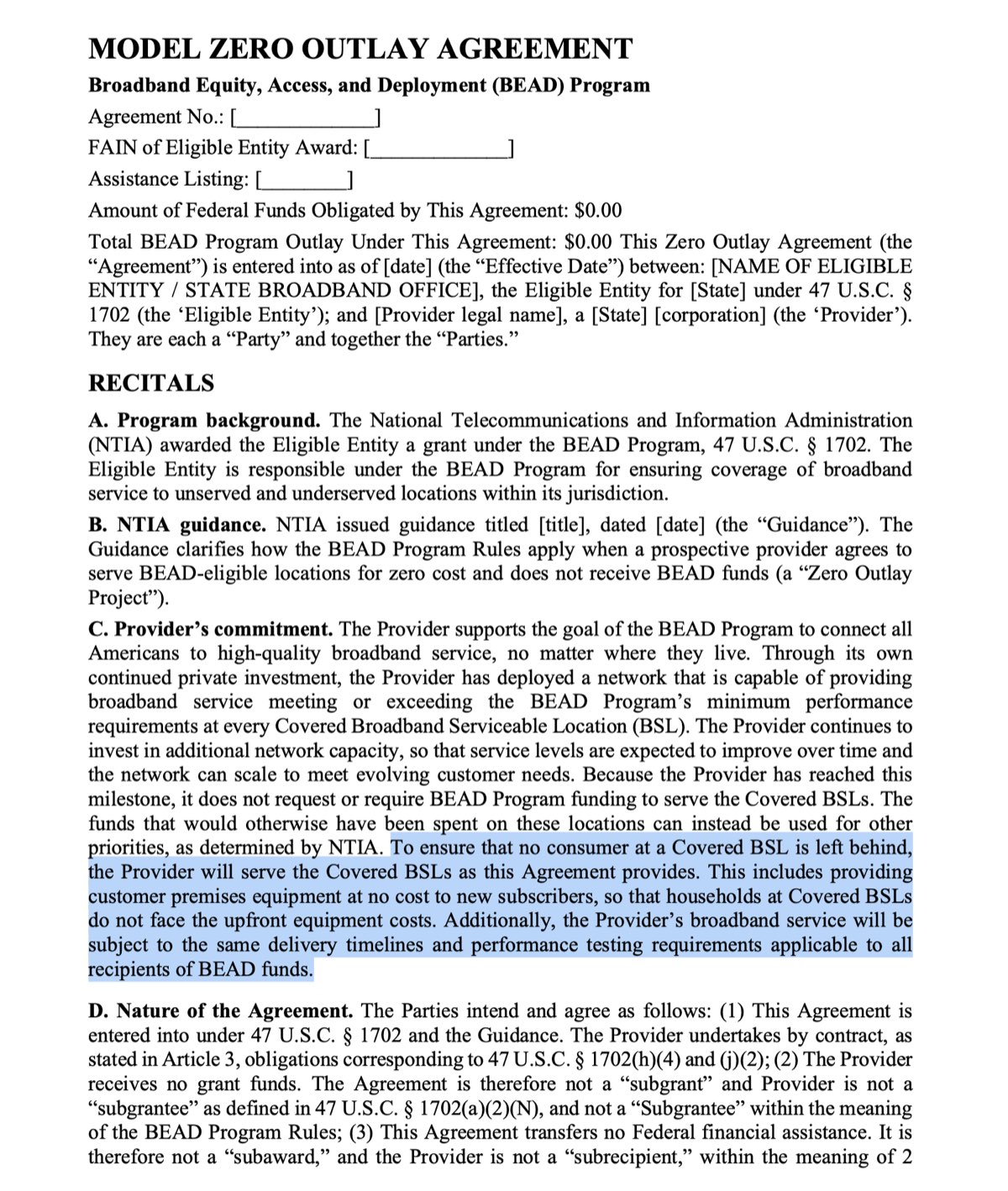
NTIA: "To ensure that no consumer at a Covered BSL is left behind, the provider (SpaceX) will serve the covered BSLs as this agreement provides. This includes providing customer premises equipment at no cost to new subscribers, so that households at covered BSL do not face the upfront equipment costs. Additionally, the provider’s broadband service will be subject to the same delivery timelines and performance testing requirements applicable to all recipients of BEAD funds."

Under the new agreement, SpaceX would:
• Provide free Starlink hardware to eligible households.
• Guarantee minimum download speeds of 100 Mbps and upload speeds of 20 Mbps.
• Offer a low-cost monthly internet plan.
• Commit to providing service for 10 years.
• Continue to comply with federal performance testing requirements.

The agreement will save American taxpayers hundreds of millions of dollars while accelerating high-speed internet access in underserved rural communities.

In exchange, SpaceX would be exempt from most BEAD-related financial audits, procurement requirements and administrative reporting, while remaining subject to network performance testing.
First page of NTIA's model agreement, as attached to the post on X. The post also carried a photo of a Starlink dish. Shown for commentary.
Read the post as text
SpaceX has agreed to forgo $738 million in U.S. federal broadband subsidies and instead provide free @Starlink hardware to eligible American households. NTIA: "To ensure that no consumer at a Covered BSL is left behind, the provider (SpaceX) will serve the covered BSLs as this agreement provides. This includes providing customer premises equipment at no cost to new subscribers, so that households at covered BSL do not face the upfront equipment costs. Additionally, the provider’s broadband service will be subject to the same delivery timelines and performance testing requirements applicable to all recipients of BEAD funds." Under the new agreement, SpaceX would: • Provide free Starlink hardware to eligible households. • Guarantee minimum download speeds of 100 Mbps and upload speeds of 20 Mbps. • Offer a low-cost monthly internet plan. • Commit to providing service for 10 years. • Continue to comply with federal performance testing requirements. The agreement will save American taxpayers hundreds of millions of dollars while accelerating high-speed internet access in underserved rural communities. In exchange, SpaceX would be exempt from most BEAD-related financial audits, procurement requirements and administrative reporting, while remaining subject to network performance testing.
Posted Nov 24, 2026About 1.98M views, 1,311 reposts and 10,718 likes on X at 11:51 UTC on Nov. 25, 2026. Merritt, whose X bio calls him a "$TSLA & $SPCX investor," has about 1.16M followers.See the original

The bottom line

If states sign, SpaceX takes $0 and still owes 100/20 Mbps service and performance testing for 10 years. The $738 million appears to predate NTIA's July cuts to satellite locations. Free starter equipment was already required. SpaceX drops most audits and financial reporting, and faces no fines. Savings depend on states signing and on NTIA's use of the money.

The claims

What the post says or clearly implies, checked one by one. How verdicts work

1

SpaceX has agreed to forgo $738 million in U.S. federal broadband subsidies.

Missing context

SpaceX offered to take $0, and states must still sign. The $738 million matches a tally of states' draft plans and appears to predate NTIA's July cuts to satellite locations. No national figure since then is public.

NTIA's model agreement sets the federal money at "$0.00"1. NTIA Administrator Arielle Roth said SpaceX agreed to meet BEAD service and testing rules "at no cost to the BEAD program"2.

Broadband Breakfast put SpaceX's award at about $738 million for 476,000 locations, citing Connected Nation3. In July it gave Connected Nation's tally of states' draft plans as nearly $739 million4. The match suggests it predates NTIA's July request to drop satellite locations a newer FCC map showed were served or weren't homes4. Using December 2025 FCC data, New York Law School researchers estimated 35 to 42 percent of satellite locations could go, cutting SpaceX and Amazon awards combined by $354 million to $423 million. NTIA's method was unconfirmed5. We found no national figure for SpaceX since.

Nor is the deal done. SpaceX is ready to sign, an NTIA official said, and each state chooses to sign or re-bid2,6. Some states had already signed contracts with SpaceX, but the official said those were no longer on the table2.

2

Instead, SpaceX will provide free Starlink hardware to eligible American households.

Missing context

New subscribers at SpaceX's BEAD locations get the dish and router free, apart from shipping. Paid satellite grantees already owed it free, up to three sets. The new deal omits the old three-set cap and the fee for extras.

Section 3.3(c) requires plans for "subscribers at Covered BSLs" that include all the equipment needed for service "at no additional cost, with the exception of standard shipping fees." Professional installation can cost extra. The gear comes with a subscription1. "Eligible households" is the post's phrase. Covered locations can be homes, businesses or anchor institutions, about 476,000 by the earlier tally, and the agreement defines "Eligible Subscriber" only for the low-cost plan1,3.

The paid version had nearly the same rule. NTIA's June 2025 notice required satellite grantees to "provide all necessary CPE at no cost" to each new subscriber, up to "no more than three (3) CPE during the period of performance." A subscriber wanting more could be charged "customary rates" unless the gear failed or was weather-damaged7. The new agreement states neither limit1. NTIA says the deal "preserves existing" requirements, free equipment among them6.

The NTIA quote is faithful in substance. It is Recital C of NTIA's model template, which names no company. The post inserted "(SpaceX)" and changed some capitals and plurals1.
3

Under the deal SpaceX owes 100/20 Mbps, a low-cost plan, 10 years of service and testing, with fewer audits.

Checks out

The model agreement says all of this, and the post names the trade-off itself. The low-cost plan has no price yet, and the only penalty left is losing the locations.

The agreement requires at least 100 Mbps down and 20 up, with "95% or more of latency measurements at or below 100 milliseconds" and outages averaging no more than 48 hours a year. SpaceX has four years from signing to certify service is available, and the 10 years run from that certification1.

The low-cost plan's price is a blank in the template, and the state "will not otherwise regulate" it. SpaceX may limit it to households eligible for the FCC's Lifeline program1. In January SpaceX proposed a Lifeline-only plan reported at $80 or less8.

The exemptions are as described. SpaceX files no financial, procurement or workforce reports and faces no site visits. Audits happen only to look into documented noncompliance, and reviewers get one records request a year absent such a finding1. If it falls short, the state's only remedy is taking back the affected locations. The agreement bars fines and calling a letter of credit1.

4

The agreement will save American taxpayers hundreds of millions of dollars.

Missing context

That is NTIA's line, and NTIA said "potential." The agreement lets NTIA pick "other priorities" for the money, and states that re-bid may spend a comparable sum. We found no plan to return it to the Treasury.

Roth said the agreement "has the potential to save taxpayers hundreds of millions of dollars"2. The agreement itself says the money "can instead be used for other priorities, as determined by NTIA"1.

Savings come only where states sign. A state that declines must find another provider "at a cost comparable" to SpaceX's approved award6, and some states were weighing that3.

What happens to leftover BEAD money is unsettled. NTIA rescinded approval of "non-deployment" activities in states' initial proposals in June 2025 and promised new guidance7. When satellite awards were cut in July, Broadband Breakfast reported it was not clear what would happen to the saved cash4.

The real disagreement

Facts can't settle this part, so we don't rule on it.

Should states accept a no-cost promise from SpaceX with lighter oversight, or keep the enforcement power that comes with paying?

BEAD is a $42.45 billion program to connect every American. In June 2025 NTIA dropped its preference for fiber and let satellite compete on cost7. SpaceX went on to win about 476,000 locations3. Contract talks with states stalled for months over financial reporting and default penalties2. Under the new deal, SpaceX's locations count as "served" while it lasts, and a state's only remedy is to take locations back1.

Take the no-cost deal

Public money shouldn't pay for a network private money already built, as long as the service promises to households hold.

SpaceX says it can already meet BEAD speeds at its locations. "SpaceX will not, and cannot, accept BEAD funding to complete a job already accomplished with private investment," vice president Lauren Dreyer wrote to states, offering "identical broadband obligations" at zero cost to taxpayers3. The company argued in January that a satellite network should be judged "exclusively" on connectivity, "not through financial monitoring" built for construction projects2. It told states "there is no single 'document' evidencing the reservation of capacity"8.

Roth said the deal has "the potential to save taxpayers hundreds of millions of dollars" while connecting people faster2. Households keep the speed floor, free equipment, a low-cost plan and 10 years of testing1. Starlink is getting faster. Ookla found 40 percent of its U.S. subscribers got BEAD-level speeds in the first half of 2026, up from under 19 percent a year earlier3.

Keep BEAD's enforcement power

Without money at stake a promise is hard to enforce, and rural areas could be tied to one provider for years.

"SpaceX traded grant money it didn't need for a contract states can't enforce and, given NTIA's rebid price cap, can't refuse," said Drew Garner of the Benton Institute for Broadband & Society3. The deal bars fines and letters of credit and limits audits to documented noncompliance1. Fiber Broadband Association CEO Gary Bolton warned of "up to 14 years of dependence on a single provider, with limited accountability"3.

Gigi Sohn of the American Association for Public Broadband said the result is "blocking competitors from receiving federal and state funding to deploy in the future" at nearly 475,000 locations3. Ookla's 40 percent figure implies, by our subtraction, that about 60 percent of Starlink's U.S. subscribers fell short of BEAD speeds in the first half of 20263.

Where they agree

  • SpaceX and the Benton Institute's Drew Garner both say the Starlink network serving these locations is already built and BEAD needn't pay for it. They split on whether the no-cost contract that replaces the grant is a good deal3.
  • Nobody quoted disputes that these homes should be held to BEAD's 100/20 Mbps floor, checked by performance testing1,3.

What would change minds

  • Performance test results for the covered locations, due with SpaceX's first January report after it certifies service, would show whether the promised speeds hold1.
  • A count of states that sign versus re-bid, and what re-bids cost, would show whether the deal saves money and whether it keeps other providers from bidding on these locations.

Sources

Every source was opened and read. Advocacy groups are labeled as such.

Show all 8 sources
  1. 1
    Model Zero Outlay Agreement, Broadband Equity, Access, and Deployment (BEAD) Program
    National Telecommunications and Information Administration (BroadbandUSA)2026-11-23Primary documentThe template contract. It names no provider. Recital C holds the text the post quotes. Sec. 3.3(c) covers equipment, Sec. 4.3 and Art. 6 limit reporting and audits, Art. 9 makes reversion the only remedy, Exhibit B leaves the low-cost price blank.
  2. 2
    SpaceX Declines BEAD Winnings, Wants to Serve Locations at No Cost
    Broadband Breakfast2026-11-23JournalismTrade publication covering broadband policy. Includes NTIA Administrator Arielle Roth's statement.
  3. 3
    Fiber ISPs, Advocates Don't Like SpaceX's BEAD Deal
    Broadband Breakfast2026-11-24JournalismQuotes SpaceX's Nov. 24 letter to states and statements from the Benton Institute, the American Association for Public Broadband and the Fiber Broadband Association, all of which favor terrestrial networks.
  4. 4
    Satellite BEAD Awards to be Reduced
    Broadband Breakfast2026-07-14Journalism
  5. 5
    BEAD Satellite Locations Could Drop 35-42%, Analysts Say
    Broadband Breakfast2026-07-16JournalismReports an estimate by New York Law School researchers Alex Karras and Michael Santorelli.
  6. 6
    BEAD Model Agreement to Accelerate Broadband Deployment
    National Telecommunications and Information Administration (BroadbandUSA)2026-11-23Primary document
  7. 7
    BEAD Restructuring Policy Notice
    National Telecommunications and Information Administration2025-06-06Primary documentThe "Benefit of the Bargain" rewrite. Appendix B sets the terms for paid satellite (LEO capacity) subgrants, including free equipment for new subscribers, capped at three CPE over the period of performance (fn. 63).
  8. 8

Think we got something wrong? Email editor@viewfromthegallery.com with a source. Corrections are made openly and logged on the page.