SNAP · Food assistance · Federal rulemaking

Vance's 7.4 million comes from USDA. "Wrongly" doesn't.

It sums USDA's estimates of people on SNAP only through a state option. They qualify under today's rules, and the Ferrari data can't be checked.

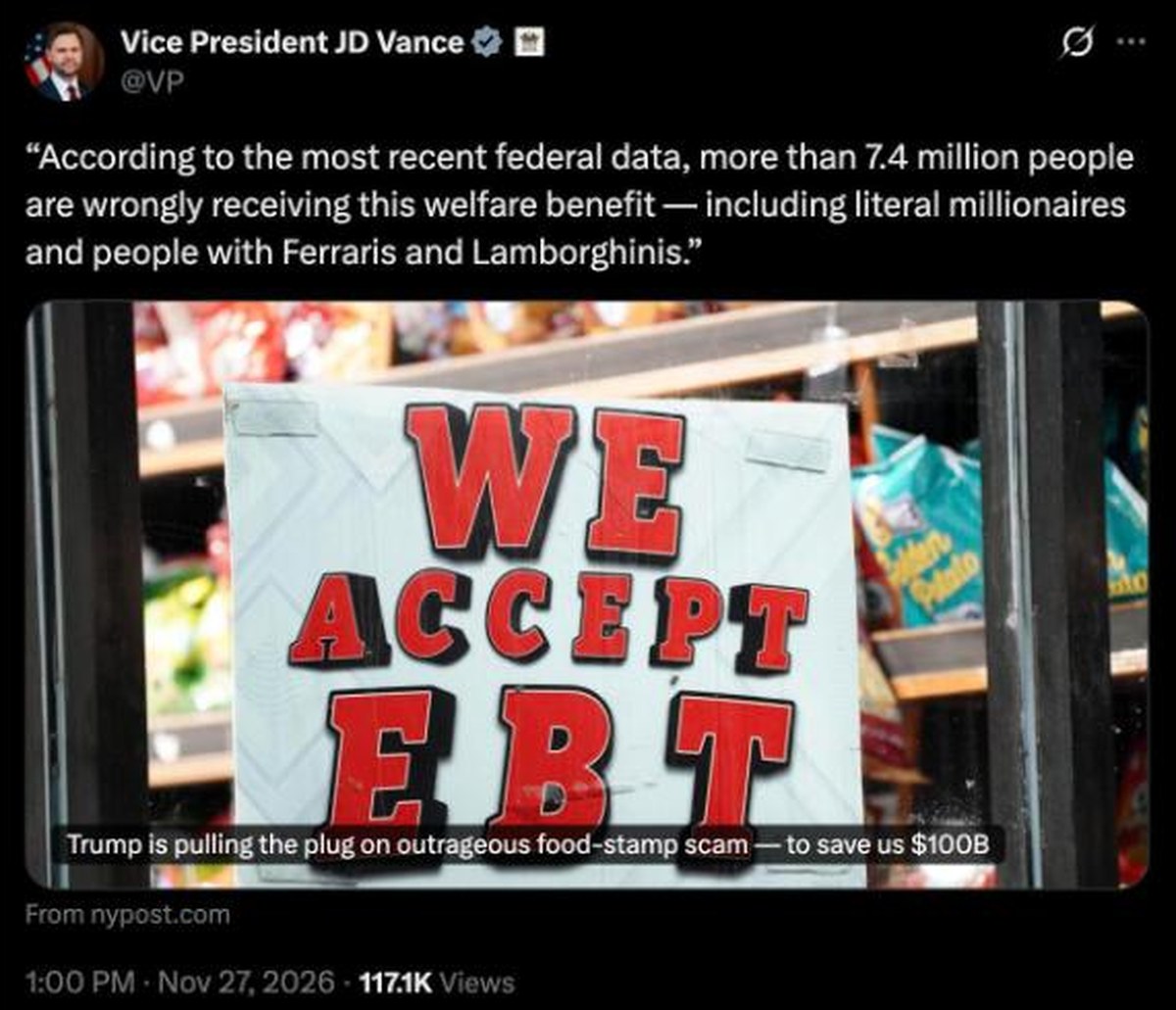
· @VP · on XThe post we're checking
“According to the most recent federal data, more than 7.4 million people are wrongly receiving this welfare benefit — including literal millionaires and people with Ferraris and Lamborghinis.”

https://nypost.com/2026/11/27/opinion/trump-is-halting-this-food-stamp-scam-to-save-us-100b/

[The link preview shows the New York Post headline: "Trump is pulling the plug on outrageous food-stamp scam — to save us $100B"
Screenshot of @VP on X, with the New York Post link preview. Shown for commentary.
Read the post as text
“According to the most recent federal data, more than 7.4 million people are wrongly receiving this welfare benefit — including literal millionaires and people with Ferraris and Lamborghinis.” https://nypost.com/2026/11/27/opinion/trump-is-halting-this-food-stamp-scam-to-save-us-100b/ [The link preview shows the New York Post headline: "Trump is pulling the plug on outrageous food-stamp scam — to save us $100B"]
Posted Nov 27, 2026About 117,000 views, 4,400 likes and 1,100 reposts on X as of Nov. 28. The @VP account has about 1.3 million followers.See the original

The bottom line

The 7.4 million adds two USDA estimates of people on SNAP only through BBCE, a state option USDA proposes to end1. They qualify under current rules, so "wrongly" overstates it. USDA cites one millionaire. The Ferrari data is one unnamed state's, unreleased2. The $100 billion is the author's own ten-year estimate.

The claims

What the post says or clearly implies, checked one by one. How verdicts work

1

According to the most recent federal data, more than 7.4 million people are wrongly receiving SNAP.

Misleading

The 7.4 million adds two USDA estimates for FY 2024 of people on SNAP only because of BBCE (our sum). They qualify under current rules. A proposed change doesn't make them wrongly paid1.

Vance quoted an op-ed by FGA's Jonathan Ingram3. Its number adds two USDA estimates for FY 20244: 5.4 million participants over the resource limit only, and 2.0 million over an income limit, some also over resources. USDA counts people failing both tests only in the income group, so the sum has no overlap1.

These people qualify today1. The Food and Nutrition Act makes households receiving TANF-funded benefits categorically eligible, and regulations count non-cash services. USDA says such participants are "only eligible due to BBCE" and proposes to end that1. USDA's wrong-payment measure is different: 10.62% of benefits in FY 20255.

The asset part is modeled from December 2019 Census survey data, since states don't check these households' assets1. USDA ties 17.6% of participants to "recent years" and to FY 2029, when it projects 6.3 million would lose benefits1,6. If that share held in FY 2024, 7.4 million implies about 42 million participants, by our calculation. FY 2029's 16.9% of households equals FY 2024's 11.5% plus 5.4%.

2

Those receiving SNAP include literal millionaires.

Missing context

USDA says a household with $1 million or more in resources and no regular income could qualify where there's no asset limit, and that it knows of "instances." The one case it cites is from 20181,7.

That case is Rob Undersander, who told Minnesota lawmakers he had $1 million in property and retirement accounts and little income. He said he got about $300 a month for 19 months to make a point, and gave the amount to his church, charity and food shelves7.

Some of that wealth wouldn't count even without BBCE. SNAP's federal resource test excludes a home and retirement savings1. BBCE lets states drop the asset test only for households with gross income up to 200% of poverty. Above that, federal asset rules apply8.

FGA estimates that 20% of BBCE enrollees over federal limits hold six figures in assets, based on a proprietary model9. Neither FGA nor USDA gives a count of millionaires.

3

Those receiving SNAP include people with Ferraris and Lamborghinis.

Unsupported

The cars come from FGA's study of one unnamed state's 2023 records, from "a leading program integrity consultant." It isn't federal data, FGA hasn't released it, and FGA says its three named examples may be identity fraud2.

The op-ed's author is FGA's vice president of policy and research4. FGA reported that enrollees in one state owned more than 14,000 newer luxury vehicles in 2023. Three were Ferraris and 11 were Lamborghinis2. The op-ed's Ferrari sentence links to an April NY Post piece describing that study10.

FGA doesn't name the state and hasn't released the data, which it says came from "a leading program integrity consultant." Its endnotes say its three named examples, including a $220,000 Lamborghini owned by a celebrity barber, "also reflect possible cases of identity fraud that were under investigation"2. FGA's April op-ed says those owners "could be victims of identity fraud"10.

FGA credits the cars to BBCE's waived asset tests, but it doesn't say how many owners qualified only through BBCE2. Under regular federal rules, a vehicle counts against the asset limit only for resale value above $4,6508.
4

The op-ed Vance shares says ending BBCE will save $100 billion over a decade.

Missing context

It's the author's own estimate, labeled that way, not USDA's. The notice's summary gives five-year totals: about $50.8 billion less in federal and state benefits over FY 2027–2031, by our sum. We couldn't read USDA's impact analysis4,1.

Ingram writes "by my estimate" and puts the savings at about $10 billion a year4. FGA's paper on BBCE says closing it would save nearly $110 billion over a 10-year window, $10 billion of it for states. That comes from a proprietary model, and the state share assumes FY 2024 error rates hold9.

The notice's summary gives five-year totals only: $44.649 billion less in federal benefit spending and $6.172 billion less in state benefit spending over FY 2027–2031, with state administrative costs up $928.5 million1. Our $50.8 billion adds the two benefit figures. We couldn't read the separate impact analysis. CBPP, which opposes the rule, puts USDA's estimate at roughly $15 billion a year once phased in11.

The savings are benefits that 6.3 million people would stop receiving1.

The real disagreement

Facts can't settle this part, so we don't rule on it.

When states use a rule in federal law to let people over SNAP's federal limits qualify, is that a loophole to close or a choice states should keep?

Both sides read the same statute. USDA says Congress created categorical eligibility "to reduce administrative burden, not to increase eligibility in the program"1. CBPP says the rule takes away "flexibility Congress gave to states"11.

Federal limits should mean what they say

Congress set income and asset limits for SNAP, and a state option shouldn't waive them for millions of people.

FGA estimates 5.9 million people are on SNAP through BBCE without meeting federal eligibility rules, and that 20% of them hold six figures in assets9. USDA's estimate is higher, and the share of participants over federal limits has grown from about 4% in FY 2010 to 17.6%1. USDA says over-limit households got nearly $214 million in minimum benefits in 2024. Some states confer eligibility with a pamphlet or an 800-number1.

Skipping the checks invites errors, this side argues. GAO found payment errors in 17.2% of BBCE households over the federal income limit in FY 2010, against 6.7% of other households1. FGA says BBCE households are nearly three times as likely to have errors. With states now paying a share of benefits when error rates run high, it says ending BBCE would save nearly $110 billion over a decade9.

States should be able to help people near the line

Working families and savers just over federal limits should get modest food aid, as the law lets states allow.

The Food and Nutrition Act makes recipients of TANF-funded benefits categorically eligible. States have used non-cash benefits to confer it since a 1999 USDA memo, and in its broad form since 20091. CBPP says about 3.5 million people helped by higher income limits in 2023 were in families with earnings, averaging about $150 a month a household. Another 1.4 million were in households with older or disabled members, averaging about $358.

The federal asset limit is $3,000 for most households, low enough to punish saving. An Urban Institute study found SNAP households in states that raised it were likelier to have a bank account8. Asset checks also cause errors, adding about a point to error rates in states that kept them in 20238. USDA cites GAO's finding that BBCE may add errors, but GAO counted households with any error, not dollars paid wrong1.

Where they agree

  • All three estimate that about 6 million people would lose SNAP if BBCE ended: FGA 5.9 million, USDA 6.3 million in FY 2029, CBPP about 6 million1,9,8.

What would change minds

  • A real count of assets among the 5.4 million people USDA models as over the resource limit only, instead of an estimate built on 2019 survey data.
  • Release of the state data behind FGA's luxury-car figures, showing how many owners were real recipients who qualified only through BBCE.

Sources

Every source was opened and read. Advocacy groups are labeled as such.

Show all 11 sources
  1. 1
    Supplemental Nutrition Assistance Program: Reforming Categorical Eligibility (proposed rule)
    Federal Register (91 FR 72454), USDA Food and Nutrition Administration2026-11-10Primary documentDocket FNA-2026-0661. Comments due Dec. 10, 2026. The separate regulatory impact analysis (FNA-2026-0661-0002) is not read here: regulations.gov returned 403.
  2. 2
    From Luxury Vehicles to Fake Emails: Why Food Stamp Program Integrity Is More Important Now Than Ever
    Foundation for Government Accountability2026-04-02Advocacy / think tankConservative think tank. By FGA's Hayden Dublois and Jonathan Ingram, and Andrew McClenahan of the United Council on Welfare Fraud. Endnotes read in the report's PDF.
  3. 3
    Vice President JD Vance post on X
    X2026-11-27Primary documentText and reach read through FxTwitter.
  4. 4
    Trump is pulling the plug on outrageous food-stamp scam — to save us $100B
    New York Post (opinion)2026-11-27Advocacy / think tankOp-ed by Jonathan Ingram, vice president of policy and research at the Foundation for Government Accountability, a conservative think tank. The source of Vance's quote.
  5. 5
    SNAP Payment Error Rates, Fiscal Year 2025
    USDA Food and Nutrition Administration2026-06-24DataNational rate 10.62%: 9.28% overpayments, 1.33% underpayments.
  6. 6
    USDA's SNAP rule is real. Its 17.6% means 6.3 million people.
    View from the Gallery2026-11-11JournalismOur own earlier breakdown of the proposed rule.
  7. 7
    Waite Park Millionaire Goes On Food Stamps To Show Loopholes
    CBS Minnesota (WCCO)2018-04-12JournalismThe case USDA cites in the notice.
  8. 8
    SNAP's "Broad-Based Categorical Eligibility" Supports Working Families, Older Adults, and Those Saving for the Future
    Center on Budget and Policy Priorities2026-03-17Advocacy / think tankProgressive-leaning policy group focused on low-income programs. Written before USDA published the rule.
  9. 9
    Broad-Based Categorical Eligibility in Food Stamps is Fraud by Design and States Should Ban It
    Foundation for Government Accountability2025-12-12Advocacy / think tankConservative think tank. Its 5.9 million and $110 billion figures come from a proprietary microsimulation model, per its endnotes.
  10. 10
    Ferrari drivers on food stamps — how states help scammers game welfare
    New York Post (opinion)2026-04-22Advocacy / think tankOp-ed by FGA's Hayden Dublois and Andrew McClenahan of the United Council on Welfare Fraud. The page Ingram links for the 7.4 million sentence.
  11. 11
    Trump Administration Rule Would Take SNAP Away From Millions More Working Families, Seniors, and People With Disabilities
    Center on Budget and Policy Priorities2026-11-10Advocacy / think tankProgressive-leaning policy group focused on low-income programs. Statement of Ty Jones Cox.

Think we got something wrong? Email editor@viewfromthegallery.com with a source. Corrections are made openly and logged on the page.